Immune System Research
Immune cell signaling and inflammation studies
Immune system research examines how peptides signal to immune cells and to the messengers those cells release, such as cytokines and the inflammatory switch nuclear factor kappa B (NF-kB). The two compounds in this category sit at opposite ends of the evidence. Thymosin Alpha-1, a 28-amino-acid peptide first isolated from calf thymus, has randomized human trials, mostly in hospital patients, with mixed results. KPV, three amino acids long, has cell and mouse work only, much of it in intestinal inflammation models. Whether a compound has an independent lab report, or none, is shown on the certificate of analysis page. Both products are supplied for laboratory research only.
Showing all 2 results
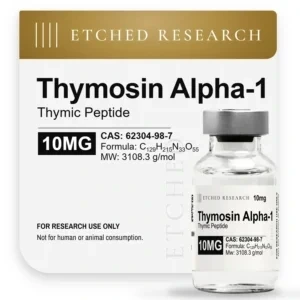
Thymosin Alpha-1
Thymosin Alpha-1, generic name thymalfasin, is a highly acidic 28-amino-acid peptide, isolated and sequenced from calf thymus in 1977 (Goldstein et al., 1977). Laboratory work on it centers on the maturation of T cells, a type of white blood cell and innate immune signaling, and its immune effects appear to run at least partly through Toll-like receptor 9 on dendritic and lymphoid cells (FDA briefing, 2024). The human trials split. A 361-patient sepsis trial measured 28-day deaths, and its result fell just short of statistical significance (Wu et al., 2013). The larger double-blind follow-up in 1,106 adults found no clear difference from placebo (Wu et al., 2025), and a 97-patient hepatitis B trial did not reach statistical significance (Mutchnick et al., 1999).
The vial is listed as Thymosin Alpha-1 10mg, and the trial list with its limits is on the thymalfasin research page.
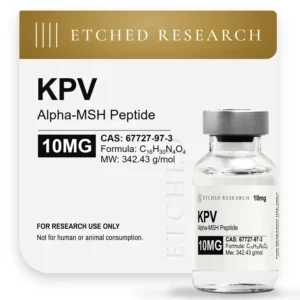
KPV
KPV is Lys-Pro-Val, the final three amino acids of alpha-MSH, a natural hormone made in the pituitary, the brain and other tissues, which is why papers also call it alpha-MSH (11-13) (PubChem). In intestinal and immune cell lines, a transporter that carries small peptides into cells carried it inside, where inflammatory signaling and cytokine output fell (Dalmasso et al., 2008). The animal work is mostly chemically induced gut inflammation in mice, and in one study the result held in mice whose melanocortin 1 receptor did not function (Kannengiesser et al., 2008). We found no published or registered human trial.
The single vial is KPV 10mg, and the KPV research summary covers the cell and mouse studies. KPV is also one of four compounds in KLOW Blend 80mg, which is listed under Tissue Repair Research.
Related reading
Selank, over in Brain & Nerve Research, starts from tuftsin, a small peptide cut from an antibody protein that acts on macrophages (Fridkin and Najjar, 1989), so its research page includes some immune-messenger work. The KLOW and GLOW research summary covers KPV as one part of a four-compound vial. For Thymosin Alpha-1 set beside a pineal peptide, read Epithalon vs Thymosin Alpha-1. For why a three-residue chain like KPV counts as a peptide under Food and Drug Administration definitions, see peptide, protein and biologic. More compounds are in the research library.
Thymosin Alpha-1, KPV and the thymosin name
| Compound | Based on | Length | Examined in | Human record |
|---|---|---|---|---|
| Thymosin Alpha-1 | A natural thymus peptide | 28 amino acids | T-cell and innate immune signaling | Randomized trials in sepsis and hepatitis B, mixed results |
| KPV | Tail of alpha-MSH | 3 amino acids | Inflammatory signaling in gut and immune cells | None found |
| TB-500 (listed under Tissue Repair) | Thymosin beta-4 | 43 amino acids | Cell migration and new blood vessel growth | Small trials of the full protein |
Which of these has human trial data?
Of the two compounds in this category, Thymosin Alpha-1 has randomized human trials and KPV has none that we found. The Thymosin Alpha-1 trials ran mostly in adults with sepsis, and the largest found no clear difference from placebo in 28-day deaths (Wu et al., 2025). KPV’s published work is in cell lines and mice (Dalmasso et al., 2008).
Is Thymosin Alpha-1 the same as TB-500?
No, they are different molecules that share a family name. Both belong to the thymosins, first described in thymus extract (Goldstein et al., 1977). Thymosin Alpha-1 is 28 amino acids and is examined in immune signaling. The TB-500 Etched sells is full-length thymosin beta-4, 43 amino acids, a protein researched in cell migration and new blood vessel growth. It has its own research summary.
Is KPV the same as alpha-MSH?
No. KPV is only the last three of alpha-MSH’s 13 amino acids, and it lacks the stretch the full hormone uses to bind the known melanocortin receptors (Brzoska et al., 2010). How KPV signals is still an open question in that review. PT-141, a synthetic alpha-MSH analog that does act at those receptors, is filed under Brain & Nerve Research.
Is there a lab report for Thymosin Alpha-1 and KPV?
Where an independent laboratory report exists for a compound, the measurements are published on the certificate of analysis page, including the compounds we hold no report for.
For research use only. Not for human consumption.