
Research-grade material. A Janoshik report for this compound is available on request. For research use only.
Research-grade material. A Janoshik report for this compound is available on request. For research use only.
Epithalon and Thymosin Alpha-1 are both catalogued under “longevity research,” a label broad enough to obscure that they investigate almost entirely different biological systems. One is studied in the context of telomerase activity and pineal gland function. The other is studied in the context of thymic function and T-cell education. Grouping them by the word “longevity” answers a marketing question, not a research one.
What Epithalon’s research actually asks
Epithalon (epitalon) is a synthetic tetrapeptide derived from the pineal gland peptide epithalamin. Its research literature, concentrated in work from Russian gerontology research groups, centers on telomerase activity and circadian regulation, including proposed effects on pineal melatonin production. The telomerase angle is what places it in cellular-aging discussions specifically, distinct from the broader “longevity” category it gets filed under informally.
What Thymosin Alpha-1’s research actually asks
Thymosin Alpha-1 is a 28-amino-acid peptide fragment derived from prothymosin alpha, studied for its role in thymic function and immune modulation. The thymus, the organ that trains immune cells (T cells) to distinguish threats from healthy tissue, shrinks measurably with age, a well-documented process called thymic involution. Thymosin Alpha-1’s research base concentrates on immune-signaling activity connected to that process, placing it in immunosenescence research rather than the telomere-and-cellular-repair lane Epithalon occupies.
The lane they are actually in
“Longevity research” spans multiple, only loosely connected biological systems: cellular senescence, mitochondrial function, immune aging, and hormonal decline all fall under the same umbrella term while being mechanistically distinct fields. Epithalon sits in the cellular senescence and circadian lane. Thymosin Alpha-1 sits in the immune-aging lane. Neither compound’s literature substitutes for the other’s, and neither should be evaluated against outcomes that belong to the other’s research question.
Why a researcher would choose one over the other
A study design interested in telomerase activity, circadian rhythm, or pineal-adjacent signaling points toward Epithalon’s literature. A design interested in immune function, thymic activity, or T-cell-mediated processes points toward Thymosin Alpha-1’s. The two are not competing options for the same research question, they answer different questions that both happen to fall under the same loosely applied marketing category.
Frequently asked questions
Do Epithalon and Thymosin Alpha-1 work on the same aging pathway?
No. Epithalon’s research is centered on telomerase and pineal/circadian function. Thymosin Alpha-1’s is centered on thymic and immune function. They are studied under the same broad “longevity” umbrella without sharing a specific mechanism.
Is one a stronger longevity compound than the other?
That framing does not hold up mechanistically. They are not on the same scale because they are not investigated for the same outcome. The comparison that matters is which biological system a research question is actually about.
Why does Etched carry both if they’re unrelated?
Because “unrelated mechanism, adjacent research category” describes most of the compounds in this space, and a researcher choosing between longevity-adjacent tools benefits from the mechanism being stated plainly rather than assumed from a shared marketing label.
For research use only. Not for human consumption.
Etched Research stocks both as single-compound research material: Epithalon 10mg in the Longevity category and Thymosin Alpha-1 10mg in the Immune category. For the deeper mechanistic read on each, see Epithalon: What the Research Actually Shows and Thymosin Alpha-1: What the Research Actually Shows.
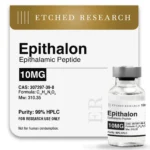
Research-grade material. A Janoshik report for this compound is available on request. For research use only.
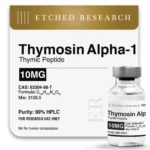
Research-grade material. A Janoshik report for this compound is available on request. For research use only.
For Research Use Only. Not for human consumption. Etched Research supplies compounds for laboratory and research use only. Nothing on this page is medical advice, a health claim, or a recommendation to use.