
Research-grade material. A Janoshik report for this compound is available on request. For research use only.
Research-grade material. A Janoshik report for this compound is available on request. For research use only.
Semax and Selank are both heptapeptides developed in the same Russian research tradition, both studied for cognitive and stress-response effects, and frequently confused for interchangeable versions of the same compound. They are not. Semax is a synthetic ACTH(4-10) analog built around a BDNF and NGF signaling pathway. Selank is a synthetic tuftsin analog studied primarily through its interaction with the GABAergic and immune-signaling systems. Different backbone, different receptor logic, different research question.
Structural origin
Semax derives from adrenocorticotropic hormone (ACTH) fragment 4-10, with a tripeptide extension (Pro-Gly-Pro) added to resist rapid enzymatic degradation. Selank derives from tuftsin, an immunomodulatory tetrapeptide, with a similar Pro-Gly-Pro extension for the same stability reason. The shared extension is a formulation detail, not a sign of a shared mechanism, both peptides needed a way to survive past initial peptidase activity, and researchers reached for the same solution independently.
What each is studied for
Semax research concentrates on neurotrophic signaling: BDNF and NGF expression, and downstream effects on attention and learning-related processes in animal models. The ACTH-derived backbone also connects it to HPA axis literature, since ACTH fragments have a documented history in stress-response research independent of Semax specifically.
Selank research concentrates on anxiolytic and immunomodulatory activity, with proposed mechanisms touching GABA-A receptor modulation and cytokine expression (notably IL-6). Where Semax’s literature clusters around cognition and neurotrophic factors, Selank’s clusters around stress physiology and immune signaling. A researcher choosing between them is not choosing a stronger or weaker version of the same tool, they are choosing which physiological system the research question is actually about.
Where the research overlaps
Both are investigated in the context of stress and cognitive performance broadly, and some study designs run them in parallel or in combination precisely because their proposed mechanisms are complementary rather than redundant. Neither compound’s literature base approaches the depth of a clinically approved therapeutic. Both remain research compounds with defined but incomplete mechanistic pictures.
The practical difference for a research design
If the study question is neurotrophic signaling, learning, or attention, Semax’s literature is the more directly relevant starting point. If the study question is stress physiology, anxiety-adjacent behavior, or immune-cytokine interaction, Selank’s literature is closer to the target. Etched Research stocks both as single-compound vials, Semax 10mg and Selank 10mg, because the two serve genuinely different research designs rather than sitting on a spectrum of the same one.
Frequently asked questions
Are Semax and Selank the same compound with different names?
No. They are structurally distinct peptides with different amino acid sequences and different primary mechanisms of interest. The shared Pro-Gly-Pro extension is a stability modification, not a sign of shared identity.
Is one more potent than the other?
Potency is not a meaningful comparison between two compounds studied for different endpoints. Semax and Selank are not positioned on the same dose-response curve because they are not investigated for the same outcome.
Has either been studied in combination with the other?
Some research designs pair neurotrophic and anxiolytic-adjacent compounds specifically because the proposed mechanisms do not compete. Etched does not sell a combined blend of the two; each is available as a standalone vial for a research design to define independently.
For research use only. Not for human consumption.
Etched Research stocks both compounds as 10mg single-vial research material: Semax 10mg and Selank 10mg. For a deeper mechanistic read on each, see Semax: What the Research Actually Shows and Selank: What the Research Actually Shows.
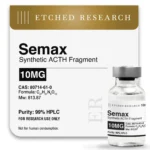
Research-grade material. A Janoshik report for this compound is available on request. For research use only.
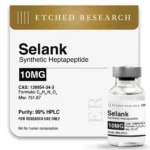
Research-grade material. A Janoshik report for this compound is available on request. For research use only.
For Research Use Only. Not for human consumption. Etched Research supplies compounds for laboratory and research use only. Nothing on this page is medical advice, a health claim, or a recommendation to use.