- What it is: A synthetic heptapeptide built from the ACTH(4-7) fragment with a Pro-Gly-Pro tail.
- Research areas: memory and recovery in stroke models, brain protection after a loss of blood flow (ischemia), and changes in brain gene activity and BDNF (a nerve growth signal).
- Evidence level: Mostly small or Russian-origin studies, plus rat models. The English-language record is thin, and there are no large independent Western trials.
- The short version: Semax has been studied mainly in Russia, where researchers looked at how it affected memory, brain injury, and nerve-signal genes in stroke and animal models. Most of that work is small, early, or published in Russian. This is a summary of what researchers observed in their models, not a claim about what it does for a person.
What it is
Semax is a synthetic seven-amino-acid peptide. It is an ACTH(4-7) fragment with a Pro-Gly-Pro tail: the first four amino acids match a short stretch of the hormone ACTH, and three more are added to the end. Most of the published work on it comes from the Institute of Molecular Genetics of the Russian Academy of Sciences in Moscow.
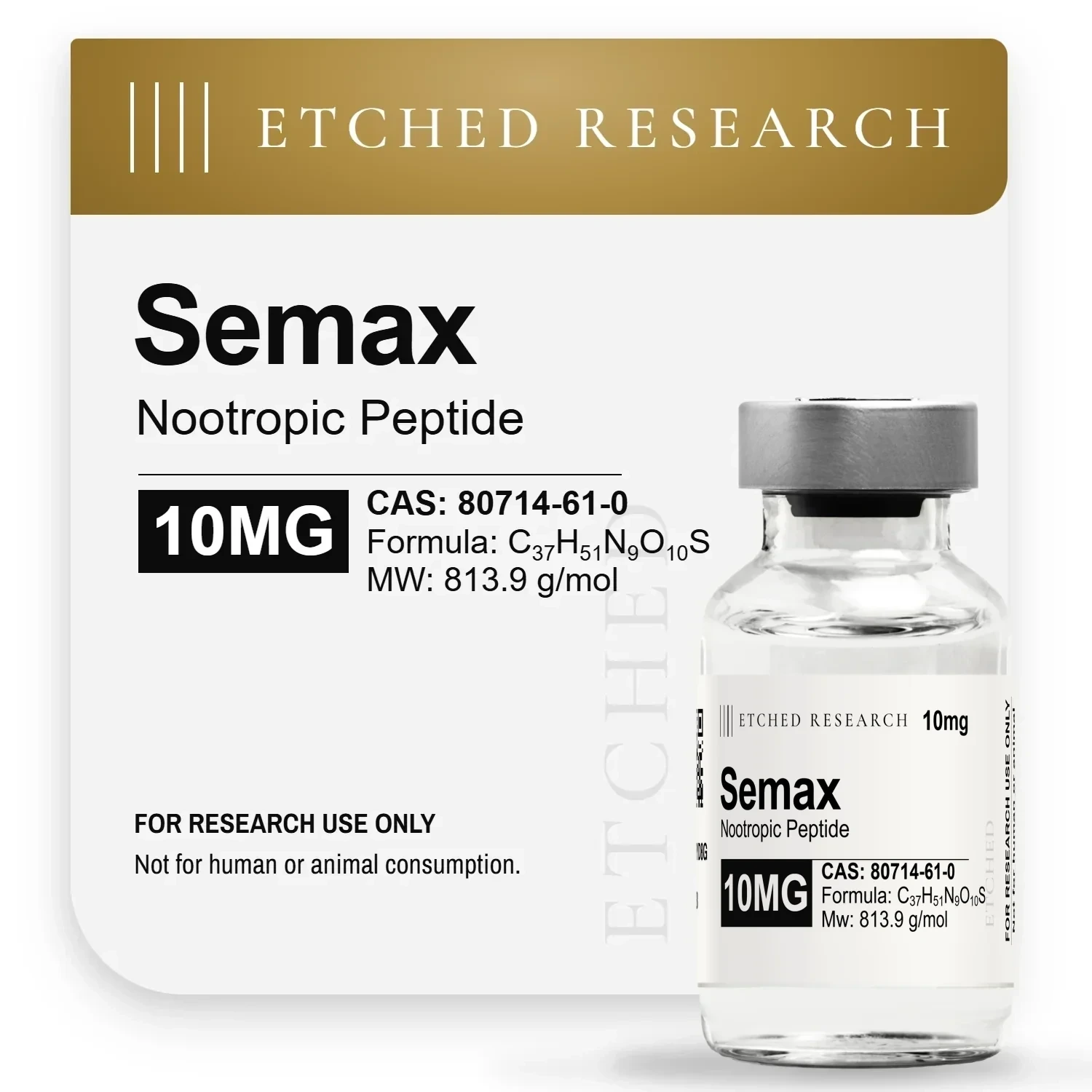
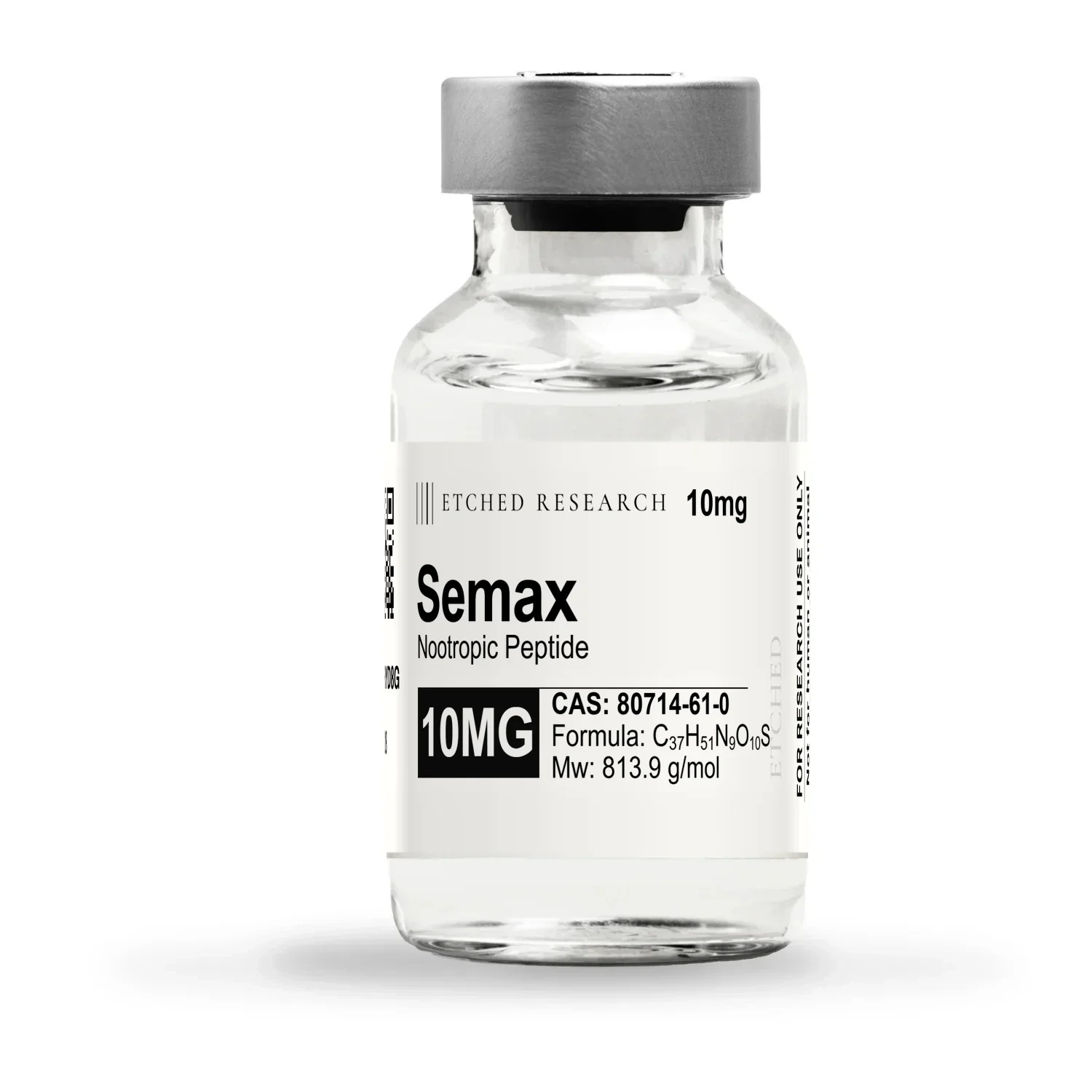
Specs at a glance. Reference values for the compound named on the label, from PubChem or KEGG. They describe the compound, not a measurement of the vial you receive. Molecular weight is the free base (the peptide alone, without a salt). Synthetic peptides are usually supplied as a salt such as acetate or TFA, and the salt in this vial has not been confirmed.
| Compound | Semax |
|---|---|
| Sequence | MEHFPGP (Met-Glu-His-Phe-Pro-Gly-Pro) |
| Molecular formula | C37H51N9O10S |
| Molecular weight | 813.93 g/mol (average, free base) |
| CAS number | 80714-61-0 |
| Reference record | PubChem CID 9811102 |
| Form | Lyophilized (freeze-dried) powder in one sealed vial |
| Vial size | 10 mg per vial |
| Storage (dry powder) | -20°C or colder, long term. Keep the vial sealed and away from light. |
| Lab report | Janoshik Analytical, May 2026. Ordered by the supplier, not by Etched Research. The report carries no lot number, so it is not matched to the vial you receive. Results on this page ↓ · All lab reports → |
What the evidence is
Most of the Semax evidence is animal work. The one human study below is small, published in Russian, and reports no placebo group. There are no large independent trials outside Russia.
| Study | Type | Who or what | What was given | What it measured | What it found |
|---|---|---|---|---|---|
| Romanova et al., Bulletin of Experimental Biology and Medicine, 2006 | Animal | Rats with a small induced stroke in the front of the brain | 250 µg/kg daily for about a week | Injury size and a memory task | Injury area about 20% smaller than in untreated rats. Treated rats kept the memory task, untreated rats did not. Both groups moved around less |
| Medvedeva et al., BMC Genomics, 2014 | Animal | Rats with a permanently blocked brain artery | 100 µg/kg, 4 times in the first 8 hours | Genome-wide gene activity in the brain at 3 and 24 hours | Shifts in genes tied to the immune and blood-vessel systems. Gene activity only, no behavior or recovery measured |
| Gusev et al., Zh Nevrol Psikhiatr Im S S Korsakova, 2018 | Human, no placebo reported, in Russian | 110 adults recovering from ischemic stroke, with and without Semax | 6,000 mcg a day, two 10-day courses 20 days apart, alongside rehab | Blood BDNF, motor strength, a daily-function score | BDNF rose and daily-function scores improved faster in the Semax groups. The authors report a smaller effect on weakness |
| Filippenkov et al., Genes, 2020 | Animal | Rats with a temporary brain artery block | 100 µg/kg, 3 times in the first 7 hours | Brain gene activity by RNA sequencing at 24 hours | Lower activity in inflammation genes, higher activity in nerve-signaling genes. Gene activity only |
Last reviewed 2026-09-23. All four studies come from Russian research groups. The mechanism work, the regulatory status and what none of it establishes are on the full research summary →
Lab reference
Janoshik Analytical tested Semax 10mg from supplier stock in May 2026. One vial measured 99.905% purity and 12.55 mg of peptide against the 10 mg label. See it on the lab reference page →
What that report does not cover: it is a reference test of the compound from supplier stock, not a test of the vial in your order. No endotoxin, sterility or heavy-metal result is published for it.
Storage and shipping
Ships as lyophilized powder in a sealed vial. Store the powder frozen at -20°C, away from light. US addresses only. Shipping costs and cutoff times →
Questions about Semax
Does Semax go by other names?
Yes. Papers call it ACTH(4-7)PGP or ACTH(4-7)-Pro-Gly-Pro, and chemical databases list it by its sequence, Met-Glu-His-Phe-Pro-Gly-Pro (MEHFPGP in one-letter code). All of these name the same seven-amino-acid peptide.
Is there human data?
A little. The one human study above ran in 110 stroke patients, compared people given Semax with people who were not (no placebo group is reported), and was published in Russian. The rest of the table is rat work. There are no large independent trials outside Russia.
Where can I buy Semax for research?
Etched Research sells Semax on this page as a 10mg vial of lyophilized powder, for laboratory research use only, shipped to US addresses. Where an independent laboratory report exists for a compound, the measurements are published on the lab reference page, including the compounds we hold no report for.
Is Semax an approved drug?
Not in the US. It is a registered drug in Russia, sold there as nasal drops. An FDA review in 2026 found it is not a component of any FDA-approved drug. Etched Research sells Semax as a research compound for laboratory use only. It is not for human use.
Shipping, eligibility and what comes in the box: store FAQ →
For research use only. Not for human consumption.