
Research-grade material. A Janoshik report for this compound is available on request. For research use only.
Research-grade material. A Janoshik report for this compound is available on request. For research use only.
MOTS-c and NAD+ both show up constantly in mitochondrial and cellular-aging research discussions, and both get reached for as “the mitochondria peptide.” Only one of them is a peptide. MOTS-c is a 16-amino-acid mitochondrial-derived peptide, encoded within the mitochondrial genome itself. NAD+ (nicotinamide adenine dinucleotide) is not a peptide at all, it is a coenzyme, a small molecule central to redox reactions and energy metabolism across the entire cell, not just the mitochondria. They intersect on the subject of mitochondrial function. They are not the same category of molecule and they are not interchangeable research tools.
What MOTS-c actually is
MOTS-c is encoded by a short open reading frame within the mitochondrial 12S rRNA gene, one of a small class of mitochondrial-derived peptides identified over the past decade. Research interest centers on its role in metabolic regulation, with proposed activity on AMPK signaling, a pathway central to cellular energy sensing. Because AMPK activation and mitochondrial biogenesis pathways overlap with exercise-adaptation research, MOTS-c appears frequently in that literature as well.
What NAD+ actually is
NAD+ is a coenzyme required for hundreds of redox reactions, most notably in the electron transport chain where mitochondria generate ATP. It also serves as a substrate for sirtuins and PARP enzymes, both implicated in DNA repair and cellular-aging research. NAD+ levels are well documented to decline with age across multiple tissue types, which is the core reason it appears throughout longevity-adjacent literature independent of any peptide research at all.
Where the mechanisms actually differ
MOTS-c’s research angle is signaling: it is proposed to act as a messenger that influences how a cell responds to metabolic stress, likely acting on nuclear gene expression in addition to any local mitochondrial effect. NAD+’s research angle is substrate: it is not signaling a response, it is a required input that reactions cannot proceed without. One is investigated as a switch. The other is investigated as fuel for reactions that are already running. A research design asking “how does this pathway get regulated” points toward MOTS-c literature. A design asking “what happens when this cofactor is scarce or restored” points toward NAD+ literature.
Why they get mentioned together anyway
Both sit inside the broader mitochondrial-function and cellular-aging research space, and study designs increasingly examine metabolic pathways as networks rather than single targets, so it is not unusual to see both referenced in the same review or discussion. That does not make them substitutes for each other in a research design. Etched stocks MOTS-c 10mg and NAD+ 500mg as separate single-compound vials because the research questions they answer are separate.
Frequently asked questions
Is MOTS-c a form of NAD+?
No. MOTS-c is a peptide encoded in mitochondrial DNA. NAD+ is a coenzyme, an entirely different class of molecule. They are studied in overlapping fields, not as versions of one another.
Does raising NAD+ levels affect MOTS-c, or vice versa?
Some research proposes overlapping downstream effects on mitochondrial function, but a direct causal interaction between the two has not been established in the published literature to the level this page can responsibly summarize as fact.
Why does Etched carry NAD+ at 500mg specifically?
The 500mg fill sits between the two sizes most commonly available elsewhere in the category (typically 100mg and 1000mg), a stocking decision, not a claim about optimal research concentration.
For research use only. Not for human consumption.
Etched Research stocks both as single-compound research material in the Longevity category: MOTS-c 10mg and NAD+ 500mg. For the deeper mechanistic read on each, see MOTS-c: What the Research Actually Shows and NAD+: What Researchers Have Actually Studied.
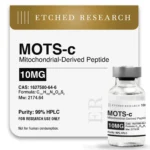
Research-grade material. A Janoshik report for this compound is available on request. For research use only.
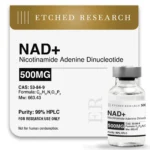
Research-grade material. A Janoshik report for this compound is available on request. For research use only.
For Research Use Only. Not for human consumption. Etched Research supplies compounds for laboratory and research use only. Nothing on this page is medical advice, a health claim, or a recommendation to use.