NAD+: What Researchers Have Actually Studied
- What it is: A coenzyme (nicotinamide adenine dinucleotide) found in all living cells, central to how cells turn fuel into energy.
- Research areas: How NAD+ levels change with age in human tissue and blood, its role as fuel for sirtuins and DNA-repair enzymes, and NAD+ given directly in cell and animal injury models.
- Evidence level: Mostly cell and animal work. The human data is measurement studies plus one small IV pilot that tracked blood and urine levels.
- The short version: Researchers have measured NAD+ falling with age in human skin and blood, and tested NAD+ itself in cell cultures and rodent stroke models. The one human study that gave NAD+ directly was an 11-person pilot that tracked where it went in the body, not any health outcome. Lower NAD+ with age is a measured pattern. What it means for a person’s health is not established.
The Janoshik lab result for this compound is on the COA page. For research use only.
On this page: Quick facts · What the research found · How it works · Limits · Common questions
NAD+ (nicotinamide adenine dinucleotide) is a coenzyme found in all living cells, and it sits at the center of how cells turn fuel into energy. It is not a peptide. This page walks through what researchers have looked at, in plain language, with links to the real studies.
Quick facts
- Names: NAD+, beta-NAD+ (β-NAD), nicotinamide adenine dinucleotide, nadide, coenzyme I, diphosphopyridine nucleotide (PubChem).
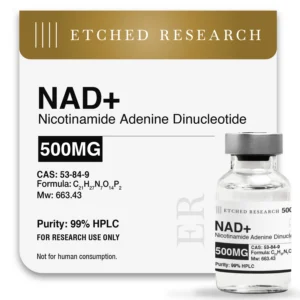
- What it is: a coenzyme made of two nucleotides joined through their phosphate groups. NAD+ is the oxidized form and NADH the reduced form. Molecular formula C21H27N7O14P2, 663.4 g/mol, CAS 53-84-9 (PubChem CID 5892).
- Evidence: one cell study, two rodent stroke-model studies, two human studies that measured NAD+ by age, and one 11-person IV pilot, all summarized below.
- How the body handles it: in 8 healthy men given NAD+ by IV drip at about 2 mg a minute, blood NAD+ did not change for the first 2 hours, which the authors read as NAD+ being cleared from the blood as fast as it went in. NAD+ and a breakdown product appeared in urine by 6 hours (Grant et al., 2019).
- Approval status: not an FDA-approved drug. FDA’s Drugs@FDA database lists no approved product with NAD+ (nadide) as its active ingredient (Drugs@FDA, searched September 2026).
What the research found, and what it did not
The studies below ran in cultured cells, in rats and mice with a blocked brain artery, and in people, where researchers measured NAD+ levels or tracked NAD+ given by IV. None of the human studies tested a health outcome.
Restoring NAD+ in damaged brain cells (Journal of Biological Chemistry, 2004). Researchers damaged the DNA of cultured mouse astrocytes (brain support cells). The damage over-activated PARP-1, a DNA-repair enzyme that burns NAD+, and NAD+ ran low before the cells died. When the researchers added NAD+ back to near-normal levels, mitochondria recovered and the cell death was blocked. This is a dish study. PMID 14960594. https://pubmed.ncbi.nlm.nih.gov/14960594/
NAD+ in a rat stroke model (Frontiers in Bioscience, 2007). Rats had a brain artery blocked for a time. Researchers gave 10 mg/kg NAD+ into the nose 2 hours after the blockage began. Brain NAD+ rose, and the damaged area was smaller at 24 and 72 hours, with fewer neurological deficits. PMID 17127275. https://pubmed.ncbi.nlm.nih.gov/17127275/
NAD+ in a mouse stroke model (Neuroscience Letters, 2012). Adult male mice had a brain artery blocked for 90 minutes. Researchers gave 50 mg/kg NAD+ by injection into the abdomen as blood flow returned. At 48 hours the damaged area was smaller, with less swelling and fewer deficits. The researchers also recorded less autophagy (a cell clean-up process) and proposed it as part of the reason. PMID 22260797. https://pubmed.ncbi.nlm.nih.gov/22260797/
All three of those studies share one author, W. Ying, so they are not independent confirmations of each other.
NAD+ in human skin by age (PLoS One, 2012). Researchers measured skin samples from 49 people, from newborns to age 77, taken during unrelated surgery. NAD+ was lower with age in both males and females. In males, activity of PARP (the NAD+-using repair enzyme) rose with age and tracked with lower NAD+. Nothing was given. This is a measurement study, not a treatment study. PMID 22848760. https://pubmed.ncbi.nlm.nih.gov/22848760/
NAD+ markers in human blood by age (Rejuvenation Research, 2019). Researchers measured NAD+ related molecules in blood plasma from healthy people aged 20 to 87. NAD+ and NADP+ were lower in older people, while the reduced forms NADH and NADPH were higher. This is a biomarker study, not an outcome study. PMID 30124109. https://pubmed.ncbi.nlm.nih.gov/30124109/
NAD+ by IV drip in 11 men (Frontiers in Aging Neuroscience, 2019). A small pilot in 11 healthy men aged 30 to 55. Eight received 750 mg NAD+ by IV drip over 6 hours, and three received saline. Blood NAD+ did not change for the first 2 hours. By 6 hours, NAD+ and a breakdown product called methylnicotinamide showed up in urine. The study tracked where NAD+ went in the body. It did not test any health outcome, and it was funded in part by NAD+ Research Inc. PMID 31572171. https://pubmed.ncbi.nlm.nih.gov/31572171/
Etched Research supplies NAD+ as a lyophilized powder for laboratory research. The NAD+ 500mg product page lists its identity data and storage.
How it works
NAD+ is an electron carrier. In plain terms, it picks up and drops off electrons during the reactions that turn food into ATP, the molecule cells use for energy.
It flips back and forth between two forms, NAD+ and NADH, during glycolysis, the citric acid cycle, and oxidative phosphorylation. That cycling is the link between the fuel a cell takes in and the energy it produces.
NAD+ is also used up by a group of enzymes, including sirtuins, PARPs, and CD38. Because those enzymes consume it, cells have to keep making more. Researchers have measured lower NAD+ with age in human skin and blood (Massudi et al., 2012, Clement et al., 2019).
What the research does not establish
This is the honest part. The findings above have real limits.
The studies that gave NAD+ and saw an effect were in cells and in rodents after a blocked brain artery. What happens in a dish or a rat does not always carry over to a human.
The human studies are small and narrow. Two only measured NAD+ by age. The one that gave NAD+ had 8 people on it, lasted 6 hours, and tracked blood and urine levels. Lower NAD+ with age is a measured pattern, not proof that NAD+ causes any change in how a person feels or functions.
No study here shows that NAD+ treats, prevents, or cures any condition. Etched Research makes no health claim. These are research findings in research models, and that is all they are.
Common questions
Is NAD+ a peptide?
No. Peptides are chains of amino acids. NAD+ is a coenzyme built from two nucleotides joined through their phosphate groups, and it contains no amino acids (PubChem CID 5892). Research stores often list it next to peptides, but it is a different kind of molecule.
What is the difference between NAD+ and NADH?
They are two forms of the same coenzyme. NAD+ is the oxidized form, ready to pick up electrons. NADH is the reduced form, carrying them. In human blood, researchers found NAD+ lower and NADH higher in older people (Clement et al., 2019).
Is NAD+ FDA approved?
No. FDA’s Drugs@FDA database lists no approved drug product with NAD+ (nadide) as its active ingredient (Drugs@FDA, searched September 2026). The NAD+ Etched Research sells is a research compound for laboratory use only, and it is not for human use.
What is NAD+ used for in research?
In the studies on this page, researchers used NAD+ to see whether restoring it protected brain cells in a dish after DNA damage (Alano et al., 2004) and whether it changed brain damage in rodent stroke models (Zheng et al., 2012). In people, the only study that gave it tracked blood and urine levels over 6 hours and tested no outcome (Grant et al., 2019). This page covers the research only.
Last reviewed 2026-09-24.
New reports, new research.
We send a note when a new lab report is posted or a compound comes back in stock, plus a short list of new research pages in any month we publish some. Never more than one email a week, and nothing else.
For Research Use Only. Not for human consumption. Etched Research supplies compounds for laboratory and research use only. Nothing on this page is medical advice, a health claim, or a recommendation to use.
The Janoshik lab result for this compound is on the COA page. For research use only.