TB-500: What the Research Actually Shows
- What it is: A synthetic peptide tied to Thymosin Beta-4, a small protein found in most cells in the body.
- Research areas: How cells move to close a wound, skin and tissue repair after injury, and new blood vessel growth.
- Evidence level: Mostly animal models, plus a few small human trials of Thymosin Beta-4 itself.
- The short version: The human studies here are on Thymosin Beta-4, the natural protein, not on the research-labeled “TB-500” by that name. Researchers looked at how the protein helps skin and vessel cells crawl toward a wound to close it. The human trials are small and early, and none of this is a safety conclusion.
The Janoshik lab result for this compound is on the COA page. For research use only.
On this page: Quick facts · What the research found · How it works · Limits · Common questions
TB-500 is a synthetic peptide tied to Thymosin Beta-4 (written Tbeta-4), a small protein found in most cells in the body. Researchers have studied it mostly in one area: how cells move to close a wound and rebuild tissue after injury, in animal models and a few small human trials of Thymosin Beta-4 itself.
One thing to get straight up front. The name TB-500 is used for two different molecules. The FDA and PubChem use it for a short synthetic fragment of Thymosin Beta-4, seven amino acids long. Some suppliers use it for the full 43-amino-acid protein. The TB-500 Etched Research sells is the full protein. Most published studies used the full protein, and we come back to that in the limits section.
Quick facts
- The short fragment: the FDA lists TB-500 as “Thymosin beta-4, fragment (LKKTETQ)” (FDA). PubChem’s TB-500 record is Ac-Leu-Lys-Lys-Thr-Glu-Thr-Gln-OH, formula C38H68N10O14, 889.0 g/mol, CAS 885340-08-9 (PubChem CID 62707662). It copies positions 17 to 23 of Thymosin Beta-4, the stretch tied to actin binding (Ho et al., 2012).
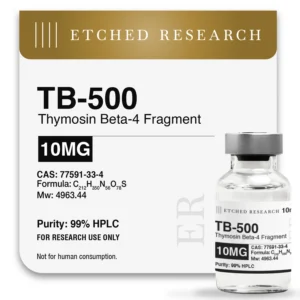
- The full protein: Thymosin Beta-4 (Tβ4, timbetasin) is 43 amino acids, formula C212H350N56O78S, 4963 g/mol, CAS 77591-33-4 (PubChem CID 16132341).
- Evidence: the fragment has cell and animal studies only. The FDA says it has identified no human exposure data for it (FDA). The full protein has animal studies and small Phase 2 human trials (Kleinman and Sosne, 2016).
- How the body handles it (rats only): in rats given the fragment, the main breakdown product was Ac-LK, and the breakdown product Ac-LKK was still found up to 72 hours later (Rahaman et al., 2024).
- FDA compounding list: the FDA lists the TB-500 fragment among substances that were in category 2 (“may present significant safety risks”) before their nominations were withdrawn. Its entry says the FDA lacks important information on whether it would cause harm if given to people (FDA, page current as of 22 April 2026). It is not an FDA-approved drug.
What the research found, and what it did not
Most studies below used the full Thymosin Beta-4 protein, in rats, mice or small human trials. Two used the short fragment, in animals and cells only. Each one says which.
Wound healing in rats (Journal of Investigative Dermatology, 1999). Full protein. Researchers applied Thymosin Beta-4 to skin wounds in rats, on the surface and by injection. They observed new skin cover over the wound rise by 42 to 61 percent. In a separate lab-dish test, skin cells moved faster toward it. PMID 10469335. https://pubmed.ncbi.nlm.nih.gov/10469335/
Diabetic and aged mice (Wound Repair and Regeneration, 2003). Full protein and fragment. Thymosin Beta-4 increased wound shrinkage and collagen in diabetic mice, with no difference in skin-cell movement, and sped healing in 26-month-old mice. The seven-amino-acid fragment LKKTETQ gave repair in the aged mice comparable to the full protein. PMID 12581423. https://pubmed.ncbi.nlm.nih.gov/12581423/
What TB-500 breaks down into (Journal of Chromatography B, 2024). Fragment. Researchers tracked the acetylated fragment in serum, enzymes and rats, and tested it and its breakdown products on fibroblast cells. Only one breakdown product, Ac-LKKTE, showed significant wound-closing activity against control. The authors said earlier reported activity may come from that product rather than TB-500 itself. PMID 38382158. https://pubmed.ncbi.nlm.nih.gov/38382158/
Human venous ulcer trial (Annals of the New York Academy of Sciences, 2007). Full protein. This paper describes the design of a European randomized, placebo-controlled study of topical Thymosin Beta-4 on venous leg ulcers, planned for 72 patients over 84 days. It was mainly a safety and tolerability study. When the paper was written, 21 patients had been enrolled and no results were reported. PMID 17495250. https://pubmed.ncbi.nlm.nih.gov/17495250/
Blood vessel growth review (Angiogenesis, 2007). Full protein. This paper reviewed how Thymosin Beta-4 affects new blood vessel growth and its possible role in heart and tissue repair. It lays out proposed mechanisms rather than running one experiment. PMID 17632766. https://pubmed.ncbi.nlm.nih.gov/17632766/
Skin-healing review (Vitamins and Hormones, 2016). Full protein. A review summarized the dermal research. It noted Thymosin Beta-4 sped repair in Phase 2 trials of patients with pressure ulcers, stasis ulcers, and a blistering skin condition, along with positive results in animal models. PMID 27450738. https://pubmed.ncbi.nlm.nih.gov/27450738/
Eye-surface Phase 2 trials (ReGenTree, LLC). Full protein. Two industry Phase 2 trials tested Thymosin Beta-4 eye solutions. One looked at corneal wounds in diabetic patients after eye surgery and was ended early for slow enrollment. The other looked at dry eye in 72 adults and was completed. Its published report found no difference from placebo on either main measure, with differences on some secondary ones (PMID 26056426, https://pubmed.ncbi.nlm.nih.gov/26056426/). Together they show the compound reached formal human testing for eye-surface repair. NCT00598871. https://clinicaltrials.gov/study/NCT00598871 and NCT01387347. https://clinicaltrials.gov/study/NCT01387347
Etched Research’s TB-500 10mg is sold for laboratory research only, and its page lists the identity data.
How it works
Thymosin Beta-4’s main known job is binding actin, the protein cells use to build their inner skeleton and to move. When tissue is hurt, cells that rebuild skin and line blood vessels have to crawl toward the wound. Research suggests Thymosin Beta-4 helps organize actin so those cells migrate, which is a required first step for closing a wound and growing new vessels. The short TB-500 fragment copies the stretch of the protein tied to actin binding (Ho et al., 2012). A 2024 cell study found the fragment itself did not show significant wound-closing activity, while one of its breakdown products did (Rahaman et al., 2024).
What the research does not establish
- Most of the human-level evidence is on Thymosin Beta-4, the natural protein, not on the research-labeled “TB-500” by that name. That distinction matters.
- The strongest data is still early. Human trials are small, some sources are reviews, and at least one trial was ended before it finished.
- There is no approved human use. It is not an FDA-approved drug, and it has not been shown to be effective or safe for general use.
- Each finding describes a research model or a specific patient trial. It does not tell you what would happen in a healthy person.
- Nothing here is a safety conclusion, and this is not a claim that the compound is safe to use.
We would rather show you the gaps than paper over them. That is how you trust the parts that are solid.
Common questions
Is TB-500 the same as thymosin beta-4?
Not always. The TB-500 Etched Research sells is full-length Thymosin Beta-4. Elsewhere, the FDA lists TB-500 as a fragment of Thymosin Beta-4 (LKKTETQ) (FDA), and a 2012 laboratory analysis identified that acetylated fragment in a product sold as TB-500 (Esposito et al., 2012). Some suppliers use the same name for the full 43-amino-acid protein. The fragment weighs about 889 g/mol and the full protein about 4963 g/mol (PubChem, PubChem).
Is TB-500 FDA approved?
No. On its compounding page, the FDA says it has not identified any human exposure data for drug products containing the TB-500 fragment, and lacks important information on whether it would cause harm in people (FDA). The full protein reached Phase 2 trials but no approval (ClinicalTrials.gov).
Does TB-500 work?
The research does not settle it. Full Thymosin Beta-4 sped wound healing in rats and mice (Malinda et al., 1999), but a 72-person dry eye trial missed both of its main measures (Sosne and Ousler, 2015). For the short fragment, one 2024 cell study found no significant wound-closing activity from the fragment itself (Rahaman et al., 2024). No human trial of the fragment has been reported.
What side effects has TB-500 research recorded?
Very little is known. The 2015 dry eye trial of the full protein reported no adverse events in its 72 participants (Sosne and Ousler, 2015). For the fragment, the FDA names a possible risk of immune reactions and questions about impurities, and says it has no human exposure data (FDA). None of this is a safety conclusion.
Last reviewed 2026-09-24.
New reports, new research.
We send a note when a new lab report is posted or a compound comes back in stock, plus a short list of new research pages in any month we publish some. Never more than one email a week, and nothing else.
For Research Use Only. Not for human consumption. Etched Research supplies compounds for laboratory and research use only. Independent lab results, where they exist, are published on the COA page. Nothing on this page is medical advice, a health claim, or a recommendation to use.
The Janoshik lab result for this compound is on the COA page. For research use only.