
Research-grade material. A Janoshik report for this compound is available on request. For research use only.
Research-grade material. A Janoshik report for this compound is available on request. For research use only.
Peptide, protein and biologic get used interchangeably in everyday conversation about research compounds. In US regulation they are not interchangeable at all. Each one names a different category, the boundaries between them are set by written definition rather than by chemistry alone, and which category a molecule lands in changes which regulatory pathway applies to it. A researcher reading the literature will find all three words applied to molecules that look broadly similar on paper.
The short version
A peptide and a protein are both chains of amino acids. The difference between them is length, and the cutoff is a definition rather than a natural boundary. A biologic is a regulatory category, not a chemical one. Proteins fall inside it. Peptides, as a rule, do not.
Where the line sits
The FDA defines a protein as an alpha amino acid polymer with a specific defined sequence that is greater than 40 amino acids in size. Anything shorter is not a protein under that definition, whatever else it may be.
Two things in that sentence do more work than they appear to. The first is alpha. Amino acids are classified by where the amino group sits relative to the carboxyl group, and alpha amino acids are the ones where it sits on the adjacent carbon. Not all residues that appear in a synthetic peptide are alpha amino acids. The second is size, because a molecule can carry components that are chemically attached without being part of the counted chain.
Why “biologic” is a separate question
A biological product is a regulatory designation under the Public Health Service Act. Proteins are named in that statute. The designation carries its own approval pathway, its own exclusivity terms, and its own framework for follow-on products.
That means a molecule’s category is not purely a description of what it is. It is also a description of which rulebook applies. Two compounds with near-identical structures can sit on opposite sides of that line if one clears the length threshold and the other does not.
What this means when reading a compound’s literature
Research materials described as peptides are generally short chains, commonly under 50 residues, and are typically produced by chemical synthesis. Short is genuinely short in practice: KPV is three residues and Semax is seven. Materials described as proteins are longer, often far longer, and are typically produced by expression in a living system.
The practical consequence for anyone reading a specification sheet is that the word chosen tells you something about how the material was made and how it is characterized, not only about its size. Analytical methods differ accordingly. A short synthetic peptide is routinely assessed by reversed-phase HPLC and mass spectrometry. A large recombinant protein carries a different analytical burden entirely.
The words that get used loosely
Three overlaps cause most of the confusion.
Polypeptide sits between the two and carries no regulatory weight of its own. It is a descriptive term for a chain long enough that “peptide” feels inadequate.
Peptide hormone describes a function, not a size class. Some are short. Some are long enough to be proteins under the definition above.
Biologic in casual use often just means “a large injectable molecule.” In regulation it means something much more specific, and the gap between those two uses is where most misreadings start.
Frequently asked questions
Is a peptide a protein?
Not under the FDA’s definition. That definition sets the boundary at greater than 40 alpha amino acids, and a peptide is shorter than a protein by construction. In general biochemistry the boundary is softer and often cited around 50 residues, which is why the two fields do not always agree on a given molecule.
Does the number of amino acids change what a compound does?
Length and biological activity are not the same axis. A short peptide can be highly active and a long protein can be inert. The length threshold is a regulatory boundary, not a measure of potency.
Why do some peptides contain amino acids that are not among the standard twenty?
Synthetic chemistry is not restricted to the residues biology uses. Non-canonical amino acids are incorporated routinely in research peptides, usually to change how the molecule behaves in solution or how quickly it is broken down.
Where can I see what is actually in a given vial?
Where an independent laboratory report exists for a compound, the measurements are published on the COA page, including the compounds we hold no report for.
Etched Research supplies lyophilized research compounds for laboratory use. More compound background is in the research library, and the full catalog is at the shop.
For research use only. Not for human or veterinary use.
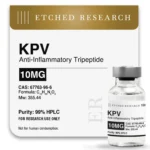
Research-grade material. A Janoshik report for this compound is available on request. For research use only.
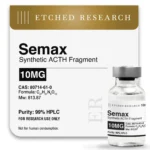
Research-grade material. A Janoshik report for this compound is available on request. For research use only.
For Research Use Only. Not for human consumption. Etched Research supplies compounds for laboratory and research use only. Nothing on this page is medical advice, a health claim, or a recommendation to use.