- What it is: The Lys-Pro-Val tripeptide that forms the tail end of the natural hormone alpha-MSH.
- Research areas: intestinal inflammation and colitis in animal models, how it quiets inflammatory signals in gut and immune cells, and how the body takes it in through a transporter called PepT1.
- Evidence level: Animal and in-vitro (lab-dish) models. No large independent human trials.
- The short version: KPV is the small tail piece of alpha-MSH, and researchers have studied it mostly in mice and cell cultures to see how it lowers inflammation in the gut. Across those colitis models it lowered inflammatory markers and eased tissue damage. This is a summary of what researchers observed in their models, not a claim about what it does for a person.
What it is
KPV is a synthetic tripeptide made of three amino acids: lysine, proline and valine. It matches the last three amino acids (positions 11 to 13) of alpha-MSH, a 13-amino-acid hormone. The name is the one-letter code for those three amino acids.
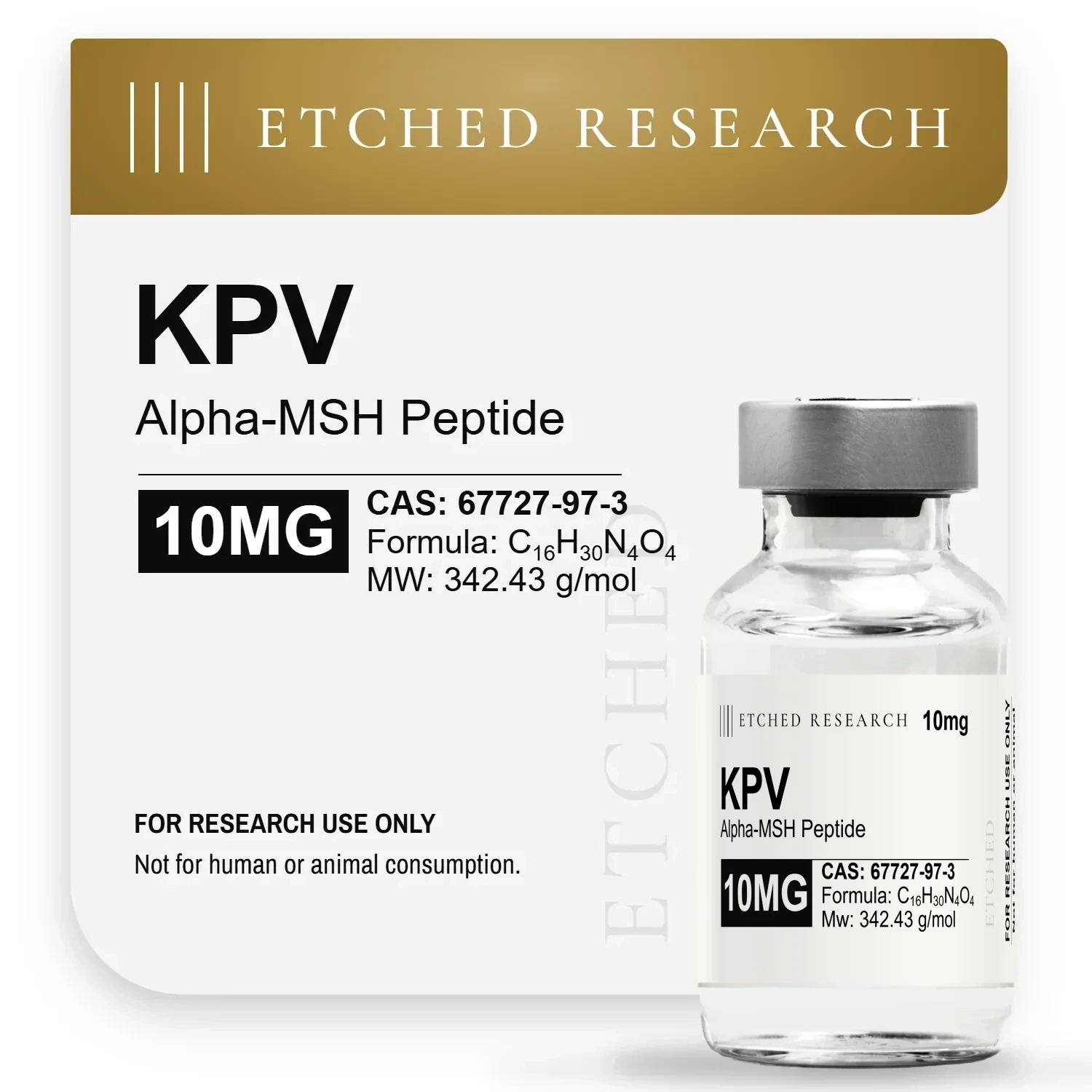
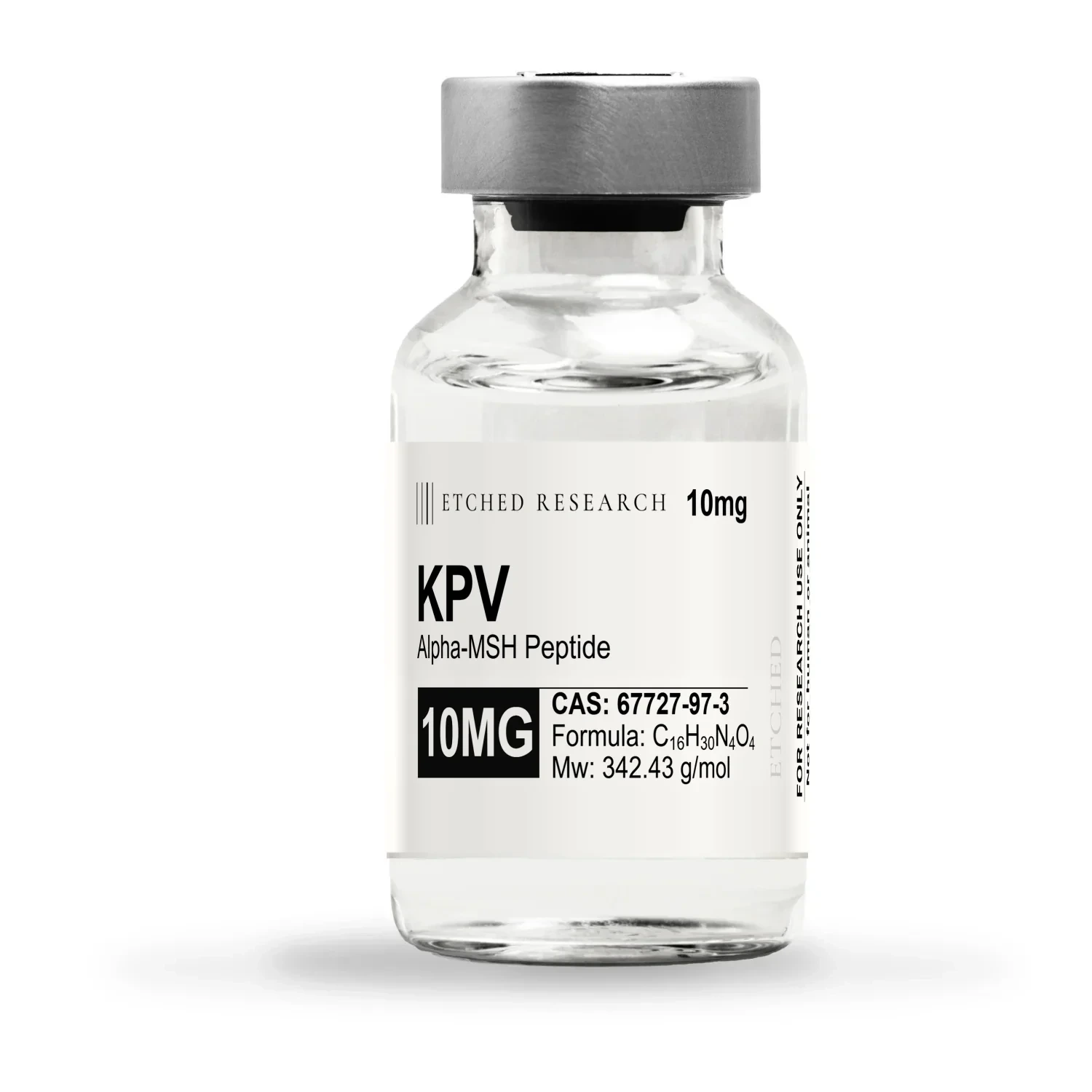
Specs at a glance. Reference values for the compound named on the label, from PubChem or KEGG. They describe the compound, not a measurement of the vial you receive. Molecular weight is the free base (the peptide alone, without a salt). Synthetic peptides are usually supplied as a salt such as acetate or TFA, and the salt in this vial has not been confirmed.
| Compound | KPV |
|---|---|
| Sequence | Lys-Pro-Val (H-KPV-OH) |
| Molecular formula | C16H30N4O4 |
| Molecular weight | 342.43 g/mol (average, free base) |
| CAS number | 67727-97-3 |
| Reference record | PubChem CID 125672 |
| Form | Lyophilized (freeze-dried) powder in one sealed vial |
| Vial size | 10 mg per vial |
| Storage (dry powder) | -20°C or colder, long term. Keep the vial sealed and away from light. |
| Lab report | Janoshik Analytical, November 2025. Ordered by the supplier, not by Etched Research. The report carries no lot number, so it is not matched to the vial you receive. Results on this page ↓ · All lab reports → |
What the evidence is
All of the KPV evidence comes from cells and mice. No human trial of KPV has been published, and most of the work below focuses on induced colitis in mice.
| Study | Type | Who or what | What was given | What it measured | What it found |
|---|---|---|---|---|---|
| Dalmasso et al., Gastroenterology, 2008 | Cell and animal | Human gut and immune cell lines, and mice with two types of induced colitis (DSS and TNBS) | KPV added to cell cultures, and to the drinking water of the mice | Inflammatory signaling, cytokines, how KPV gets into cells, colon tissue damage | KPV entered cells through the PepT1 transporter and lowered inflammatory signaling and cytokines in cells. The mice showed less colitis |
| Kannengiesser et al., Inflammatory Bowel Diseases, 2008 | Animal | Mice with DSS colitis or transfer colitis, including mice with a nonworking MC1R receptor | KPV during induced colitis | Body weight, colon tissue under the microscope, an inflammation enzyme (MPO) | Faster recovery, more weight regained and less inflammation in colon tissue. The effect also showed up in the MC1R mice, so it looked at least partly independent of that receptor |
| Xiao et al., Molecular Therapy, 2017 | Cell and animal | Colon cells, immune cells (macrophages), and mice with induced colitis | KPV packed in hyaluronic-acid-coated nanoparticles aimed at the colon | Uptake into target cells, colon lining damage, TNF-alpha | Coated particles did better than uncoated KPV particles on colon damage and TNF-alpha in the mice. Tests a delivery system, not KPV alone |
| Brzoska et al., Endocrine Reviews, 2008 | Review | Published cell and animal studies of alpha-MSH and related tripeptides | Not a new experiment | What the earlier work showed | Described KPV as keeping the anti-inflammatory activity of alpha-MSH in those models without its skin-darkening effect. Framed as future potential, not established human use |
Last reviewed 2026-09-23. The mechanism, the other models, and what none of this establishes are on the full research summary →
Lab reference
Janoshik Analytical tested KPV 10mg from supplier stock on 24 November 2025. Two vials measured 99.689% and 99.582% purity, and 10.47 mg and 10.36 mg of peptide against the 10 mg label. See it on the lab reference page →
What that report does not cover: it is a reference test of the compound from supplier stock, not a test of the vial in your order. It did not test for endotoxin, sterility or heavy metals.
Storage and shipping
Ships as lyophilized powder in a sealed vial. Store the powder frozen at -20°C. US addresses only. Shipping costs and cutoff times →
Questions about KPV
Is KPV the same thing as alpha-MSH?
No. Alpha-MSH is 13 amino acids long. KPV is only its last three (positions 11 to 13), which is why it is also listed as alpha-MSH (11-13) or Lys-Pro-Val.
Is there human data?
No. As of 2026-09-23 there is no published human trial of KPV on PubMed and no registered one on ClinicalTrials.gov. Everything in the table above is cell or mouse work.
Does KPV work through the same receptors as alpha-MSH?
Not as far as the research shows. KPV lacks the part of alpha-MSH needed to bind the known melanocortin receptors, and in the published models it showed no skin-darkening activity. How it acts is still being worked out (Brzoska et al., 2010).
Shipping, eligibility and what comes in the box: store FAQ →
For research use only. Not for human consumption.