Single-Vial Blends
A blend is two or more research peptides freeze-dried together into one vial of lyophilized powder. It is one vial, not a kit of separate vials. This category holds three: the BPC-157 + TB-500 Blend, GLOW and KLOW. Between them they use four compounds, BPC-157, TB-500, GHK-Cu and KPV, and each of those has its own research record and its own product page. The research behind a blend is almost all research on its parts. We found one published rat study that tested two of these compounds in combination, and none that tested a pre-blended vial. The certificate of analysis page shows which blends and compounds have an independent lab report and which do not. All products here are research material for laboratory use.
Showing all 3 results
BPC-157 + TB-500 Blend
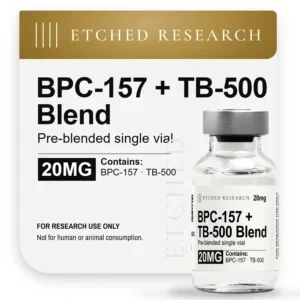
This vial holds 10mg of BPC-157 and 10mg of TB-500, 20mg in all. The TB-500 is full-length thymosin beta-4, 43 amino acids, not the seven-amino-acid fragment that is also sold under that name. It is the one blend in this category with a published combination study. After surgical repair of the Achilles tendon in 32 rats, researchers compared four groups: no compound, BPC-157, TB-500, or both. The combined group showed no added benefit over either compound alone (Biçer et al., 2026). We found no human study of the two in combination.
See the BPC-157 + TB-500 Blend 20mg or read what the blend research shows.
GLOW
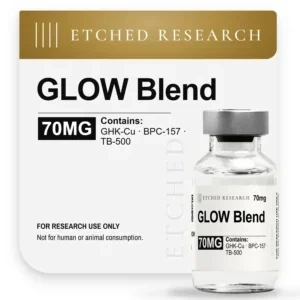
GLOW holds GHK-Cu 50mg, BPC-157 10mg and TB-500 10mg, 70mg in one vial. GLOW is the name the market uses for this three-compound blend, not the name of a compound. We found no published study that tested the three in combination, in people or in animals, so GLOW has no research page of its own. Its research is the research on each part, and the KLOW research summary covers all three of them as components.
See GLOW Blend 70mg, or start with the GHK-Cu research summary.
KLOW
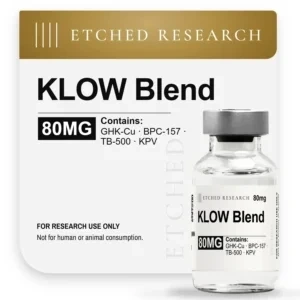
KLOW adds a fourth compound, KPV 10mg, to the same three, for 80mg in one vial. We found no published study of all four in combination. The closest is the same 2026 rat study of two of its parts, BPC-157 and TB-500, and KPV and GHK-Cu were not part of it.
See the KLOW 80mg vial or the KLOW component research.
The four components
Each compound in these vials has its own product page and its own summary in the research library. BPC-157, TB-500 and GHK-Cu are filed under Tissue Repair Research, and KPV under Immune System Research.
BPC-157 is a synthetic 15-amino-acid peptide with a sequence taken from a protein in human gastric juice. A 2025 review of its musculoskeletal research counted 36 studies, 35 in animals or cells and one human chart review with no control group (Vasireddi et al., 2025). See BPC-157 10mg.
TB-500, in these vials, is full-length thymosin beta-4, a 43-amino-acid peptide found in nearly all cells, where it binds actin. Its record is cell and animal work plus small human trials. In the completed 72-person dry eye trial, neither main measure differed from placebo (Sosne and Ousler, 2015). See TB-500 10mg.
GHK-Cu is the copper complex of GHK, a tripeptide of glycine, histidine and lysine. Most of its research is in cultured fibroblasts, the cells that build connective tissue. In one of those studies, copper ions alone reproduced the shift in a matrix-remodeling enzyme, and the GHK peptide alone did not (Siméon et al., 2000). See GHK-Cu.
KPV is Lys-Pro-Val, the last three amino acids of alpha-MSH, a natural hormone made in the pituitary, the brain and other tissues. Its research is in intestinal and immune cells and in mouse colitis models (Dalmasso et al., 2008), and we found no published human trial. See KPV 10mg.
How the three blends compare
| Blend | In the vial | Total | Tested in combination |
|---|---|---|---|
| BPC-157 + TB-500 Blend | BPC-157 10mg, TB-500 10mg | 20mg | One rat study, no added benefit over either alone (Biçer, 2026) |
| GLOW | GHK-Cu 50mg, BPC-157 10mg, TB-500 10mg | 70mg | No study found |
| KLOW | GHK-Cu 50mg, BPC-157 10mg, TB-500 10mg, KPV 10mg | 80mg | No study of all four found |
Has any blend been studied as a blend?
The only combination study we found is a 2026 rat study of BPC-157 with TB-500, and the combined group showed no added benefit over either compound alone (Biçer et al., 2026). We found no published study of GLOW or KLOW in any species. We found no study of a pre-blended vial, and no human study of any of these combinations.
What is a pre-blended vial?
A pre-blended vial holds two or more peptides that were mixed and freeze-dried together into one lyophilized powder. It is a single vial, not a kit of separate vials, and the product page lists the amount of each compound inside. The difference between a freeze-dried powder and a liquid is covered in lyophilized vs reconstituted peptides.
How is a blend’s lab report different from a single compound’s?
The blend reports on file measure each compound in the vial separately, so they give one amount per component, not one amount for the vial. Purity was not requested on those reports, so the blend rows on the certificate of analysis page show amounts only, and KLOW has no report on file there. The GHK-Cu figure in GLOW is listed as unresolved, because the report does not settle whether the 50mg on the label means the copper complex or the GHK inside it.
Why are the blends also listed under Tissue Repair Research?
Because three of their four compounds, BPC-157, TB-500 and GHK-Cu, sit in that research area, so the blends are listed in both categories. KPV, the fourth compound in KLOW, is filed under Immune System Research.
Where are the lab reports?
Where an independent laboratory report exists for a compound, the measurements are published on the certificate of analysis page, including the compounds we hold no report for.
For research use only. Not for human consumption.