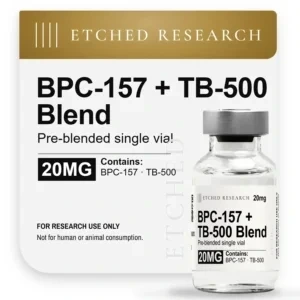
- What it is: The Body Protection Compound: a synthetic 15-amino-acid peptide first isolated from a protein in gastric juice.
- Research areas: Tendon and ligament healing, muscle repair after injury, and new blood vessel growth at an injury site.
- Evidence level: Almost all animal and in-vitro models. No controlled human trials.
- The short version: Nearly every BPC-157 study so far used rats or isolated cells, not people. Researchers watched connective tissue like tendon and ligament repair faster in those models, and looked at collagen and blood vessel signals as the reason why. What that would mean in a person is still unstudied, and none of it is a safety conclusion.
What it is
BPC-157, short for Body Protection Compound 157, is a synthetic peptide made of 15 amino acids. Its sequence comes from a protein found in human gastric juice. Older research papers also call it PL 14736.
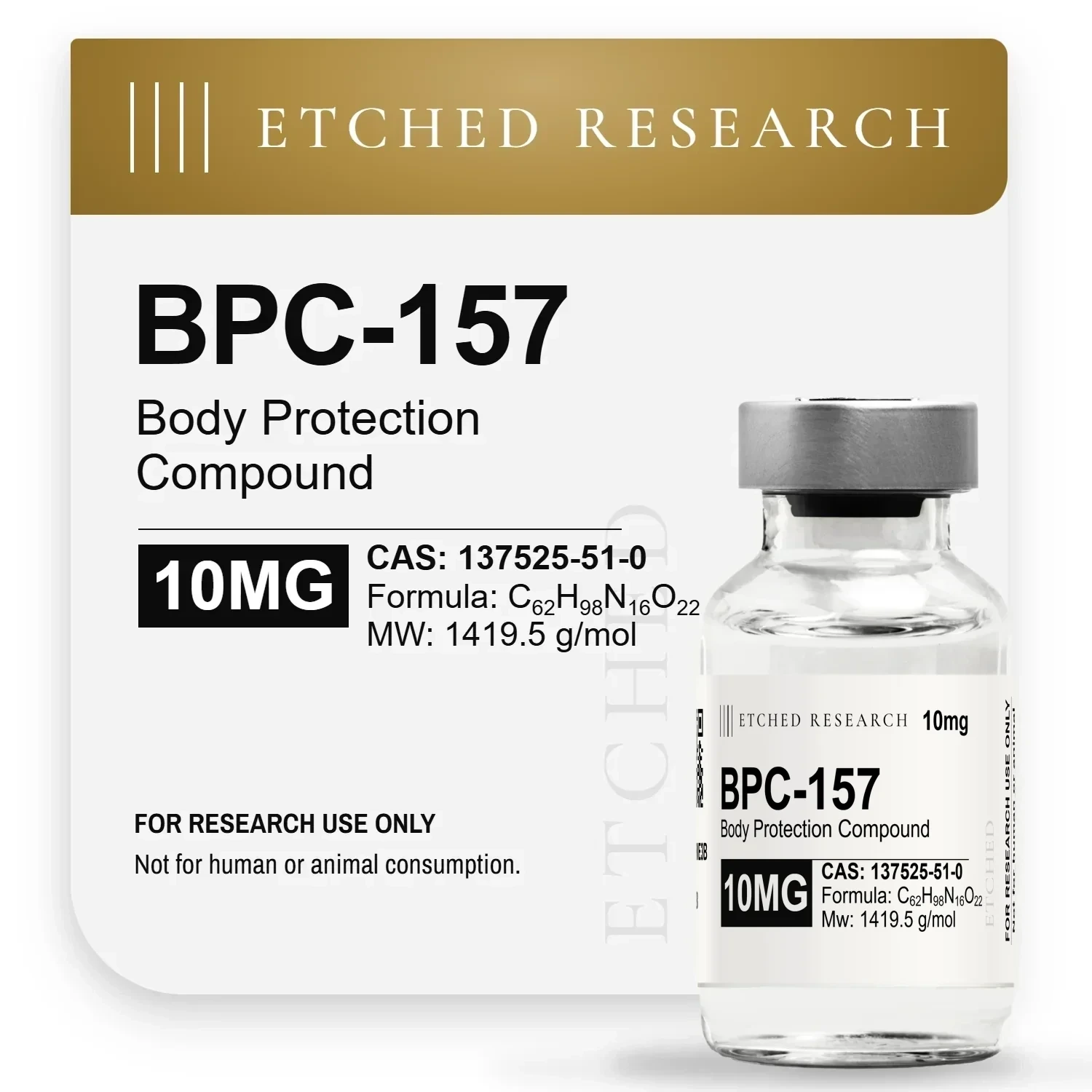
Specs at a glance. Reference values for the compound named on the label, from PubChem or KEGG. They describe the compound, not a measurement of the vial you receive. Molecular weight is the free base (the peptide alone, without a salt). Synthetic peptides are usually supplied as a salt such as acetate or TFA, and the salt in this vial has not been confirmed.
| Compound | BPC-157 |
|---|---|
| Sequence | GEPPPGKPADDAGLV (Gly-Glu-Pro-Pro-Pro-Gly-Lys-Pro-Ala-Asp-Asp-Ala-Gly-Leu-Val) |
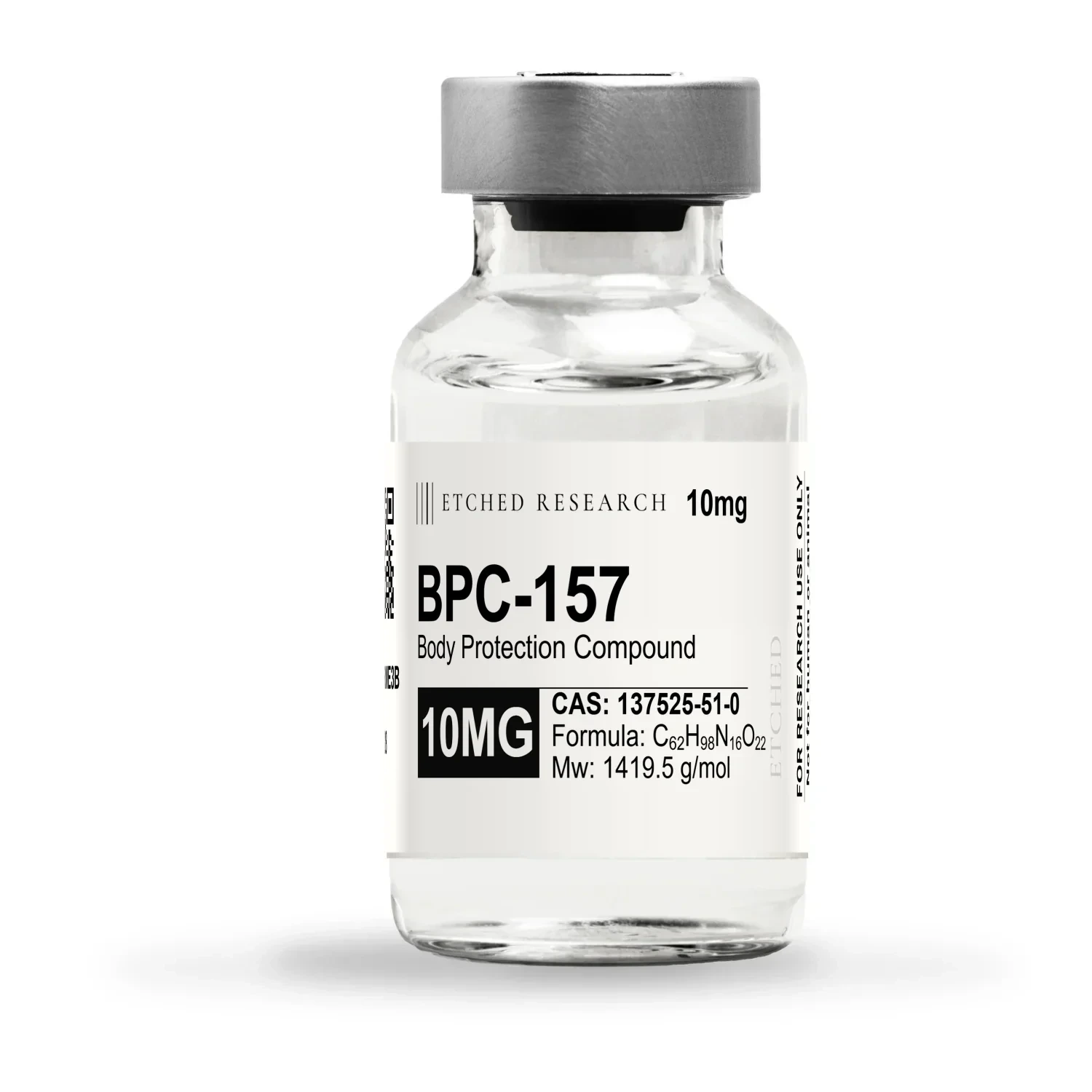
| Molecular formula | C62H98N16O22 |
| Molecular weight | 1419.56 g/mol (average, free base) |
| CAS number | 137525-51-0 |
| Reference record | PubChem CID 9941957 |
| Form | Lyophilized (freeze-dried) powder in one sealed vial |
| Vial size | 10 mg per vial |
| Storage (dry powder) | -20°C or colder, long term. Keep the vial sealed and away from light. |
| Lab report | Janoshik Analytical, April 2026 and May 2026. Ordered by the supplier, not by Etched Research. The report carries no lot number, so it is not matched to the vial you receive. Results on this page ↓ · All lab reports → |
What the evidence is
Almost all BPC-157 research is in rats or in cells. No controlled human trial has been published, and the few human reports that exist are small and have no comparison group.
| Study | Type | Who or what | What was given | What it measured | What it found |
|---|---|---|---|---|---|
| Krivic et al., Journal of Orthopaedic Research, 2006 | Animal | Rats with the Achilles tendon cut away from the heel bone | 10 µg/kg, 10 ng/kg or 10 pg/kg once daily, alone or with a corticosteroid, up to 21 days | Tendon-to-bone healing: function, strength and tissue structure | Treated rats healed better on these measures. BPC-157 also offset some of the harm the corticosteroid did to healing |
| Cerovecki et al., Journal of Orthopaedic Research, 2010 | Animal | Rats with a cut knee ligament (MCL) | 10 µg/kg or 10 ng/kg daily, by three different routes, for up to 90 days | Ligament function, strength and tissue | Better healing recorded with all three routes |
| Brcic et al., Journal of Physiology and Pharmacology, 2009 | Cell and animal | Cultured cells, and rats with injured muscle or a cut tendon | Dose not stated in the abstract | New blood vessel growth and VEGF, a vessel-growth signal | No direct effect on vessel growth in the cell cultures. In the rats, more VEGF signal and more complete healing |
| Chang et al., Molecules, 2014 | Cell | Tendon cells taken from rat Achilles tendon, grown in a dish | A range of concentrations in the dish | Growth hormone receptor levels on the cells | Receptor levels rose with dose and time. Whole tendons were not tested |
| Vasireddi et al., HSS Journal, 2025 | Systematic review | 36 musculoskeletal studies published 1993 to 2024 | Not applicable | How much of the research was in people, and what it found | 35 of the 36 studies were in animals or cells. The one human study was a look back at patient charts with no control group. The authors found no clinical safety data |
Last reviewed 2026-09-23. Three of the four lab studies above come from one research group in Zagreb, Croatia, and a 2019 review noted that only a handful of groups have studied BPC-157 in depth. More studies, and what none of them establishes, are on the full research summary →
Lab reference
Janoshik Analytical tested a BPC-157 10mg sample from supplier stock on 4 May 2026. The sample measured 99.155% purity and 11.39 mg of BPC-157 against the 10 mg label. An earlier April 2026 result is listed there too. See it on the lab reference page →
What that report does not cover: it is a reference test of the compound from supplier stock, not a test of the vial in your order. It did not test for endotoxin, sterility or heavy metals.
Storage and shipping
Ships as lyophilized powder in a sealed vial. Store the powder frozen at -20°C. US addresses only. Shipping costs and cutoff times →
Questions about BPC-157
What is BPC-157?
BPC-157, short for Body Protection Compound 157, is a synthetic 15-amino-acid peptide whose sequence comes from a protein found in human gastric juice. Almost all of its published research is in rats or cells: a 2025 systematic review found 35 of 36 musculoskeletal studies were preclinical (Vasireddi et al., HSS Journal, 2025).
Has BPC-157 been tested in humans, and is it FDA approved?
No controlled human trial of BPC-157 has been published, and it is not an FDA-approved drug. The human reports on PubMed are small (2 to 17 people) with no placebo group, and a 2025 review found no clinical safety data (Vasireddi et al., HSS Journal, 2025). We found no approval from the FDA or any other regulator.
Is BPC-157 a natural peptide?
No, the BPC-157 sold here is made synthetically. Its 15-amino-acid sequence was taken from a protein found in human gastric juice, which is why it is sometimes called natural, but the product is a lab-made peptide.
Where can I buy BPC-157 for research?
Etched Research sells BPC-157 on this page as a 10mg vial of lyophilized powder, for laboratory research use only, shipped to US addresses. A Janoshik Analytical reference test of BPC-157 from supplier stock, dated 4 May 2026, is on the lab reference page.
Is there a third-party lab report for BPC-157 10mg?
One Janoshik Analytical reference test of BPC-157 from supplier stock, dated 4 May 2026, is on the lab reference page, and it is not a test of the vial in your order. It did not test for endotoxin, sterility or heavy metals, and the report carries no lot number.
Shipping, eligibility and what comes in the box: store FAQ →
For research use only. Not for human consumption.