BPC-157 + TB-500 Blend: What the Research Actually Shows
- What it is: A blend of two separate research peptides, BPC-157 and TB-500 (full-length thymosin beta-4), combined in one vial.
- Research areas: tendon and ligament repair (BPC-157), wound closure and cell migration (TB-500), and new blood vessel growth in tissue repair models (both).
- Evidence level: Mostly preclinical animal work, plus a few small human trials of full-length thymosin beta-4. One 2026 rat study gave the two together. No human study has tested the pair.
- The short version: This is two separately studied compounds in one vial. Almost all of the work is in animal models, with a little early human data on full-length thymosin beta-4, which is the form of TB-500 in this blend. The one rat study that gave both together found the pair did no better than either one alone.
The Janoshik lab result for this compound is on the COA page. For research use only.
On this page: Starting point · Quick facts · What the research found · How it works · Limits · Common questions
The honest starting point
BPC-157 and TB-500 are two different peptides that researchers have looked at in the same broad area: how tissue repairs after injury. This page lays out what the studies on each one actually looked at, in plain words, with links so you can check them yourself.
One thing to get straight up front. Nearly all of the research is on each compound on its own. Only one published study has given the two together, in rats, and it found no added benefit from the pair. No study has tested a pre-blended vial, and we come back to that in the limits section.
Each compound has its own full write-up. For the complete rundown on each, see the BPC-157 article and the TB-500 article.
Quick facts
- Also sold elsewhere as: the “Wolverine” blend. That is a vendor nickname, not a scientific name.
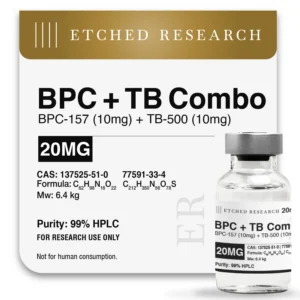
- What is in the vial: 10mg of BPC-157 and 10mg of TB-500, blended into one freeze-dried powder, 20mg in total.
- BPC-157: a synthetic peptide of 15 amino acids, formula C62H98N16O22, 1419.5 g/mol (PubChem CID 9941957). Its sequence comes from a protein in human gastric juice (Chang et al., 2014).
- TB-500 in this blend: full-length thymosin beta-4 (Tβ4, timbetasin), 43 amino acids, formula C212H350N56O78S, 4963 g/mol, CAS 77591-33-4 (PubChem CID 16132341). The FDA and PubChem use the name TB-500 for a different molecule, a seven-amino-acid fragment (Ac-LKKTETQ, PubChem CID 62707662). This blend does not contain that fragment.
- Evidence: for BPC-157, a 2025 systematic review found 36 musculoskeletal studies, 35 in animals or cells and 1 in people with no control group (Vasireddi et al., 2025). Full-length thymosin beta-4 has animal studies and small Phase 2 human trials (Kleinman and Sosne, 2016). The two together: one rat study (Biçer et al., 2026).
- Approval: we found no approval for BPC-157 from the FDA or any other regulator. Full-length thymosin beta-4 reached Phase 2 trials but no approval (ClinicalTrials.gov).
- FDA compounding list: the FDA lists BPC-157 and the TB-500 fragment among substances that were in category 2 (“may present significant safety risks”) before their nominations were withdrawn (FDA, page current as of 22 April 2026).
BPC-157 + TB-500 research: what the studies found, and what they didn’t
Every study below used rats, mice, isolated cells or small groups of patients. One tested the two compounds together. The rest tested one compound at a time, and the misses are listed next to the hits.
The two together
Achilles tendon repair in rats (Joint Diseases and Related Surgery, 2026). Researchers cut and repaired the Achilles tendon in 32 rats and split them into four groups of eight: untreated, BPC-157, TB-500, or both, by injection for four weeks. The TB-500 group had significantly stronger tendons than untreated rats. The TB-500 group and the combined group had significantly better tissue scores on one scale. The BPC-157 group trended better without reaching significance on the total scores. The combined treatment gave no added benefit over either compound alone. The abstract calls its TB-500 synthetic thymosin beta-4 and does not say whether it was full-length. PMID 42542926. https://pubmed.ncbi.nlm.nih.gov/42542926/
BPC-157
Ligament healing in rats (Journal of Orthopaedic Research, 2010). Researchers cut the knee ligament in rats and gave BPC-157 by several routes over 90 days. They observed better functional recovery and better structural healing in the treated animals. Live animal model, not people. PMID 20225319. https://pubmed.ncbi.nlm.nih.gov/20225319/
Achilles tendon-to-bone healing in rats (Journal of Orthopaedic Research, 2006). This study looked at how a detached Achilles tendon reattached to bone in rats. Treated animals healed faster, and BPC-157 offset some of the harm corticosteroids caused in that model. PMID 16583442. https://pubmed.ncbi.nlm.nih.gov/16583442/
Blood vessel growth during repair (Journal of Physiology and Pharmacology, 2009). Researchers examined new blood vessel growth in cell cultures and in muscle and tendon healing in animals. BPC-157 had no direct effect on vessel growth in the cell cultures. In the animals, they reported it raised VEGF, a signal tied to vessel formation, and linked that to more complete repair. PMID 20388964. https://pubmed.ncbi.nlm.nih.gov/20388964/
TB-500 (full-length thymosin beta-4)
Wound healing in rats (Journal of Investigative Dermatology, 1999). Researchers applied Thymosin Beta-4 to skin wounds in rats, on the surface and by injection. They observed new skin cover over the wound rise by 42 to 61 percent. In a separate lab-dish test, skin cells moved faster toward it. PMID 10469335. https://pubmed.ncbi.nlm.nih.gov/10469335/
Human venous ulcer trial (Annals of the New York Academy of Sciences, 2007). This paper describes the design of a European randomized, placebo-controlled study of topical Thymosin Beta-4 on venous leg ulcers, planned for 72 patients over 84 days. It was mainly a safety and tolerability study. When the paper was written, 21 patients had been enrolled and no results were reported. PMID 17495250. https://pubmed.ncbi.nlm.nih.gov/17495250/
Dry eye trial (Clinical Ophthalmology, 2015). A Phase 2, placebo-controlled trial gave 72 adults with dry eye a Thymosin Beta-4 eye solution or placebo for 28 days. Neither main measure differed from placebo. Some secondary measures did. PMID 26056426. https://pubmed.ncbi.nlm.nih.gov/26056426/
Skin-healing review (Vitamins and Hormones, 2016). A review summarized the dermal research. It noted Thymosin Beta-4 sped repair in Phase 2 trials of patients with pressure ulcers and stasis ulcers, along with positive results in animal models. PMID 27450738. https://pubmed.ncbi.nlm.nih.gov/27450738/
Etched Research supplies BPC-157 + TB-500 Blend as a lyophilized powder for laboratory research. The BPC-157 + TB-500 Blend 20mg product page lists its identity data and storage.
How it works
These are two separate mechanisms that researchers happen to study in the same repair setting.
BPC-157 seems to interact with the signals that control how the body lays down collagen, the scaffold that holds tissue together, and it appears to influence growth factor signals tied to new blood vessel growth at an injury site. Both ideas come out of animal and cell studies, and the exact receptor it binds to is still an open question.
The TB-500 in this blend is full-length Thymosin Beta-4, whose main known job is binding actin, the protein cells use to build their inner skeleton and to move. It grabs single, unlinked actin units and holds them in reserve, so a cell has a ready supply when it needs to reshape itself. When tissue is hurt, the cells that rebuild skin and line blood vessels have to crawl toward the wound. Research suggests Thymosin Beta-4 helps organize actin so those cells can migrate.
So one compound is studied around collagen and vessel signaling, the other around cell movement. They are different pathways. One vial holding both is not evidence that the two act as a pair. The authors of the 2026 rat study suggested the pair may have shown no added benefit because both act on shared downstream pathways, and said that idea still needs testing.
What the research does not establish
- Only one published study has tested the two compounds together, in 32 rats, and the combined group did no better than either compound alone. No study has tested a pre-blended vial, and none has tested the pair in people. The idea that the two add up to something greater is not something the literature shows.
- Almost all of the BPC-157 work is preclinical, meaning rats or isolated cells, not human trials.
- The human trials of full-length thymosin beta-4 are small and early. One trial stopped early for slow recruitment, and the completed dry eye trial missed both of its main measures. The short fragment that also goes by the name TB-500 has no human data at all, and it is not what this blend contains.
- There is no approved human use for either compound. Neither is an FDA-approved drug, and neither has been shown to be effective or safe in people.
- Each finding describes what happened in a research model. It does not tell you what would happen in a person, and nothing here is a claim that this blend is safe to use.
The honest limits are the point. Anyone telling you the combined case is settled is well ahead of the research.
Common questions
Why is BPC-157 + TB-500 called the Wolverine blend?
“Wolverine” is a marketing nickname, not a scientific name, and no published study uses it. Some vendors and online forums use it for this pairing, after a comic-book character who recovers from any wound. The name borrows from the tissue repair research on each compound separately, most of it in rats. The one published study that gave the two together, in 32 rats, found the pair did no better than either compound alone (Biçer et al., 2026). The Etched Research vial holds 10mg of BPC-157 and 10mg of TB-500 (full-length thymosin beta-4), pre-blended in one vial, not a kit. What the research does and does not show is in What the research does not establish.
Is BPC-157 and TB-500 FDA approved?
No. Neither compound is an FDA-approved drug. On the FDA’s compounding page, BPC-157 and the TB-500 fragment are both listed with the note that the agency lacks information on whether they would cause harm in people (FDA). Full-length thymosin beta-4 reached Phase 2 trials but was not approved (ClinicalTrials.gov).
What research has BPC-157 and TB-500 been part of?
Tissue repair after injury, mostly in animals. BPC-157 was studied in rats with cut tendons and ligaments (Cerovecki et al., 2010). Thymosin beta-4 was studied in rat skin wounds (Malinda et al., 1999) in small human trials of pressure and stasis ulcers (Kleinman and Sosne, 2016), and in a dry eye trial (Sosne and Ousler, 2015). The pair was studied together once, in rat Achilles tendon repair (Biçer et al., 2026). None of this is an approved use in people.
Is BPC-157 and TB-500 better than BPC-157 alone?
The one study that compared them says no. In rats with a repaired Achilles tendon, the combined group showed no added benefit over either compound given alone, and on tendon strength only the TB-500 group differed significantly from untreated rats (Biçer et al., 2026). It was a small, four-week animal study, and no human study has compared them.
What is BPC-157 and TB-500 made of?
Two peptides. BPC-157 is a chain of 15 amino acids whose sequence was taken from a protein in human gastric juice (PubChem). The TB-500 in this blend is thymosin beta-4, a chain of 43 amino acids found in nearly all cells (PubChem). Both are made synthetically for research.
Last reviewed 2026-09-24.
New reports, new research.
We send a note when a new lab report is posted or a compound comes back in stock, plus a short list of new research pages in any month we publish some. Never more than one email a week, and nothing else.
For Research Use Only. Not for human consumption. Etched Research supplies compounds for laboratory and research use only. Nothing on this page is medical advice, a health claim, or a recommendation to use.
The Janoshik lab result for this compound is on the COA page. For research use only.