Brain & Nerve Research
Peptides studied in the brain and nervous system
Neuropeptide research looks at short peptides examined in brain and nervous-system signaling, including the gamma-aminobutyric acid (GABA) system, brain-derived neurotrophic factor (BDNF), a growth signal for nerve cells, and the melanocortin receptors. The three compounds here start from three different parent molecules. Semax is built from a fragment of adrenocorticotropic hormone (ACTH), a stress hormone made by the pituitary. Selank is built from tuftsin, and PT-141 from a natural melanocortin hormone. Their human records are far apart. PT-141 has placebo-controlled trials with more than a thousand participants, while Semax and Selank rest mostly on small Russian studies and rat work. The certificate of analysis page lists which of these have an independent lab report and which have none. The vials listed here are sold as research material for laboratory use only.
Showing all 3 results
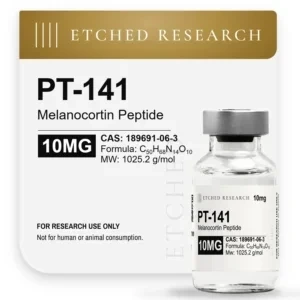
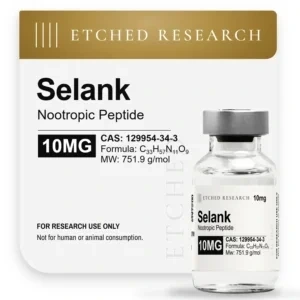
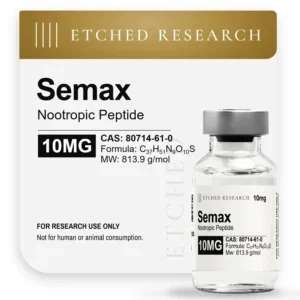
Semax
Semax is seven amino acids, Met-Glu-His-Phe-Pro-Gly-Pro. The first four copy a stretch of adrenocorticotropic hormone (ACTH), a stress hormone made by the pituitary, and the Pro-Gly-Pro tail was added to the end (PubChem). Rat work makes up most of its record, including genome-wide reads of brain gene activity after a blocked artery (Medvedeva et al., 2014). The one human study on our research page enrolled 110 adults after a brain injury, was published in Russian, and reports no placebo group (Gusev et al., 2018).
The vial is Semax 10mg, and the studies are laid out in the Semax research review.
Selank
Selank is tuftsin, a four-amino-acid fragment of the antibody protein immunoglobulin G, with the same Pro-Gly-Pro tail added (Czabak-Garbacz et al., 2006). Most of its mechanism work points at the GABA system. In one cell study, Selank did not shift GABA-related genes on its own but changed how GABA acted on them (Filatova et al., 2017). Its clinical record is two small Russian-language studies that compared it with a benzodiazepine in adults in a clinical setting, and neither abstract reports a placebo group (Zozulia et al., 2008, Medvedev et al., 2014).
Etched’s Selank 10mg is in the grid above. The Selank study summary lists the full record, including the rat and blood-sample work.
PT-141
PT-141 is the development code for bremelanotide, a seven-amino-acid peptide with six of them closed into a ring, designed as a synthetic analog of alpha-MSH, a natural melanocortin hormone (Diamond et al., 2006). It acts at two of the body’s melanocortin receptors. Two placebo-controlled trials in 1,267 premenopausal women with a low sexual desire diagnosis measured desire and distress scores over 24 weeks (Kingsberg et al., 2019). An independent re-analysis of the same trial data reported much higher dropout for side effects on bremelanotide than on placebo (Spielmans, 2021).
Find it as PT-141 10mg. The bremelanotide trial record has the full trial list and its limits.
Nearby in the library
The research library also covers P21, a small synthetic peptide modeled on part of ciliary neurotrophic factor (CNTF), a growth signal for nerve cells. Etched does not sell it. Its record is mouse and cell work, and in one mouse model the effect seen in the dish did not carry over into the live animal (Mottolese et al., 2024). PT-141 has a relative in another category. KPV, the last three amino acids of alpha-MSH, is filed under Immune System Research because its research is on inflammatory signaling. Two short reads go further: Semax vs Selank on the two Moscow peptides, and where the FDA draws the peptide line on why a seven-amino-acid chain is a peptide and not a protein.
The four compounds side by side
| Compound | Built from | Length | Main system examined | Human record |
|---|---|---|---|---|
| Semax | Part of ACTH (amino acids 4 to 7) plus Pro-Gly-Pro | 7 amino acids | BDNF and brain gene activity | One small Russian study, no placebo reported, plus one brain-scan study |
| Selank | Tuftsin plus Pro-Gly-Pro | 7 amino acids | GABA system | Two small Russian studies against a benzodiazepine, plus one brain-scan study |
| PT-141 | Synthetic alpha-MSH analog | 7 amino acids, 6 in a ring | Two melanocortin receptors | Two placebo-controlled trials, 1,267 participants |
| P21 (not sold here) | Part of CNTF | Short synthetic peptide | Nerve-cell growth in mice | None found |
Which of these have human trial data?
Of the three compounds sold here, PT-141 has the largest human record: two placebo-controlled trials in 1,267 premenopausal women (Kingsberg et al., 2019). Semax has one Russian study in 110 patients after a brain injury with no placebo group reported (Gusev et al., 2018). Selank has two small Russian studies that used a benzodiazepine as the comparison, and neither abstract reports a placebo group (Zozulia et al., 2008, Medvedev et al., 2014). One placebo-controlled study did include both Moscow peptides, in 52 healthy adults, and it measured brain connectivity on scans, not symptoms or behavior (Panikratova et al., 2020). For P21 we found no human trial.
How is Selank different from Semax?
They share a length and a tail, and little else. Both are seven amino acids ending in Pro-Gly-Pro, and both came out of the same Moscow research institute. Semax starts from a fragment of ACTH, and its research leans on BDNF and on gene activity after brain injury in rats. Selank starts from tuftsin, and its research leans on the GABA system. The 2020 brain-scan study reported overlapping and distinct changes in one amygdala connection, measured over 20 minutes (Panikratova et al., 2020).
What does PT-141 have to do with alpha-MSH?
PT-141 was designed as a synthetic analog of alpha-MSH, a 13-amino-acid hormone that acts on melanocortin receptors (Diamond et al., 2006). KPV comes from the same hormone, but as its last three amino acids it lacks the stretch alpha-MSH uses to bind those receptors (Brzoska et al., 2010).
Where can I see the lab results for Semax, Selank and PT-141?
Where an independent laboratory report exists for a compound, the measurements are published on the certificate of analysis page, including the compounds we hold no report for.
For research use only. Not for human consumption.