- What it is: A synthetic peptide specified as full-length thymosin beta-4 (43 amino acids), an actin-binding protein found in nearly all cells.
- Research areas: How cells move to close a wound, skin and tissue repair after injury, and new blood vessel growth.
- Evidence level: Mostly animal models, plus a few small human trials of Thymosin Beta-4 itself.
- The short version: The human studies here are on Thymosin Beta-4, the natural protein, not on the research-labeled “TB-500” by that name. Researchers looked at how the protein helps skin and vessel cells crawl toward a wound to close it. The human trials are small and early, and none of this is a safety conclusion.
What it is
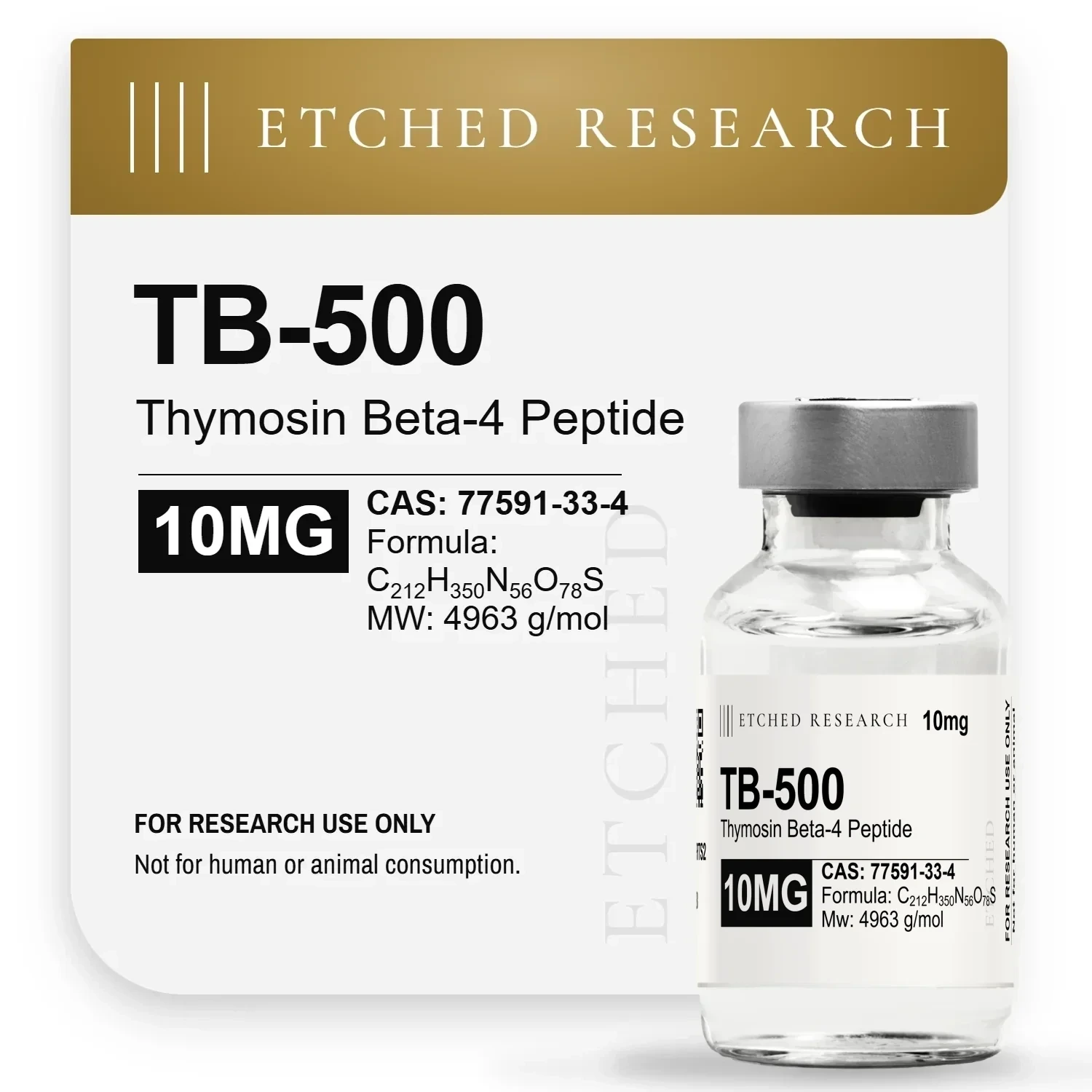
This TB-500 is specified by the supplier as full-length thymosin beta-4, a 43-amino-acid peptide found in nearly all cells in the body, where it binds actin, a protein cells use to change shape and move. Its generic name is timbetasin. The name TB-500 is also used elsewhere for a short seven-amino-acid fragment of it (Ac-LKKTETQ). No lab report on file gives a molecular mass, so the reports do not yet confirm which form is in the vial.
Specs at a glance. Reference values for the compound named on the label, from PubChem or KEGG. They describe the compound, not a measurement of the vial you receive. Molecular weight is the free base (the peptide alone, without a salt). Synthetic peptides are usually supplied as a salt such as acetate or TFA, and the salt in this vial has not been confirmed.
| Compound | TB-500 (specified as full-length thymosin beta-4, timbetasin) |
|---|---|
| Identity note | Values are for full-length thymosin beta-4, the form the supplier specifies. No lab report on file gives a molecular mass, so the reports do not confirm full-length over the short seven-amino-acid fragment. |
| Sequence | Ac-SDKPDMAEIEKFDKSKLKKTETQEKNPLPSKETIEQEKQAGES (43 aa, N-acetyl) |
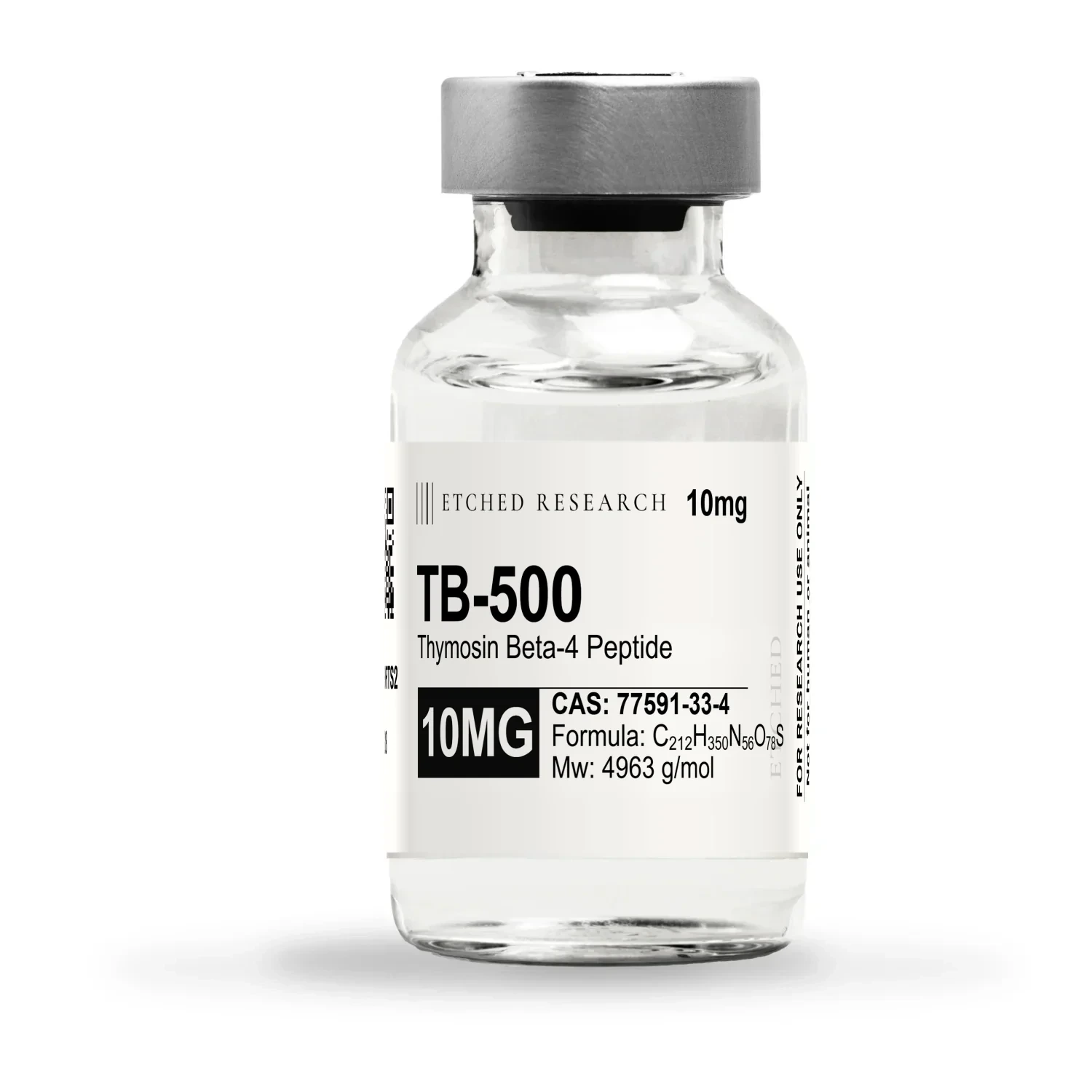
| Molecular formula | C212H350N56O78S |
| Molecular weight | 4963.5 g/mol (average, free base) |
| CAS number | 77591-33-4 |
| Reference record | PubChem CID 16132341 |
| Form | Lyophilized (freeze-dried) powder in one sealed vial |
| Vial size | 10 mg per vial |
| Storage (dry powder) | -20°C or colder, long term. Keep the vial sealed and away from light. |
| Lab report | Janoshik Analytical, November 2025 and May 2026. Ordered by the supplier, not by Etched Research. The report carries no lot number, so it is not matched to the vial you receive. Results on this page ↓ · All lab reports → |
What the evidence is
Most of this research used full-length thymosin beta-4, not the short fragment. The fragment has cell and animal studies only, and the FDA says it has identified no human exposure data for it. The human trials of the full protein are small Phase 2 studies with mixed results.
| Study | Type | Who or what | What was given | What it measured | What it found |
|---|---|---|---|---|---|
| Malinda et al., Journal of Investigative Dermatology, 1999 | Animal and cell | Rats with full-thickness skin wounds, and skin cells in a lab chamber | Full-length thymosin beta-4, by two routes. Dose not stated in the abstract | New skin cover over the wound, wound shrinkage, skin-cell movement | New skin cover rose 42% over saline at day 4 and up to 61% at day 7. Wounds shrank at least 11% more by day 7. Skin cells moved 2 to 3 times more in the dish |
| Philp et al., Wound Repair and Regeneration, 2003 | Animal | Diabetic mice and 26-month-old mice with skin wounds | Full-length thymosin beta-4 in saline or a gel. Separately, the seven-amino-acid fragment LKKTETQ (the abstract does not say whether it was acetylated) | Wound shrinkage, collagen, skin-cell movement | Diabetic mice: more wound shrinkage and collagen, no difference in skin-cell movement. Aged mice: faster healing, and the fragment gave repair comparable to the full protein |
| Rahaman et al., Journal of Chromatography B, 2024 | Cell and animal | Human serum and enzymes in a dish, rats, and skin-derived fibroblast cells | The TB-500 fragment (Ac-LKKTETQ) and its breakdown products | How it breaks down, and wound-closing activity in cells | In rats the main breakdown product was Ac-LK, and Ac-LKK was found up to 72 hours. Only the breakdown product Ac-LKKTE showed significant wound-closing activity against control. The authors said earlier reported activity may come from that product, not TB-500 itself |
| Sosne and Ousler, Clinical Ophthalmology, 2015 | Human, Phase 2, double-masked, placebo-controlled | 72 adults with moderate to severe dry eye | Full-length thymosin beta-4 (0.1%) or placebo, for 28 days | Eye discomfort and lower corneal staining at day 29 | Neither main measure differed from placebo. Some secondary measures did, including 27% lower discomfort during an eye-stress test on day 28 |
| NCT00598871, ReGenTree, LLC, 2007 to 2009 | Human, Phase 2, placebo-controlled | Diabetic patients with corneal wounds after eye surgery, 12 enrolled | Full-length thymosin beta-4, or placebo | Corneal wound healing | Stopped early for slow recruitment |
| Guarnera et al., Annals of the New York Academy of Sciences, 2007 | Human, trial design report | Planned 72 patients with venous leg ulcers at 10 sites in Italy and Poland. 21 enrolled when the paper was written | Full-length thymosin beta-4 at rising doses, or placebo, for 84 days | Side effects, tolerability, full ulcer closure | No results reported. The paper describes a study still enrolling |
Last reviewed 2026-09-24. Only the Philp and Rahaman studies tested the short fragment. More studies, and what none of them establishes, are on the full research summary →
Lab reference
Janoshik Analytical has tested TB-500 10mg from supplier stock twice. On 24 November 2025, two vials measured 99.605% and 99.512% purity, and 11.59 mg and 11.48 mg against the 10 mg label. On 4 May 2026, the sample measured 99.234% purity and 12.07 mg against the 10 mg label. See both on the lab reference page →
What those reports do not cover: they are reference tests of the compound from supplier stock, not a test of the vial in your order. They did not test for endotoxin, sterility or heavy metals. Both list the material as “TB-500 (TB4)”. Neither report gives a molecular mass, so on their own they do not tell full-length thymosin beta-4 apart from the short fragment.
Storage and shipping
Ships as lyophilized powder in a sealed vial. Store the powder frozen at -20°C. US addresses only. Shipping costs and cutoff times →
Questions about TB-500
Is TB-500 the same as thymosin beta-4?
This product is specified as full-length thymosin beta-4, which a lab mass reading has not yet confirmed. The name is not used the same way everywhere. The FDA lists TB-500 as “Thymosin beta-4, fragment (LKKTETQ)”, and a 2012 laboratory analysis found that seven-amino-acid fragment in a product sold as TB-500 (Esposito et al., 2012). The fragment is PubChem CID 62707662.
Is there human data?
Full-length thymosin beta-4, the form this product is specified as, has reached small Phase 2 trials. The short fragment has none, and the FDA says it has identified no human exposure data for it. The completed dry eye trial above missed both of its main measures, and a corneal wound trial stopped early for slow recruitment.
Where can I buy TB-500 for research?
Etched Research sells TB-500 on this page as a 10mg vial of lyophilized powder, for laboratory research use only, shipped to US addresses. Where an independent laboratory report exists for a compound, the measurements are published on the lab reference page, including the compounds we hold no report for.
Is TB-500 an approved drug?
No. On its compounding safety-risks page, the FDA says it lacks important information on whether TB-500 would cause harm if given to people. Etched Research sells TB-500 as a research compound for laboratory use only. It is not for human use.
Shipping, eligibility and what comes in the box: store FAQ →
For research use only. Not for human consumption.