Cell Energy Research
How cells make and use energy, plus related cell studies
Cell energy research looks at how cells make energy and keep that machinery working: the inner mitochondrial membrane, the coenzyme that carries electrons through it, the signals mitochondria send back to the nucleus, and the telomeres that cap each chromosome. SS-31 binds cardiolipin, a lipid of the inner membrane. MOTS-c is a peptide encoded in mitochondrial DNA. NAD+ is a coenzyme, not a peptide. Epithalon is a four-amino-acid peptide examined in telomerase research. Human data runs from four published SS-31 trials, with a mixed record, to no controlled trial we found for MOTS-c or Epithalon. The certificate of analysis page shows which compounds have an independent lab report and which do not. All products here are research material for laboratory use.
Showing all 4 results
-
Cell Energy Research
MOTS-c 10mg, 40mg
Price range: $45.00 through $135.00 Select options This product has multiple variants. The options may be chosen on the product page
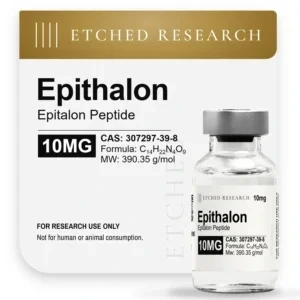
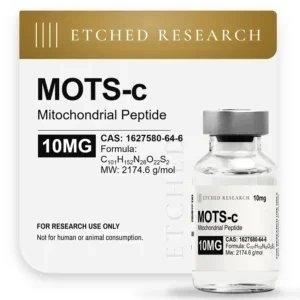
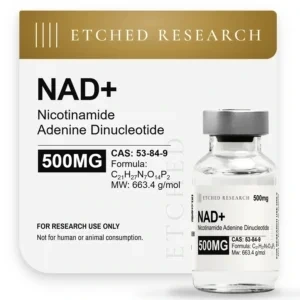
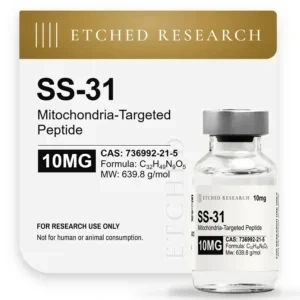
SS-31
SS-31, also called elamipretide, is a synthetic four-amino-acid peptide, two of them not found in human proteins (written D-Arg-Dmt-Lys-Phe-NH2), at 639.8 g/mol. It binds cardiolipin, a lipid found only on the inner mitochondrial membrane. In lab and animal work, that binding kept cardiolipin from turning cytochrome c, a small electron carrier, into an enzyme that oxidizes lipids (Szeto, 2014). Its research page lists four published human trials, all in people with rare mitochondrial disease or heart failure. The two larger ones, in 218 people with mitochondrial myopathy (Karaa et al., 2023) and 71 people with heart failure (Butler et al., 2020), did not meet their main goals.
See SS-31 10mg or read what the elamipretide trials found.
MOTS-c
MOTS-c is a 16-amino-acid peptide whose code sits inside the mitochondrial gene for 12S ribosomal RNA, first described in 2015. Its founding study, in cells and mice, traced its effects to the folate cycle and the cell’s energy sensor, AMP-activated protein kinase (AMPK), mainly in skeletal muscle (Lee et al., 2015). A 2018 cell study from the same group found that under metabolic stress it moved from the mitochondria into the nucleus and changed the activity of a broad set of genes (Kim et al., 2018). The human studies we found measured the body’s own MOTS-c, or a natural variant of its gene, and gave no peptide (von Walden et al., 2021).
See MOTS-c in 10mg and 40mg vials or read how the MOTS-c studies trace the cell’s energy sensor.
NAD+
NAD+, nicotinamide adenine dinucleotide, is a coenzyme made of two nucleotides, 663.4 g/mol, with no amino acids in it. It carries electrons in the reactions that make adenosine triphosphate (ATP), the cell’s energy currency, and enzymes such as sirtuins and DNA-repair enzymes use it up, so cells keep making more. Researchers have measured NAD+ falling with age in human skin (Massudi et al., 2012) and lower in the blood plasma of older adults (Clement et al., 2019). In cultured mouse brain cells with DNA damage, NAD+ ran low before the cells died (Alano et al., 2004).
See NAD+ 500mg or the NAD+ measurement and pilot studies.
Epithalon
Epithalon, also spelled Epitalon, is the four-amino-acid peptide Ala-Glu-Asp-Gly, 390.35 g/mol, with a sequence designed from Epithalamin, an extract of cattle pineal glands. Its research centers on telomerase, the enzyme that adds length back to telomeres. In human fetal fibroblasts, a cell type that starts with no telomerase activity, a 2003 study reported telomerase switching on and telomeres growing longer (Khavinson et al., 2003). Most of its literature comes from one St. Petersburg group. The main independent work we found is a 2025 UK study in human cell lines (Al-Dulaimi et al., 2025).
See Epithalon 10mg or read what the telomerase studies measured.
Four molecules, side by side
| Compound | What it is | Where the research places it | Size | Human record |
|---|---|---|---|---|
| SS-31 | Synthetic peptide, 4 amino acids | Cardiolipin, inner mitochondrial membrane | 639.8 g/mol | Four published trials in rare disease and heart failure, the two larger ones missed their main goals |
| MOTS-c | Peptide encoded in mitochondrial DNA, 16 amino acids | Cell energy sensing (AMPK), mainly muscle, in mice and cells | 2174.6 g/mol | Measurements of the body’s own MOTS-c, or its gene, only |
| NAD+ | Coenzyme, not a peptide | Electron carrier, used up by sirtuins and DNA-repair enzymes | 663.4 g/mol | Two studies that measured it by age, one 11-person pilot with no health outcome |
| Epithalon | Synthetic peptide, 4 amino acids | Telomerase, in cell work | 390.35 g/mol | A few small reports with no comparison group described |
Further reading
The research library holds the full summary for each compound above, and how long a lyophilized peptide lasts covers why storage conditions, not one fixed date, set shelf life.
Which of these have human trial data?
SS-31 has the most human data: its research page lists four published trials, all in people with rare mitochondrial disease or heart failure, and the two larger ones missed their main goals (Karaa et al., 2023). NAD+ has two studies that measured it by age and gave nothing, plus an 11-person pilot that tracked blood and urine levels and measured no health outcome (Grant et al., 2019). The human MOTS-c studies we found measured the body’s own peptide, or a natural variant of its gene, and gave none. Epithalon has a few small Russian-language reports that describe no comparison group. We found no controlled human trial of MOTS-c or Epithalon.
What is the difference between MOTS-c and SS-31?
They are both short peptides tied to mitochondria, but they come from different places and act at different points. MOTS-c is made from the cell’s own mitochondrial DNA, and in mouse and cell work it acts as a signal through AMPK (Lee et al., 2015). SS-31 is a lab-designed peptide carrying two amino acids that do not occur in human proteins, built to bind cardiolipin on the inner membrane (Szeto, 2014). SS-31 has published human trials, and we found none that gave MOTS-c to people. We found no published study that compares the two directly.
Is NAD+ a peptide?
No. NAD+ is a coenzyme built from two nucleotides joined through their phosphate groups, one carrying nicotinamide and one carrying adenine, and it contains no amino acids. It sits in this category because its research is about how cells make energy, the same ground the SS-31 and MOTS-c work covers.
Is Epithalon the same as Epithalamin?
No. Epithalamin is an extract of cattle pineal glands. Epithalon is a single synthetic four-amino-acid peptide whose sequence was designed from that extract’s amino-acid makeup (Araj et al., 2025). Epitalon, Epithalone and AEDG (its sequence in one-letter code) are other names for Epithalon itself.
Where are the lab reports?
Where an independent laboratory report exists for a compound, the measurements are published on the certificate of analysis page, including the compounds we hold no report for.
For research use only. Not for human consumption.