Metabolism Research
How the body uses sugar and balances its energy
Metabolism research looks at the signals behind energy balance: hormones that act on receptors in the brain, pancreas and liver, and enzymes inside cells that shape how fuel is stored and used. The three compounds here reach that system at different points. Retatrutide is one peptide that acts at three hormone receptors. Cagrilintide is a long-acting analog of amylin, a hormone released alongside insulin. 5-Amino-1MQ is not a peptide. It is a small molecule that blocks an enzyme called nicotinamide N-methyltransferase (NNMT). The human record runs from published randomized trials for the first two to none for 5-Amino-1MQ. The certificate of analysis page shows which compounds have an independent lab report and which do not. All products here are research material for laboratory use.
Showing all 3 results
-
Metabolism Research
Retatrutide 10mg, 30mg
Price range: $85.00 through $210.00 Select options This product has multiple variants. The options may be chosen on the product page
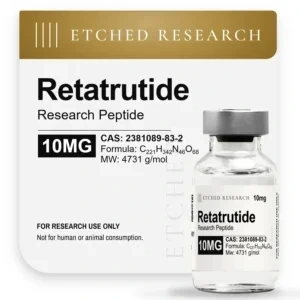
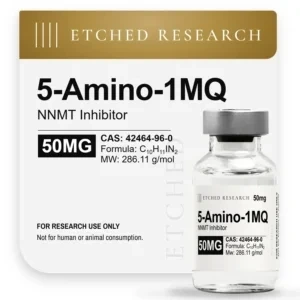
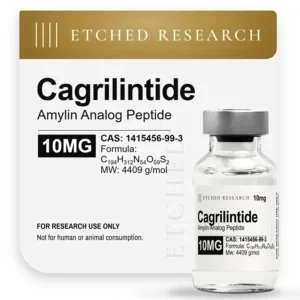
Retatrutide
Retatrutide is a 39-amino-acid synthetic peptide, with two kinds of non-standard amino acid in its chain and a fatty-acid group attached at position 17. It is one molecule built to act at the receptors for three hormones: glucagon and two gut hormones, GIP and GLP-1. In its developers’ cell tests, its activity at the GIP receptor was the strongest of the three (Coskun et al., 2022). Its published human trials measured body weight (Jastreboff et al., 2023), HbA1c, a long-term blood sugar marker (Rosenstock et al., 2023), and liver fat (Sanyal et al., 2024).
See Retatrutide 10mg and 30mg or read what the retatrutide trials measured.
Cagrilintide
Cagrilintide is a 37-amino-acid analog of amylin, the hormone the pancreas releases with insulin after a meal. Its developers added a fatty-acid chain at its first amino acid so it would last far longer than natural amylin, which clears quickly (Kruse et al., 2021). It acts through amylin receptors, not GLP-1 receptors. In mice bred without two parts of the amylin receptor, its activation of a hindbrain region called the area postrema was weaker (Carvas et al., 2025).
See Cagrilintide 10mg or the amylin-analog trial summary.
5-Amino-1MQ
5-Amino-1MQ, full name 5-amino-1-methylquinolinium, is a small molecule with no amino acids in it. It blocks NNMT, an enzyme that moves a methyl group from S-adenosylmethionine (SAM), the cell’s main methyl donor, onto nicotinamide, and in lab tests it left related SAM-using enzymes alone (Neelakantan et al., 2018). It is usually listed as an iodide salt, which is why its listings carry two molecular weights. Its published animal work is a handful of mouse studies from one research group, plus one pharmacokinetic study in rats (Awosemo et al., 2021).
5-Amino-1MQ 50mg is in the grid above, and the NNMT inhibitor research lists the five mouse studies.
How the compounds compare
| Compound | Type | Acts at | Size | Human record |
|---|---|---|---|---|
| Retatrutide | Peptide with a fatty-acid group | Receptors for glucagon and two gut hormones | 39 amino acids, 4731 g/mol | Randomized trials, all developer-funded, longest published 48 weeks |
| Cagrilintide | Peptide with a fatty-acid group | Amylin receptors | 37 amino acids, 4409 g/mol | Randomized trials, longest published standalone trial 26 weeks |
| 5-Amino-1MQ | Small molecule, not a peptide | NNMT, an enzyme inside cells | 159.21 g/mol (the charged ion) | None found. Animal studies only |
Nearby in the library
The research library holds the full summaries. One compound filed under another category sits close to this one. MOTS-c, a 16-amino-acid peptide encoded in mitochondrial DNA, is examined in insulin signaling research, mostly in mice and cells, and is listed under Cell Energy Research. Two short reads cover how molecules like these are classified. The 40-amino-acid line in the Food and Drug Administration’s protein rule uses retatrutide’s structure as its worked example, and peptide, protein, biologic sets out where US regulation draws each line.
Which of these have human trial data?
Retatrutide and cagrilintide have published randomized human trials, and 5-Amino-1MQ has none that we found. Retatrutide’s trials, all funded by its developer, enrolled adults with obesity or overweight, type 2 diabetes, or fatty liver disease, the largest published one with 537 adults (Bajaj et al., 2026). Cagrilintide’s published standalone record is a 26-week trial in 906 adults, 706 of them on cagrilintide (Lau et al., 2021), plus a heart-rhythm study in 105 healthy adults (Gabe et al., 2024). 5-Amino-1MQ has animal studies only, and we found no human trial published or registered.
How do retatrutide, cagrilintide and 5-Amino-1MQ differ?
They act at three different points: retatrutide at three hormone receptors, cagrilintide at amylin receptors, and 5-Amino-1MQ at an enzyme inside cells. The two peptides each carry a fatty-acid chain, which their developers added to make the molecule last longer. 5-Amino-1MQ is far smaller, its charged ion weighing 159 g/mol against about 4,400 to 4,700 for the two peptides. No study cited on these pages compares the three directly.
Is 5-Amino-1MQ a peptide?
No. 5-Amino-1MQ is a small molecule built on a quinoline ring, with 10 carbon atoms and no amino acids. Peptides are chains of amino acids. It sits in this category because its research is in the same area, energy balance, not because of its structure.
Where are the lab reports?
Where an independent laboratory report exists for a compound, the measurements are published on the certificate of analysis page, including the compounds we hold no report for.
For research use only. Not for human consumption.