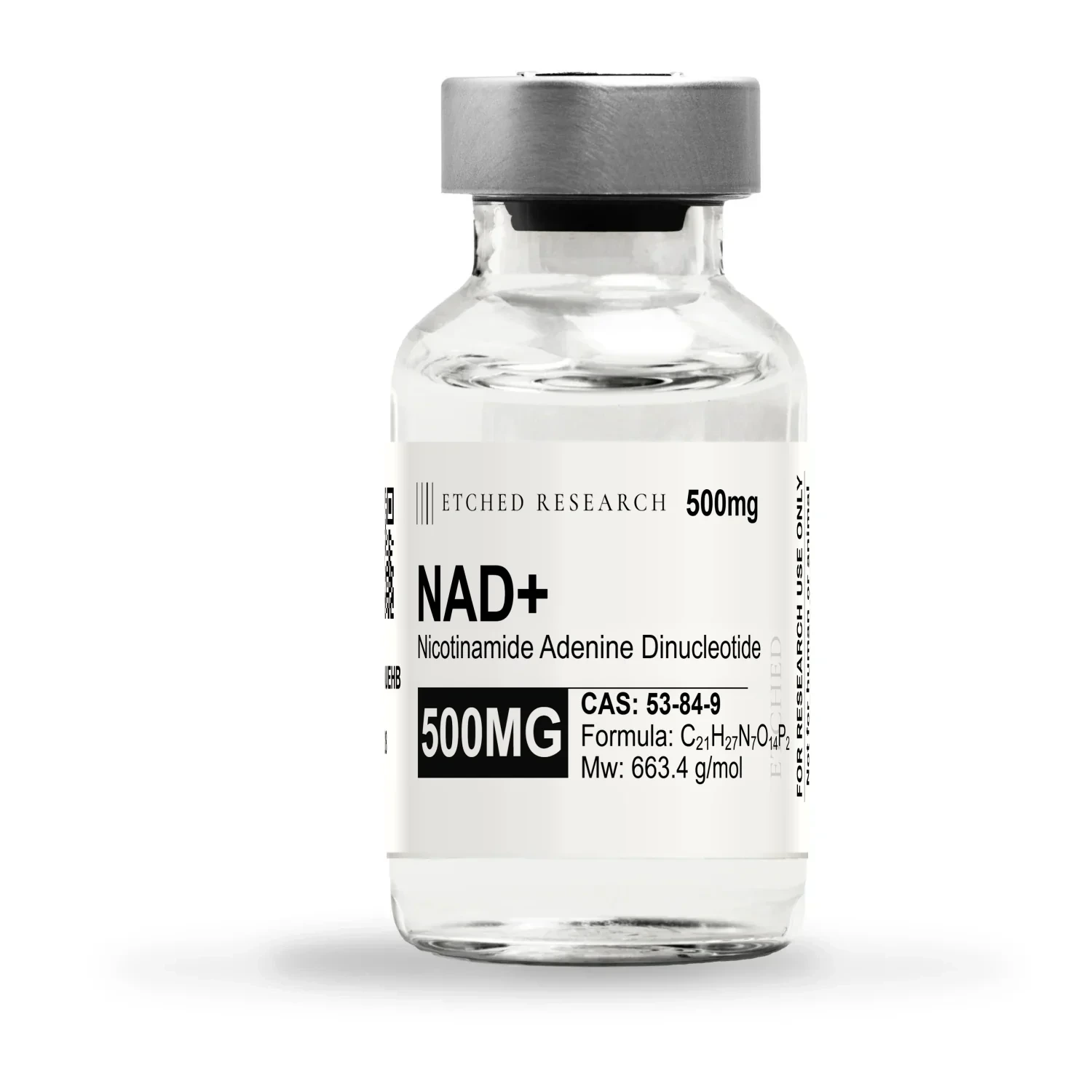
- What it is: Nicotinamide adenine dinucleotide, a coenzyme found in all living cells and central to how they turn fuel into energy.
- Research areas: How NAD+ levels change with age in human tissue and blood, its role as fuel for sirtuins and DNA-repair enzymes, and NAD+ given directly in cell and animal injury models.
- Evidence level: Mostly cell and animal work. The human data is measurement studies plus one small IV pilot that tracked blood and urine levels.
- The short version: Researchers have measured NAD+ falling with age in human skin and blood, and tested NAD+ itself in cell cultures and rodent stroke models. The one human study that gave NAD+ directly was an 11-person pilot that tracked where it went in the body, not any health outcome. Lower NAD+ with age is a measured pattern. What it means for a person’s health is not established.
What it is
NAD+ (nicotinamide adenine dinucleotide) is a coenzyme, not a peptide. It is made of two nucleotides joined through their phosphate groups, one carrying nicotinamide and one carrying adenine. NAD+ is the oxidized form. NADH is the reduced form.
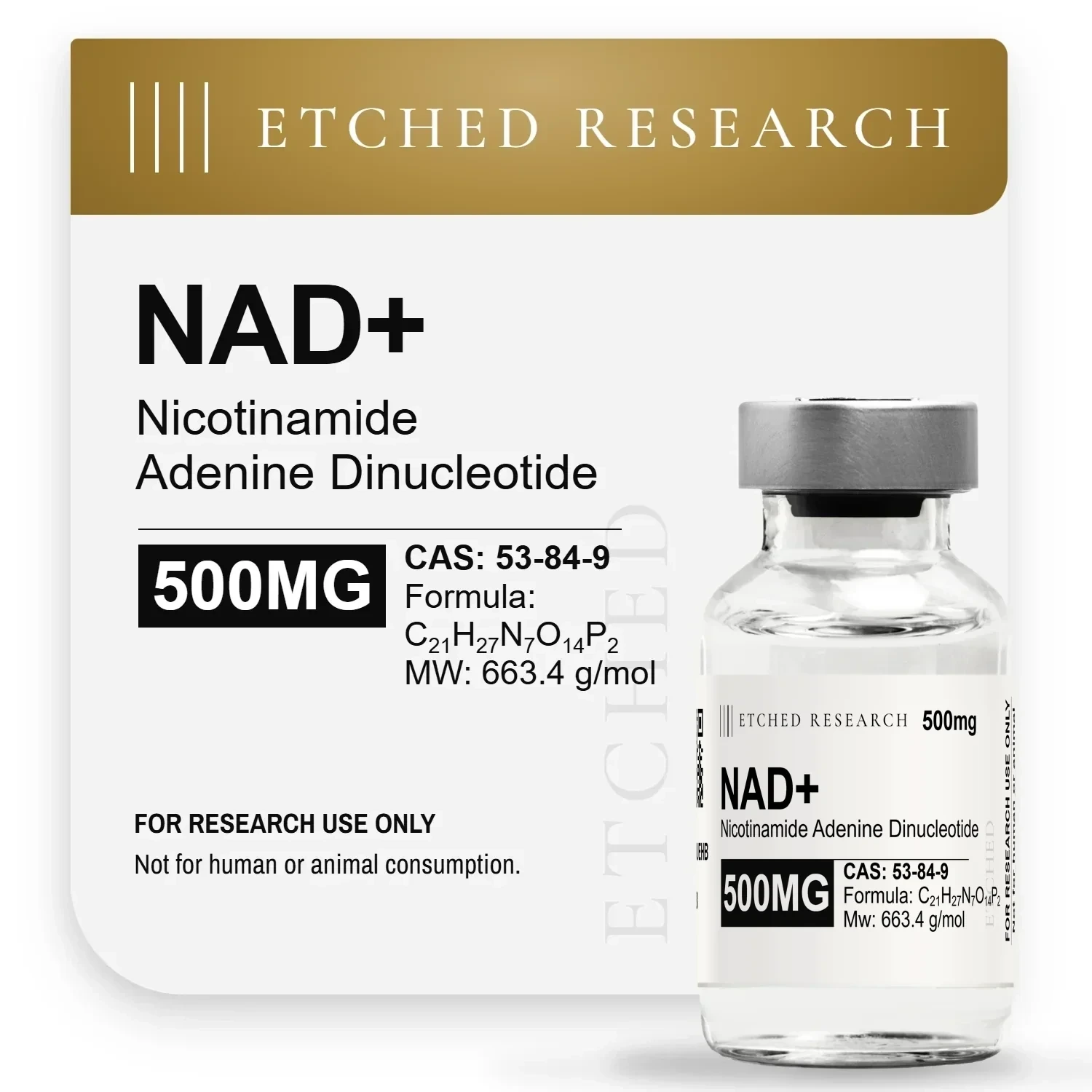
Specs at a glance. Reference values for the compound named on the label, from PubChem or KEGG. They describe the compound, not a measurement of the vial you receive. Molecular weight is the free acid, as PubChem lists it. Commercial NAD+ may be a sodium salt or a hydrate, and the form in this vial has not been confirmed.
| Compound | NAD+ (nicotinamide adenine dinucleotide, oxidized), coenzyme, not a peptide |
|---|---|
| Sequence | Not a peptide. Dinucleotide coenzyme. |
| Molecular formula | C21H27N7O14P2 |
| Molecular weight | 663.43 g/mol (average, free acid) |
| CAS number | 53-84-9 |
| Reference record | PubChem CID 5892 |
| Form | Lyophilized (freeze-dried) powder in one sealed vial |
| Vial size | 500 mg per vial |
| Storage (dry powder) | -20°C or colder, long term. Keep the vial sealed and away from light. |
| Lab report | Janoshik Analytical, April 2026. Identity and measured content only. Purity was not requested. Ordered by the supplier, not by Etched Research. The report carries no lot number, so it is not matched to the vial you receive. Results on this page ↓ · All lab reports → |
What the evidence is
Most research on NAD+ itself is in cells and animals. The human studies below either measured NAD+ levels by age or tracked what happens to NAD+ given by IV drip. None of them tested a health outcome in people.
| Study | Type | Who or what | What was given | What it measured | What it found |
|---|---|---|---|---|---|
| Alano et al., Journal of Biological Chemistry, 2004 | Cell | Mouse astrocytes (brain support cells) in a dish, with DNA damage set off by chemicals | NAD+ added to the culture after the damage | Cell NAD+ levels, mitochondrial function and cell death | The damage drained NAD+ before the cells died. Restoring NAD+ to near-normal levels blocked the cell death in these cultures |
| Ying et al., Frontiers in Bioscience, 2007 | Animal | Rats with a brain artery blocked for a time (a stroke model) | 10 mg/kg NAD+, 2 hours after the blockage began | Brain NAD+, size of the damaged area, neurological deficits | Brain NAD+ rose. The damaged area was smaller at 24 and 72 hours, with fewer deficits |
| Zheng et al., Neuroscience Letters, 2012 | Animal | Adult male mice with a brain artery blocked for 90 minutes | 50 mg/kg NAD+ as blood flow returned | Damaged area, swelling, neurological deficits and autophagy (a cell clean-up process) | Smaller damaged area, less swelling and fewer deficits at 48 hours. Less autophagy in the brain |
| Massudi et al., PLoS One, 2012 | Human, observational | Skin samples from 49 people, newborn to age 77, taken during unrelated surgery | Nothing given | Tissue NAD+, DNA damage and PARP (a DNA-repair enzyme) activity by age | NAD+ was lower with age in both males and females. PARP activity rose with age in males. No treatment was tested |
| Clement et al., Rejuvenation Research, 2019 | Human, observational | Blood plasma from healthy adults aged 20 to 87 | Nothing given | NAD+ and related molecules by age | NAD+ and NADP+ were lower in older people. NADH and NADPH were higher. No treatment was tested |
| Grant et al., Frontiers in Aging Neuroscience, 2019 | Human, small pilot, saline comparison | 11 healthy men aged 30 to 55 (8 given NAD+, 3 given saline) | 750 mg NAD+ over 6 hours | NAD+ and its breakdown products in blood and urine | Blood NAD+ did not change for the first 2 hours of the drip. NAD+ and a breakdown product showed up in urine by 6 hours. It measured where NAD+ went, not any health outcome |
Last reviewed 2026-09-24. The cell study and both stroke-model studies share one author, W. Ying. The IV pilot was funded in part by NAD+ Research Inc. How NAD+ works, and what none of this establishes, is on the full research summary →
Lab reference
Janoshik Analytical tested an NAD+ 500mg sample from supplier stock, with the analysis dated 30 April 2026. The tests requested were identity and amount, and the sample measured 496.78 mg of NAD+ against the 500 mg label. This report format gives no purity figure. See it on the lab reference page →
What that report does not cover: it is a reference test of the compound from supplier stock, not a test of the vial in your order. It gives no purity result, and it did not test for endotoxin, sterility or heavy metals.
Storage and shipping
Ships as lyophilized powder in a sealed vial. Store the powder frozen at -20°C. US addresses only. Shipping costs and cutoff times →
Questions about NAD+
Is NAD+ a peptide?
No. Peptides are chains of amino acids. NAD+ is a coenzyme made of two nucleotides, and it contains no amino acids. Research stores often list it next to peptides, but it is a different kind of molecule.
Is this NAD+ or NADH?
NAD+, the oxidized form (PubChem CID 5892, also listed as beta-NAD+ and nadide). NADH is the reduced form of the same coenzyme. Cells switch between the two as NAD+ picks up and hands off electrons.
Where can I buy NAD+ for research?
Etched Research sells NAD+ on this page as a 500mg vial of lyophilized powder, for laboratory research use only, shipped to US addresses. Where an independent laboratory report exists for a compound, the measurements are published on the lab reference page, including the compounds we hold no report for.
Is there human data?
Only a little, and none of it tests an outcome. Two studies measured NAD+ in human skin and blood by age and gave nothing. One pilot gave NAD+ by IV drip to 8 healthy men, with 3 on saline, and tracked blood and urine levels over 6 hours. The rest of the research is in cells and animals.
Shipping, eligibility and what comes in the box: store FAQ →
For research use only. Not for human consumption.