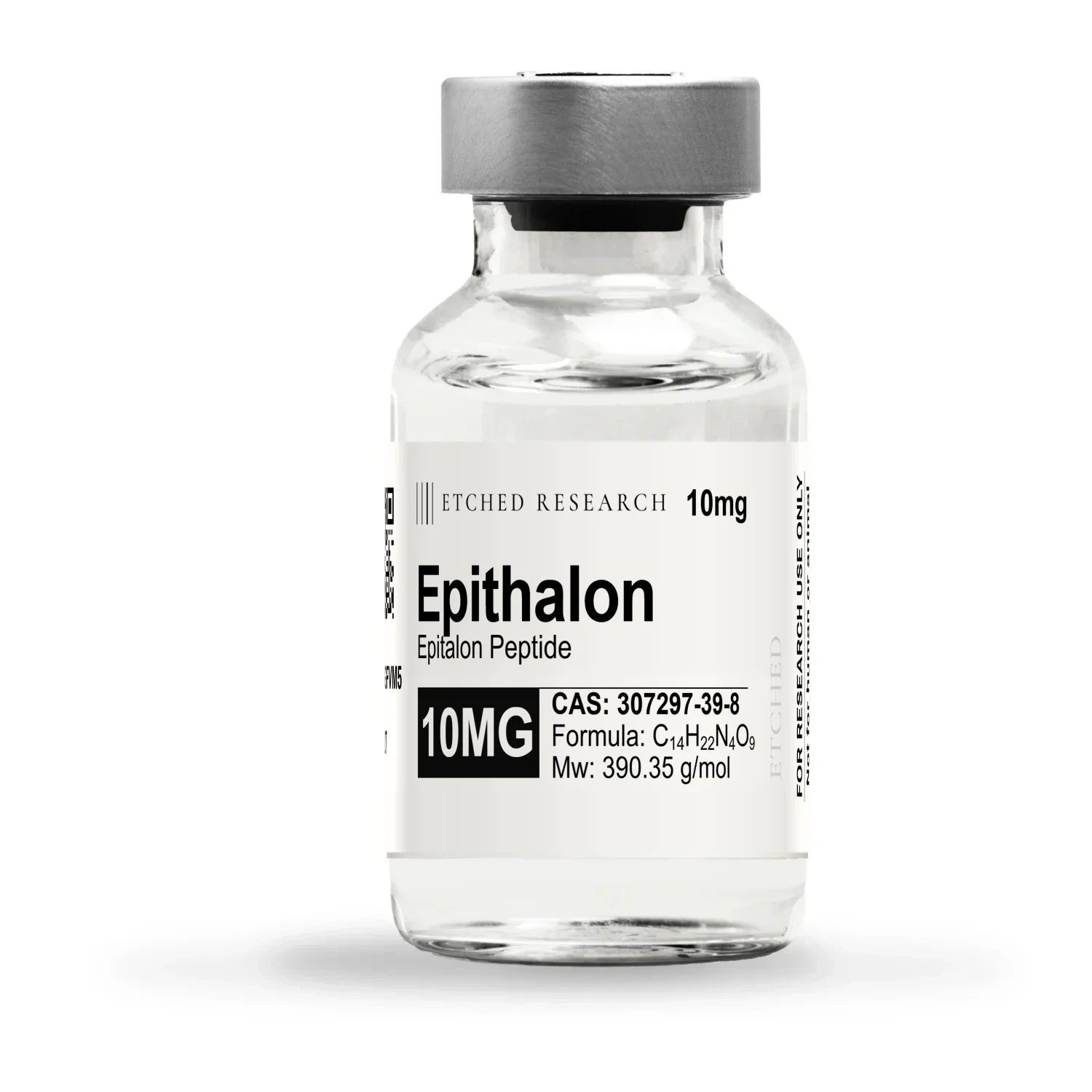
- What it is: The synthetic Ala-Glu-Asp-Gly tetrapeptide, a bioregulator modeled on a pineal-gland extract.
- Research areas: Telomerase activity and telomere length in cells, a lifetime study in one mouse strain, and pineal and circadian signaling.
- Evidence level: Thin. Mostly older Russian lab and animal work, plus a couple of recent cell studies. No controlled human trial.
- The short version: Epithalon is a four-amino-acid peptide with a big story and a small evidence base. Most of what researchers have published comes from Russian animal and cell studies, with very little independent confirmation.
What it is
Epithalon, also spelled Epitalon, is a synthetic peptide made of four amino acids: alanine, glutamic acid, aspartic acid and glycine (Ala-Glu-Asp-Gly, or AEDG). Its sequence was designed from the amino-acid makeup of Epithalamin, an extract of cattle pineal glands.
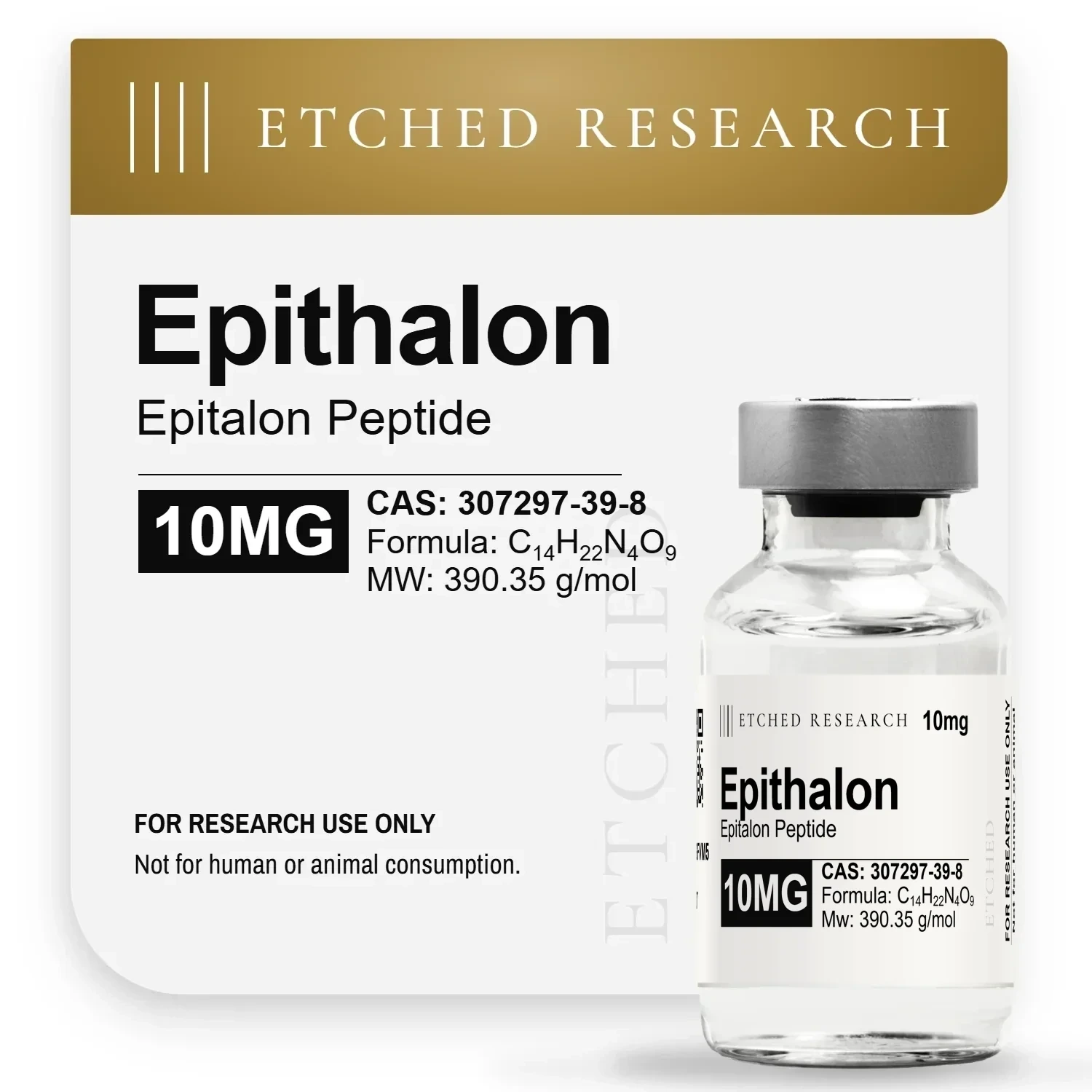
Specs at a glance. Reference values for the compound named on the label, from PubChem or KEGG. They describe the compound, not a measurement of the vial you receive. Molecular weight is the free base (the peptide alone, without a salt). Synthetic peptides are usually supplied as a salt such as acetate or TFA, and the salt in this vial has not been confirmed.
| Compound | Epithalon (Epitalon) |
|---|---|
| Sequence | AEDG (Ala-Glu-Asp-Gly) |
| Molecular formula | C14H22N4O9 |
| Molecular weight | 390.35 g/mol (average, free base) |
| CAS number | 307297-39-8 |
| Reference record | PubChem CID 219042 |
| Form | Lyophilized (freeze-dried) powder in one sealed vial |
| Vial size | 10 mg per vial |
| Storage (dry powder) | -20°C or colder, long term. Keep the vial sealed and away from light. |
| Lab report | No lab report on file for this compound. All lab reports → |
What the evidence is
Almost all Epithalon research is in cells or animals. A few small human reports exist, mostly in Russian-language journals, and their abstracts describe no comparison group. No controlled human trial has been published.
| Study | Type | Who or what | What was given | What it measured | What it found |
|---|---|---|---|---|---|
| Khavinson et al., Bulletin of Experimental Biology and Medicine, 2003 | Cell | Human fetal fibroblasts grown in a dish, a cell type with no telomerase activity to start with | Epithalon added to the culture. Amount not stated in the abstract | The telomerase enzyme subunit, telomerase activity and telomere length | All three appeared in the treated cells, and telomeres got longer. Cells in a dish only |
| Anisimov et al., Biogerontology, 2003 | Animal | Female SHR mice, 54 per group, from 3 months of age until natural death | 1.0 µg per mouse (about 30 to 40 µg/kg) on 5 days in a row each month, compared with saline | Lifespan, body weight, reproductive cycling and chromosome damage in bone marrow | No change in average lifespan or body weight. Maximum lifespan was longer than in the saline group, reproductive cycling faded more slowly, and bone marrow cells showed fewer chromosome aberrations |
| Korkushko et al., Advances in Gerontology, 2007 | Animal and human, uncontrolled | Old monkeys and older people. Article in Russian | Epithalon, and separately Epithalamin (the pineal extract) | Melatonin levels in the blood across the day | The authors report that night-time melatonin rose. The English abstract gives no group sizes, doses or comparison group |
| Al-Dulaimi et al., Biogerontology, 2025 | Cell | Two breast cancer cell lines, plus normal human epithelial cells and fibroblasts | Several concentrations in the dish | Telomere length, telomerase activity, and ALT, a second way cells can lengthen telomeres | Telomeres lengthened with dose in the normal cells, through telomerase. In the cancer cells, the lengthening went through ALT instead |
| Araj et al., International Journal of Molecular Sciences, 2025 | Review | About 25 years of cell, animal and computer-model studies | Not applicable | What the published record shows | The authors summarize reported effects on aging markers and hormone signaling. They say it is still uncertain whether the mechanisms found so far are the only ones |
Last reviewed 2026-09-24. Three of the four primary studies above list Vladimir Khavinson of St. Petersburg, Russia, as an author, and most of the Epithalon literature comes from his group. The 2025 UK cell study is the main independent work we found. More studies, and what none of them establishes, are on the full research summary →
Storage and shipping
Ships as lyophilized powder in a sealed vial. Store the powder frozen at -20°C. US addresses only. Shipping costs and cutoff times →
Questions about Epithalon
Is Epithalon the same as Epitalon?
Yes. Epithalon, Epitalon and Epithalone are spellings of the same four-amino-acid peptide, and papers also call it AEDG. It is not the same thing as Epithalamin, the pineal-gland extract its sequence was designed from.
Is there human data?
Very little. The two human reports we found on PubMed both list Vladimir Khavinson as an author, and their abstracts give no patient numbers or comparison group. One looked at melatonin levels in older people, the other at patients with degenerative retinal disease. No controlled human trial has been published.
Where can I buy Epithalon for research?
Etched Research sells Epithalon on this page as a 10mg vial of lyophilized powder, for laboratory research use only, shipped to US addresses. Where an independent laboratory report exists for a compound, the measurements are published on the lab reference page, including the compounds we hold no report for.
Is Epithalon an approved drug?
No. The FDA’s compounding page lists epitalon among substances that were in category 2 before their nominations were withdrawn, and says the agency lacks enough information to know whether it would cause harm in people. Etched Research sells Epithalon as a research compound for laboratory use only. It is not for human use.
Shipping, eligibility and what comes in the box: store FAQ →
For research use only. Not for human consumption.