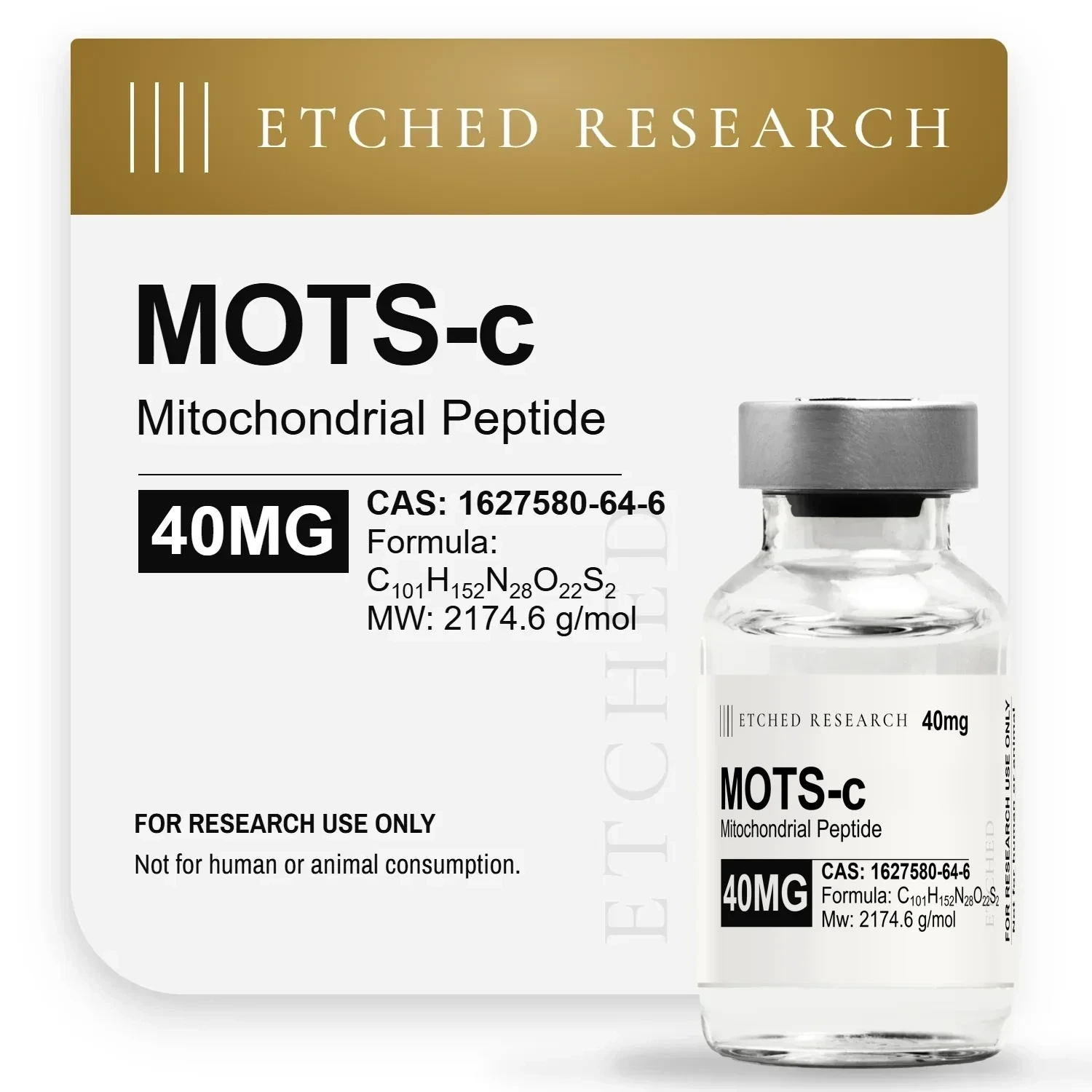
- What it is: A 16-amino-acid peptide encoded by mitochondrial DNA.
- Research areas: metabolism and insulin signaling, AMPK signaling in muscle, and bone loss in animal models.
- Evidence level: Almost all animal and cell work. The little human data measured the body’s own MOTS-c, not a peptide given to people.
- The short version: MOTS-c research centers on an energy sensor called AMPK, mostly in mice and cells. The human data is thin, and it measured the body’s own MOTS-c, not a peptide given to people.
What it is
MOTS-c is a 16-amino-acid peptide whose code sits in mitochondrial DNA, inside the gene for the mitochondria’s 12S ribosomal RNA. The name stands for mitochondrial open reading frame of the 12S rRNA-c. It was first described in 2015 by researchers at the University of Southern California.
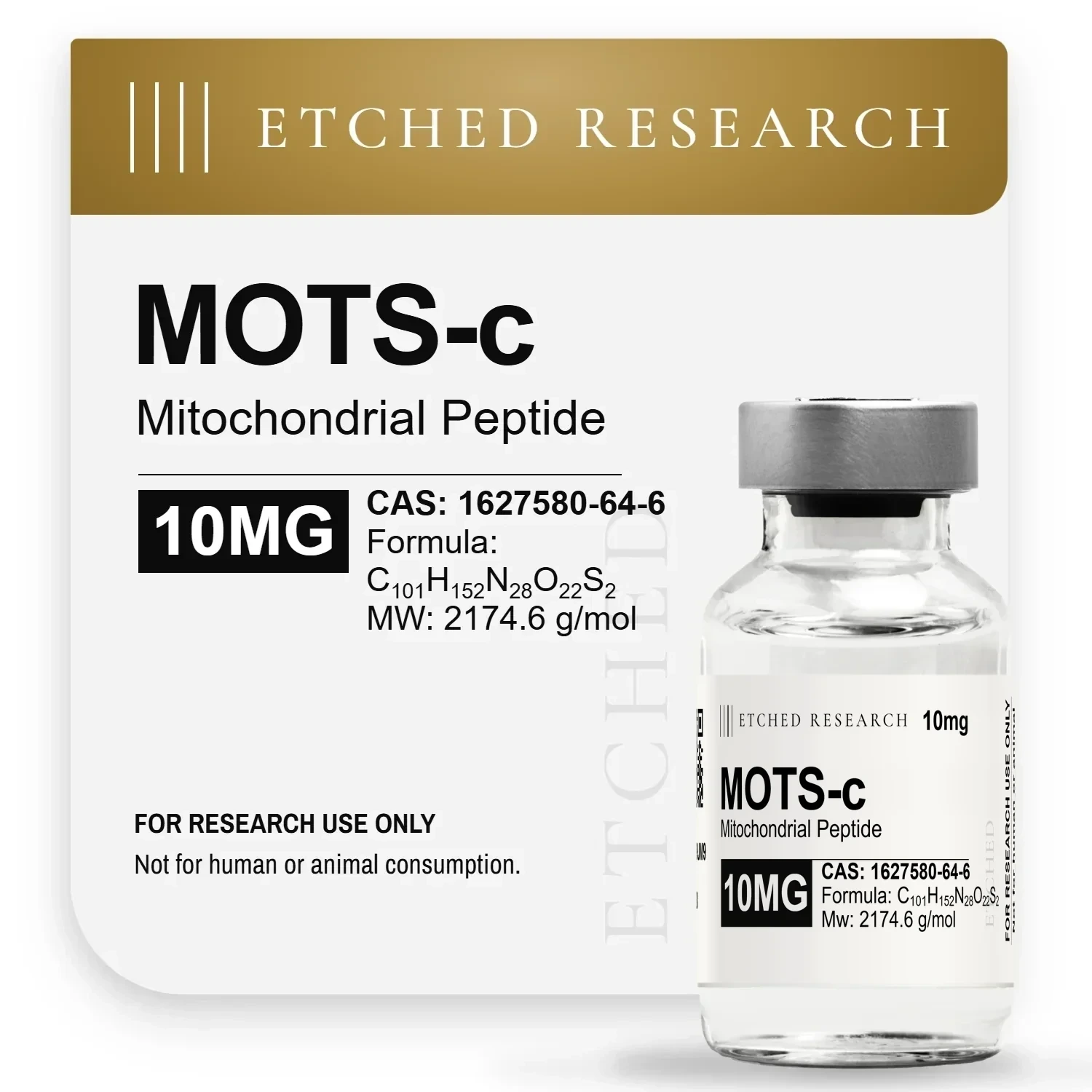
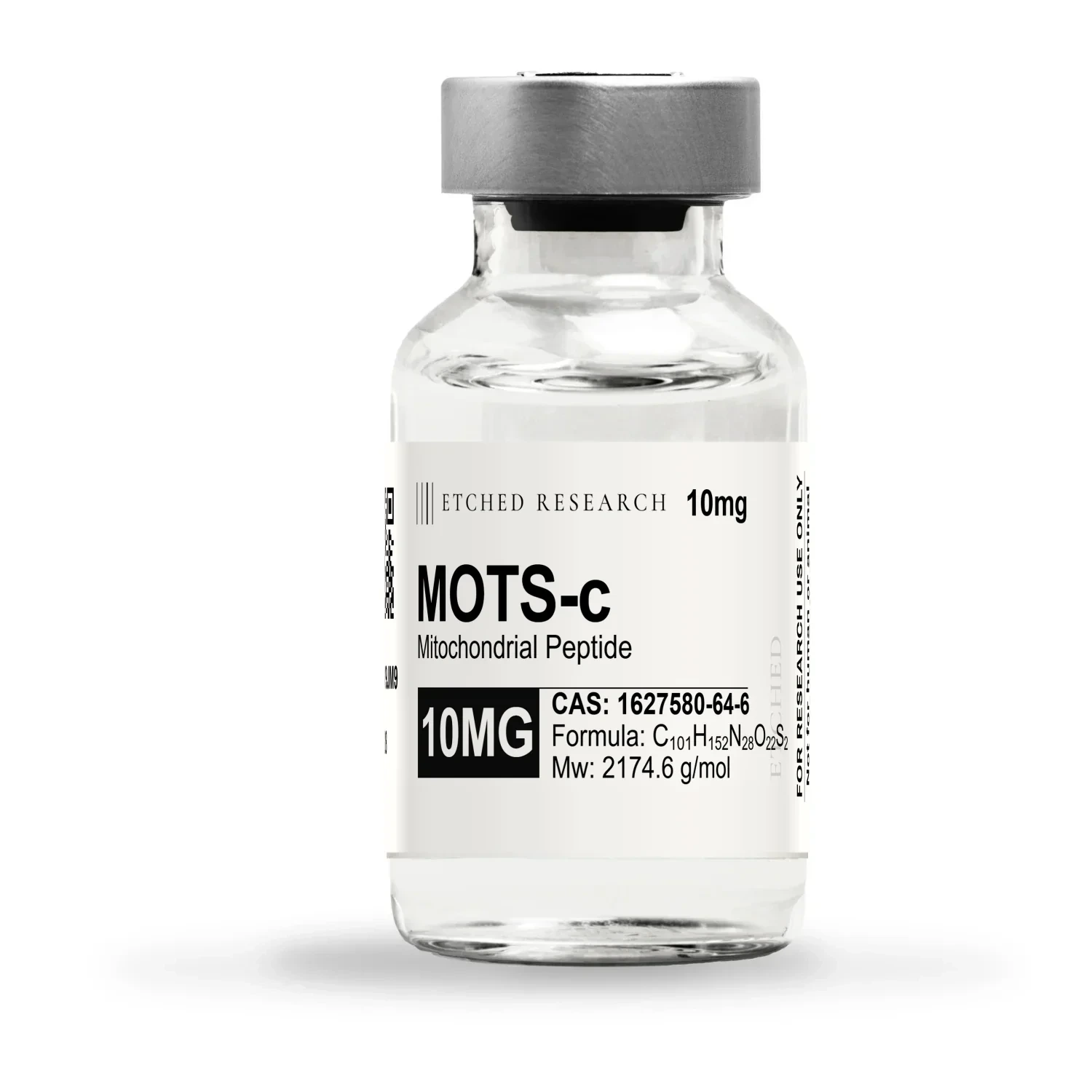
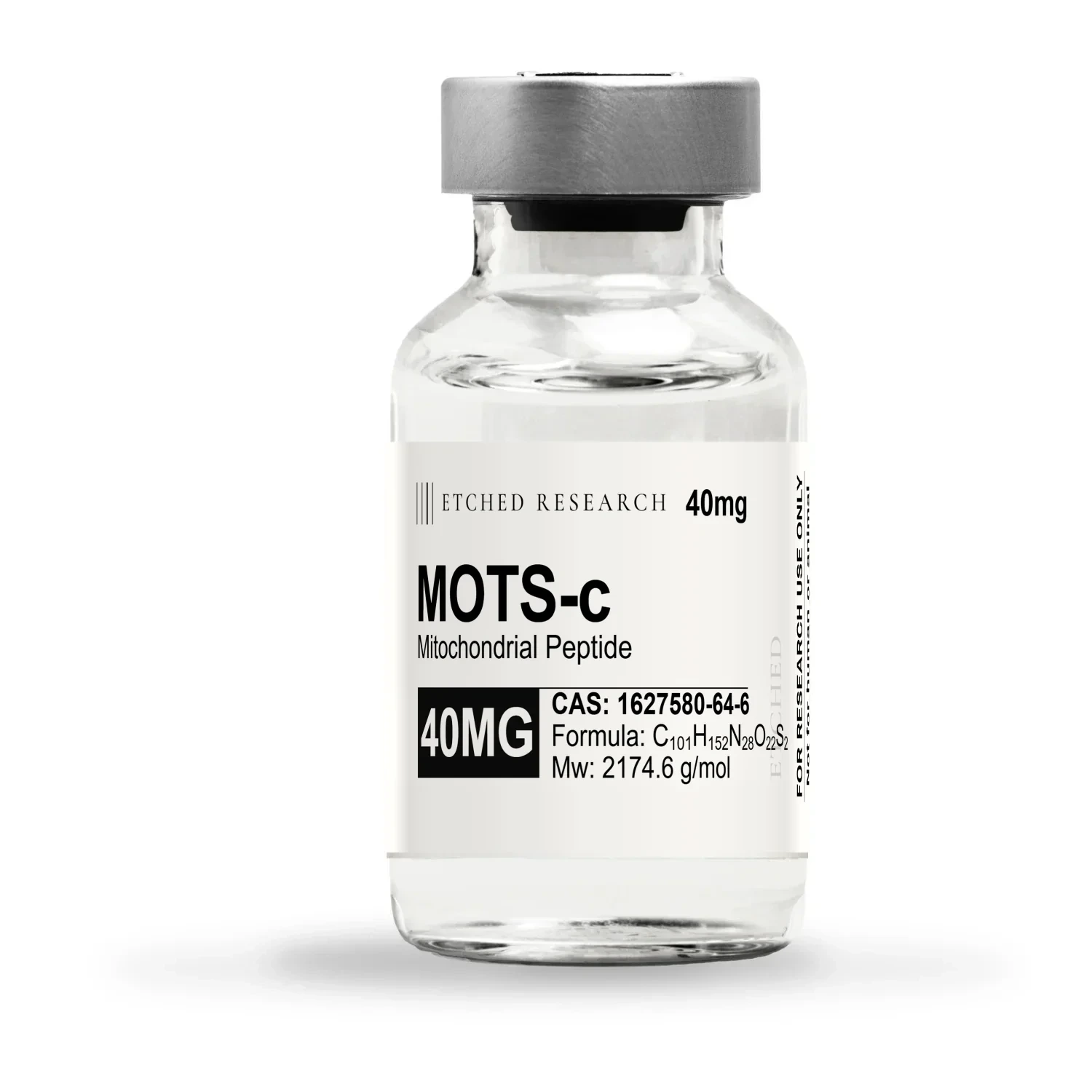
Specs at a glance. Reference values for the compound named on the label, from PubChem or KEGG. They describe the compound, not a measurement of the vial you receive. Molecular weight is the free base (the peptide alone, without a salt). Synthetic peptides are usually supplied as a salt such as acetate or TFA, and the salt in this vial has not been confirmed.
| Compound | MOTS-c |
|---|---|
| Sequence | MRWQEMGYIFYPRKLR (Met-Arg-Trp-Gln-Glu-Met-Gly-Tyr-Ile-Phe-Tyr-Pro-Arg-Lys-Leu-Arg) |
| Molecular formula | C101H152N28O22S2 |
| Molecular weight | 2174.6 g/mol (average, free base) |
| CAS number | 1627580-64-6 |
| Reference record | PubChem CID 146675088 |
| Form | Lyophilized (freeze-dried) powder in one sealed vial |
| Vial sizes | 10 mg or 40 mg per vial |
| Storage (dry powder) | -20°C or colder, long term. Keep the vial sealed and away from light. |
| Lab report | 10 mg: Janoshik Analytical, November 2025. Ordered by the supplier, not by Etched Research. The report carries no lot number, so it is not matched to the vial you receive. 40 mg: no lab report on file. The 10 mg result does not cover it. |
What the evidence is
Almost all MOTS-c research is in mice and cells. No controlled human trial of MOTS-c has been published. The human studies measured the body’s own MOTS-c, not a dose given to people.
| Study | Type | Who or what | What was given | What it measured | What it found |
|---|---|---|---|---|---|
| Lee et al., Cell Metabolism, 2015 | Cell and animal | Cultured cells, and mice that were older or on a high-fat diet | Dose not stated in the abstract | Insulin sensitivity, weight gain on a high-fat diet, and the pathway involved | Treated mice were protected from the insulin resistance seen with age and a high-fat diet, and from diet-induced obesity. The main target looked like skeletal muscle, working through AMPK |
| Ming et al., Biochemical and Biophysical Research Communications, 2016 | Animal | Mice with ovaries removed, a model of bone loss after menopause | 5 mg/kg once a day for 12 weeks | Bone loss on micro-CT scans, and the formation of bone-resorbing cells | Less bone loss in treated mice. Blocking AMPK only partly cancelled the effect on bone-resorbing cells |
| Kim et al., Physiological Reports, 2019 | Animal | Mice made obese on a high-fat diet | Dose not stated in the abstract | Blood metabolites and insulin sensitivity | Three metabolic pathways that run high in obesity and diabetes models were lower. The authors reported better insulin sensitivity and lower body weight and fatty liver |
| Reynolds et al., Nature Communications, 2021 | Animal, plus human samples | Young, middle-aged and old mice. Muscle and blood from people who exercised | Mice only. Old mice were treated 3 times a week starting late in life | Physical performance in mice, and natural MOTS-c after exercise in people | Better physical performance in mice at all three ages. In people, exercise raised natural MOTS-c in muscle and blood. No peptide was given to people |
| von Walden et al., Journal of Applied Physiology, 2021 | Human, randomized, exercise only | 30 people split into endurance exercise, resistance exercise or no exercise | No MOTS-c was given | Natural MOTS-c and humanin in blood and muscle after one session | MOTS-c showed only a trend to rise after endurance exercise. A related peptide, humanin, rose clearly. Blood levels were not linked to fitness |
Last reviewed 2026-09-24. Three of these five studies come from the University of Southern California group that first described MOTS-c, and authors of two of them report being consultants and shareholders of CohBar Inc. The mechanism work behind these studies, and what none of it establishes, is on the full research summary →
Lab reference
Janoshik Analytical tested MOTS-c 10mg from supplier stock on 24 November 2025. Two vials measured 99.278% and 99.706% purity, and 10.74 mg and 10.96 mg of peptide against the 10 mg label. See it on the lab reference page →
The 40mg size has no lab report. No test of MOTS-c 40mg is on file, and the 10mg result above does not cover it.
What that report does not cover: it is a reference test of the 10mg size from supplier stock, not a test of the vial in your order. It did not test for endotoxin, sterility or heavy metals.
Storage and shipping
Ships as lyophilized powder in a sealed vial. Store the powder frozen at -20°C. US addresses only. Shipping costs and cutoff times →
Questions about MOTS-c
What is MOTS-c?
MOTS-c is a 16-amino-acid peptide encoded by mitochondrial DNA, inside the gene for 12S ribosomal RNA. Its research is almost all mouse and cell work on metabolism and AMPK signaling in muscle, starting with the paper that named it (Lee et al., Cell Metabolism, 2015).
Has MOTS-c been tested in humans, and is it FDA approved?
No controlled human trial has given MOTS-c to people, and MOTS-c is not an approved drug in the United States. Human studies so far measured the body’s own MOTS-c in blood and muscle, for example after exercise (von Walden et al., Journal of Applied Physiology, 2021). Drugs@FDA lists no product containing it.
Where can I buy MOTS-c for research?
Etched Research sells MOTS-c on this page in 10mg and 40mg vials of lyophilized powder, for laboratory research use only, shipped to US addresses. Janoshik Analytical tested the 10mg size from supplier stock on 24 November 2025. No lab report is on file for the 40mg size, and the 10mg result does not cover it.
What does MOTS-c stand for?
Mitochondrial open reading frame of the 12S rRNA-c. An open reading frame is a stretch of DNA that can be read to build a protein or peptide. This one sits inside the mitochondrial gene for 12S ribosomal RNA, which is where the name comes from.
Shipping, eligibility and what comes in the box: store FAQ →
For research use only. Not for human consumption.