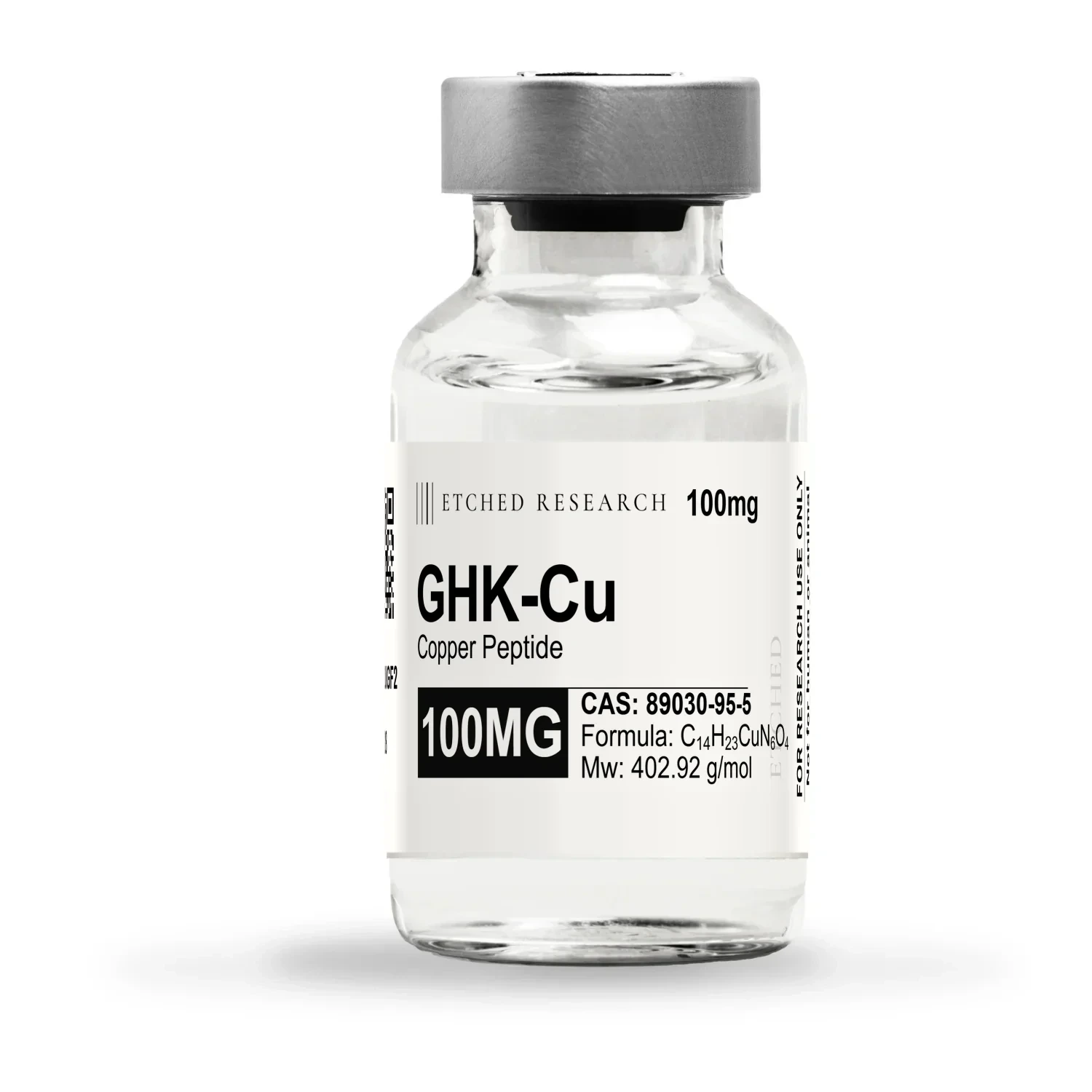
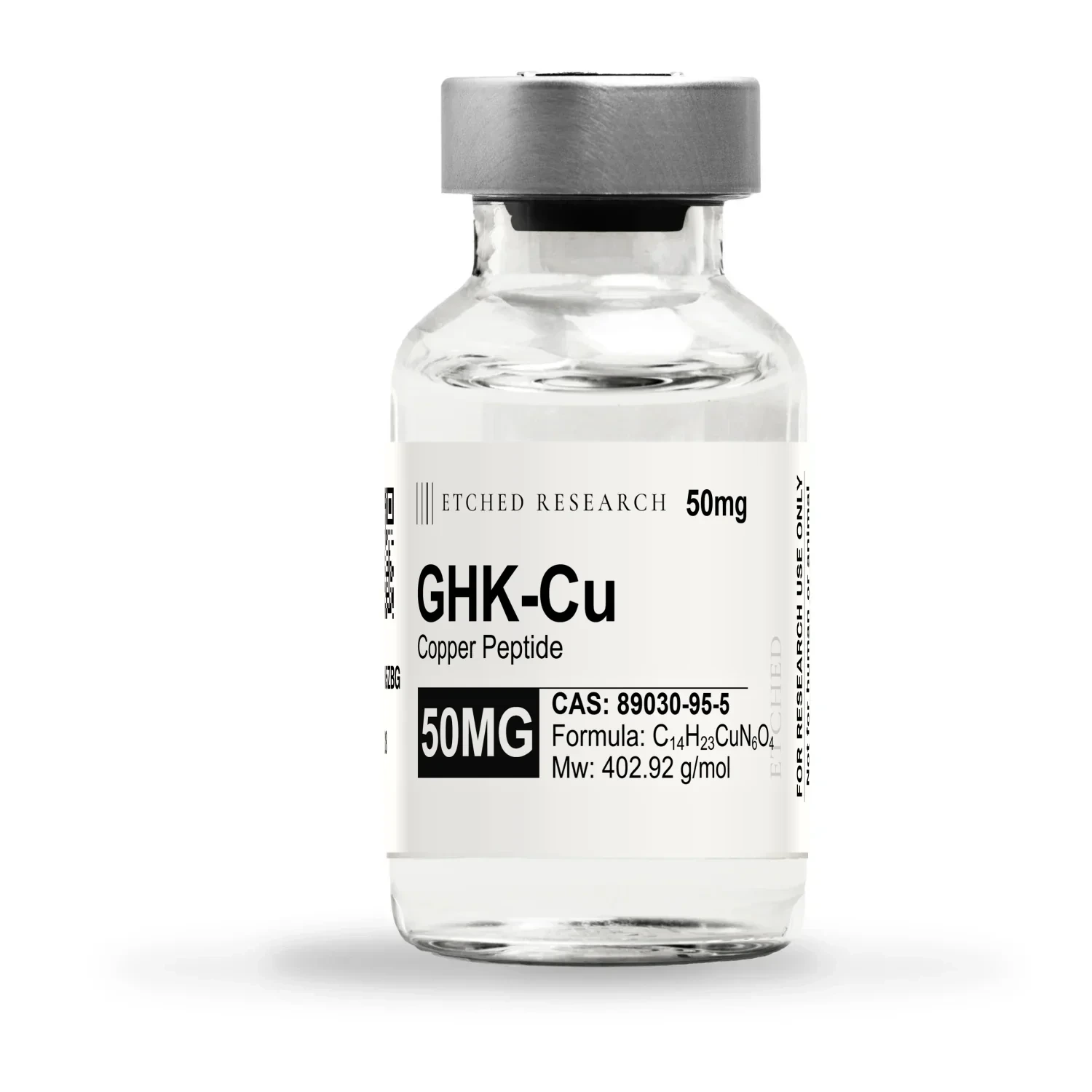
- What it is: The copper-binding tripeptide Gly-His-Lys, three amino acids bound to a copper ion.
- Research areas: how copper-peptide biology drives matrix remodeling, growth-factor output, and gene expression in cell and animal models.
- Evidence level: Mostly preclinical (isolated cells and short animal work). Two published ulcer trials in people, from 1992 and 1994, split: one positive, one no different from placebo. A newer wound-repair trial is registered but still recruiting.
- The short version: Most of what researchers know about GHK-Cu comes from cells in a dish and short animal studies of copper-peptide biology. They frame it as a modulator of tissue remodeling, but the human case is not settled. This is a summary of research, not a reason to use anything.
What it is
GHK-Cu is the tripeptide glycyl-L-histidyl-L-lysine (GHK) bound to a copper(II) ion. GHK occurs naturally and was first isolated from human plasma. PubChem lists the peptide and its copper complex as two separate records, and both are shown below.
Specs at a glance. Reference values for the compound named on the label, from PubChem or KEGG. They describe the compound, not a measurement of the vial you receive. Molecular weight is shown for the copper complex first, then for the GHK peptide alone without copper. Neither figure includes a salt, and the salt in this vial has not been confirmed.
| Compound | GHK-Cu (copper complex of Gly-His-Lys) |
|---|---|
| Sequence | Gly-His-Lys, copper(II) complex (GHK) |
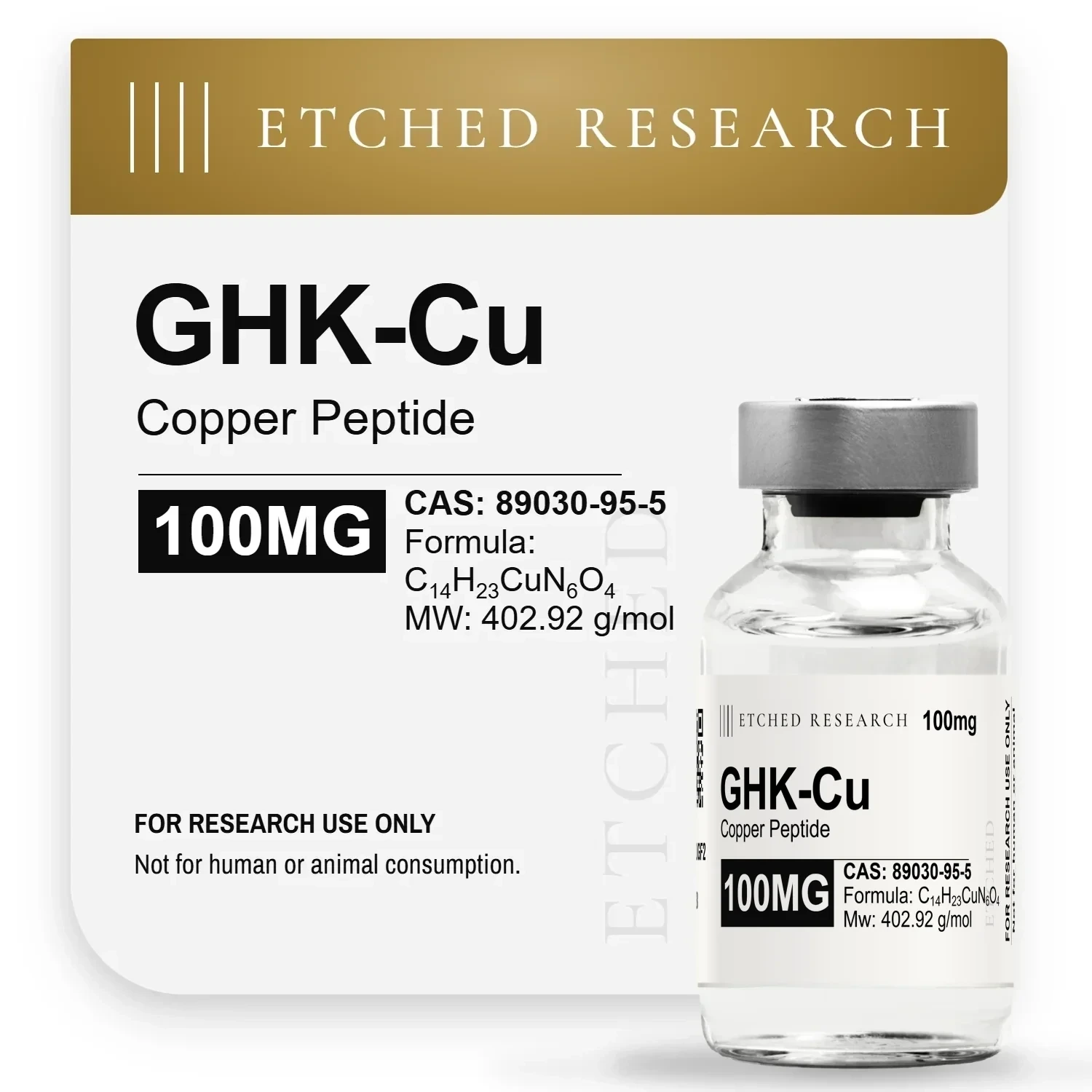
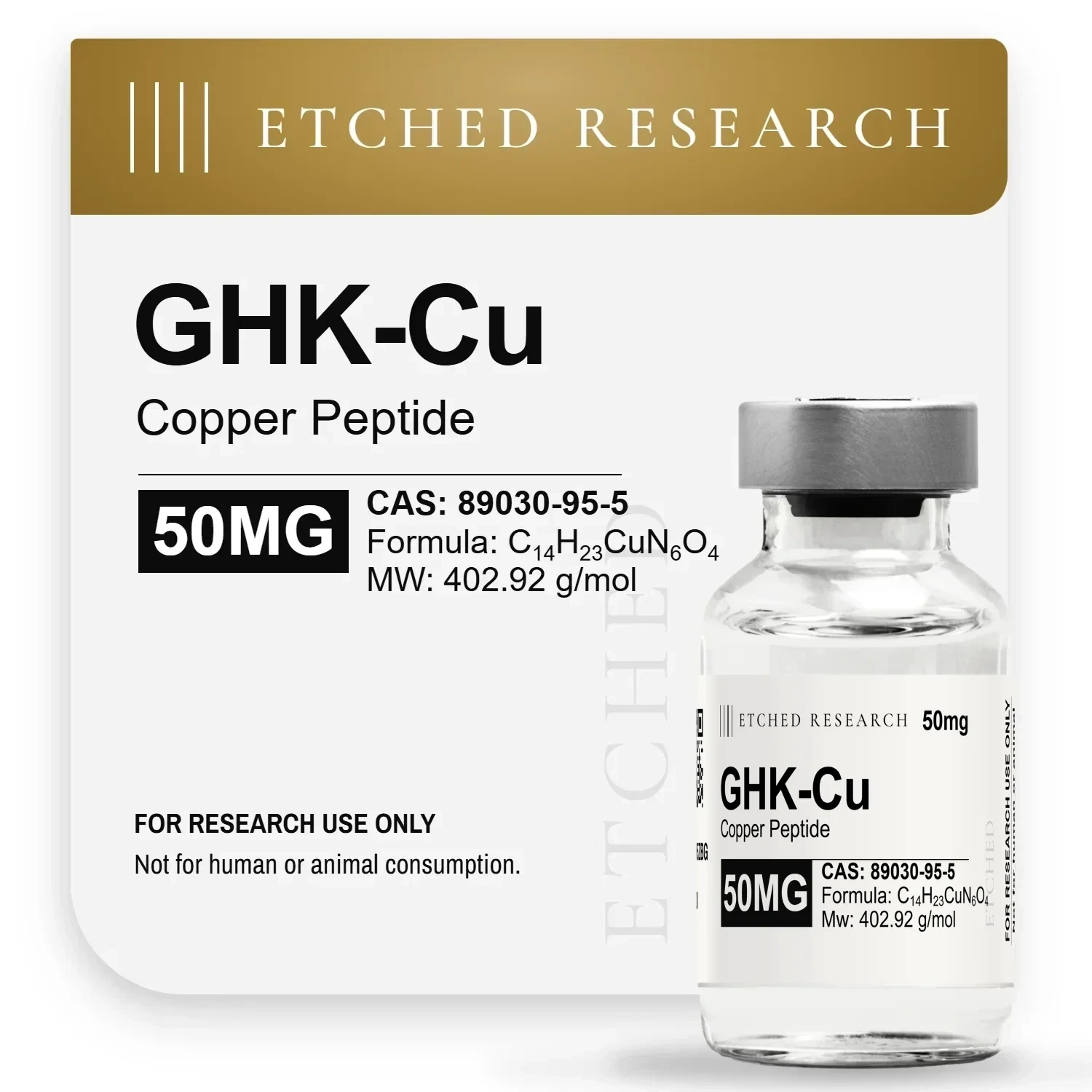
| Molecular formula | C14H23CuN6O4+ (copper complex). GHK alone: C14H24N6O4 |
| Molecular weight | 402.92 g/mol (copper complex). GHK alone: 340.38 |
| CAS number | 89030-95-5 (copper complex) |
| Reference record | PubChem CID 71587328 (copper complex). PubChem CID 73587 (GHK alone) |
| Form | Lyophilized (freeze-dried) powder in one sealed vial |
| Vial sizes | 50 mg or 100 mg per vial |
| Storage (dry powder) | -20°C or colder, long term. Keep the vial sealed and away from light. |
| Lab report | Janoshik Analytical, November 2025 and August 2026. Ordered by the supplier, not by Etched Research. The report carries no lot number, so it is not matched to the vial you receive. Whether the label’s milligrams count the copper complex or the peptide alone is not yet confirmed, so the measured content is shown both ways on the lab reports page. Results on this page ↓ · All lab reports → |
What the evidence is
Most GHK-Cu evidence is cell and short animal work. Two human trials have been published, both on chronic ulcers in the early 1990s, and they split: one positive, one no different from placebo. A newer Phase 2 wound trial (NCT07437586) is registered and recruiting, with no results yet.
| Study | Type | Who or what | What was given | What it measured | What it found |
|---|---|---|---|---|---|
| Maquart et al., FEBS Letters, 1988 | Cell | Cultured fibroblasts, the cells that build connective tissue | GHK-Cu added to the culture across a range of concentrations | Collagen made by the cells | Collagen output rose starting at very low (picomolar) concentrations and peaked at 1 nanomolar. The rise was not explained by a change in cell number |
| Maquart et al., Journal of Clinical Investigation, 1993 | Animal | Rats with small wire-mesh wound chambers implanted in the back | Repeated injections of GHK-Cu at several concentrations into the chamber, against saline | Dry weight, collagen, total protein, DNA, glycosaminoglycans, collagen and TGF-beta mRNA | All rose with concentration. Type I and III collagen mRNA went up, TGF-beta mRNA did not. A control tripeptide had no significant effect |
| Bishop et al., Journal of Vascular Surgery, 1992 | Human, randomized, evaluator-blinded | 86 evaluable patients with venous leg ulcers | A 0.4% tripeptide-copper complex cream, silver sulfadiazine cream, or a placebo cream | Ulcer size | The copper-peptide cream was no different from placebo. Silver sulfadiazine did better than both |
| Mulder et al., Wound Repair and Regeneration, 1994 | Human, multicenter, randomized, evaluator-blinded, placebo-controlled | People with diabetes and nerve-related foot ulcers, all on the same standardized wound care | A GHK-Cu gel applied daily, against the same gel without GHK-Cu | Ulcer closure | Median closure of ulcers on the sole of the foot was 98.5% against 60.8% on the plain gel. The abstract does not give the number of patients |
| Siméon et al., Life Sciences, 2000 | Cell | Cultured fibroblasts | GHK-Cu, copper ions alone, or GHK alone | MMP-2 (an enzyme that reshapes the matrix), its mRNA, TIMP-1 and TIMP-2 | GHK-Cu raised MMP-2, its mRNA, and both TIMPs. Copper alone reproduced the MMP-2 rise. GHK alone did not |
| Pollard et al., Archives of Facial Plastic Surgery, 2005 | Cell | Human fibroblasts, normal and from patients who had radiation therapy | GHK-Cu at 1 nanomolar in serum-free culture | Doubling time, bFGF, TGF-beta1 and VEGF output | Treated cells of both kinds doubled faster than untreated ones. Treated irradiated cells made more bFGF and VEGF early after exposure |
Last reviewed 2026-09-24. Both human trials used a topical gel or cream on chronic ulcers, and the 1992 abstract names the compound only as a tripeptide-copper complex (PubMed indexes it as glycyl-histidyl-lysine). The reviews, the mechanism, and what none of this establishes are on the full research summary →
Lab reference
Janoshik Analytical has tested both sizes from supplier stock. Each result covers only the size named.
- 100mg, tested 24 November 2025. Two vials measured 99.868% and 99.756% purity, and 98.26 mg and 102.54 mg of GHK-Cu against the 100 mg label.
- 50mg, tested 18 August 2026. One vial measured 99.875% purity and 53.02 mg of GHK-Cu against the 50 mg label. Of that, 44.77 mg was GHK and 8.25 mg was copper.
See them on the lab reference page →
What those reports do not cover: they are reference tests of the compound from supplier stock, not tests of the vial in your order. The 50mg report names a supplier batch that has not been matched to a lot Etched Research holds. Neither tested for endotoxin, sterility or heavy metals.
Storage and shipping
Ships as lyophilized powder in a sealed vial. Store the powder frozen at -20°C. US addresses only. Shipping costs and cutoff times →
Questions about GHK-Cu
What is GHK-Cu?
GHK-Cu is the tripeptide glycyl-L-histidyl-L-lysine (GHK) bound to a copper(II) ion. GHK was first isolated from human plasma, and most GHK-Cu research is cell and short animal work on collagen and matrix remodeling (Maquart et al., FEBS Letters, 1988).
What is the difference between the GHK-Cu 50mg vial and the 100mg vial?
The only difference is the amount of powder: 50mg or 100mg of GHK-Cu in one vial. Both sizes are the same compound in the same lyophilized form, and each size has its own dated Janoshik result on the lab reference page.
Has GHK-Cu been tested in humans, and is it FDA approved?
Two small human trials of GHK-Cu have been published, both on chronic ulcers in the early 1990s, and we found no drug approval for GHK-Cu anywhere. A foot ulcer trial reported faster closure than a plain gel (Mulder et al., Wound Repair and Regeneration, 1994), and a venous leg ulcer trial found no difference from placebo (Bishop et al., Journal of Vascular Surgery, 1992). The FDA lists GHK-Cu for injectable routes among bulk substances that may present significant safety risks in compounding.
Where can I buy GHK-Cu for research?
Etched Research sells GHK-Cu on this page in 50mg and 100mg vials of lyophilized powder, for laboratory research use only, shipped to US addresses. Where an independent laboratory report exists for a compound, the measurements are published on the lab reference page, including the compounds we hold no report for.
Is GHK-Cu the same as GHK?
Not quite. GHK is the three-amino-acid peptide on its own. GHK-Cu is GHK bound to a copper ion, and it is what this product is named for. PubChem keeps them as separate records, both in the table above. The difference matters in the research: in one cell study, copper alone reproduced the effect of GHK-Cu on MMP-2 and GHK alone did not.
Shipping, eligibility and what comes in the box: store FAQ →
For research use only. Not for human consumption.