
Research-grade material. A Janoshik report for this compound is available on request. For research use only.
Research-grade material. A Janoshik report for this compound is available on request. For research use only.
A research peptide and a recombinant protein can both be described as chains of amino acids supplied as a lyophilized powder. How each one got into the vial is entirely different. One was assembled by chemistry, residue by residue, on a solid support. The other was produced by living cells instructed to build it. That difference shapes the achievable length, the impurity profile, the analytical methods that apply, and what a specification sheet can meaningfully report.
The two routes, in one paragraph each
Solid-phase peptide synthesis anchors the first amino acid to an insoluble resin bead and adds the next residue in a repeating cycle of coupling and deprotection. The chain grows in a defined order determined by the chemist. When the sequence is complete it is cleaved from the resin and purified. The method dates to the 1960s and remains the standard route for short sequences.
Recombinant expression inserts a gene encoding the target sequence into a host organism, commonly a bacterium or a yeast, and lets the host’s own ribosomes build the chain. The product is then harvested from the culture and purified away from everything else the cell made. This is the standard route for proteins, and for anything long enough that stepwise chemistry becomes impractical.
Where the length limit comes from
Each coupling step in solid-phase synthesis is efficient but not perfect. A small fraction of chains fail to extend at each cycle, and those failures accumulate multiplicatively across the sequence.
The arithmetic is unforgiving. Even at the high per-step coupling efficiency modern synthesis achieves, the losses compound multiplicatively. A 30-residue sequence finishes with roughly three quarters of chains intact. By 50 residues that falls to around three fifths. By 100 residues fewer than two in five are the full-length target. The remainder are truncated chains missing one or more residues, and because they are chemically similar to the target they are the hardest impurities to separate.
This is the practical reason short sequences are made by chemistry and long ones are not. The peptides in ordinary laboratory use sit well inside that range: BPC-157 is fifteen residues and GHK-Cu is three. Biology does not have this problem, because a ribosome that starts a chain generally finishes it.
Different routes produce different impurities
The distinction matters more than the manufacturing detail suggests, because the two routes fail in opposite ways.
Synthetic material carries sequence-related impurities. Deletion sequences missing a residue. Truncated chains. Products of incomplete removal of the protecting groups used during assembly. Residual solvents and scavengers from the cleavage step. Counterion from the purification, commonly trifluoroacetate, which contributes real mass to the powder without being peptide.
Recombinant material carries host-derived impurities. Host cell proteins. Residual DNA. And, when the host is a Gram-negative bacterium, endotoxin from the cell wall, which is why endotoxin testing is a standing concern for that route in a way it is not for pure chemistry.
Neither profile is inherently cleaner. They are different problems requiring different tests.
What this means for reading a specification
A purity figure from reversed-phase HPLC reports the proportion of UV-absorbing, peptide-related material eluting as the main peak. For synthetic material this is a meaningful and well-matched measure, because the impurities it is looking for are the sequence-related ones the method separates well.
It does not, on its own, tell you three other things:
Identity. That the main peak is the intended sequence and not a closely eluting variant is established by mass spectrometry, not by the purity number.
Net peptide content. How much of the vial’s mass is peptide, as opposed to water and counterion, is a separate measurement. A powder can be high-purity and still be a smaller quantity of peptide than the label weight implies, because purity is a ratio and content is a mass.
Anything non-peptide. Endotoxin, microbial burden and residual solvents do not appear in a purity chromatogram. They are separate assays and a report that does not include them is not silent because the result was good.
Where an independent laboratory report exists for a compound, the measurements are published on the COA page, including the compounds we hold no report for.
Side by side
| Synthetic peptide | Recombinant protein | |
|---|---|---|
| Built by | Stepwise chemistry on a resin | Host cell ribosomes |
| Typical length | Short, commonly under 50 residues | Long, often hundreds |
| Sequence control | Defined by the chemist at each step | Defined by the inserted gene |
| Characteristic impurities | Deletions, truncations, solvents, counterion | Host cell protein, residual DNA, endotoxin |
| Non-standard residues | Straightforward to incorporate | Requires engineered systems |
| Core analytical methods | RP-HPLC, mass spectrometry | Electrophoresis, immunoassay, bioassay |
Frequently asked questions
Can a synthetic peptide contain amino acids that biology does not use?
Yes, and this is one of the clearest advantages of the chemical route. The chemist selects each residue, so non-canonical amino acids are incorporated as readily as standard ones. A recombinant system is limited to what the host’s machinery can build unless it has been specifically engineered.
Why does trifluoroacetate matter?
It is a counterion carried over from purification and it contributes mass to the finished powder. Two vials of identical peptide purity can hold different quantities of actual peptide if their counterion content differs, which is why net peptide content is measured separately from purity.
Is endotoxin a concern for synthetic material?
The characteristic source of endotoxin is the Gram-negative bacterial cell wall, which is a feature of the recombinant route rather than the chemical one. That does not make a synthetic product endotoxin-free by definition, because contamination can be introduced at other points. It means the risk arises somewhere other than the synthesis itself. Endotoxin is a separate assay either way, and a material carries no endotoxin result unless one was specifically commissioned. Etched holds no endotoxin data for any compound and does not present the synthesis route as a substitute for that test.
Which route produces a better research material?
Neither, as a general statement. They suit different sequence lengths and different research questions, and the useful comparison is between a specific material’s documentation and what the research design actually requires.
Etched Research supplies lyophilized research compounds for laboratory use. More compound background is in the research library, and the full catalog is at the shop.
For research use only. Not for human or veterinary use.
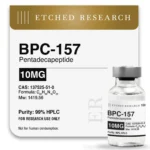
Research-grade material. A Janoshik report for this compound is available on request. For research use only.
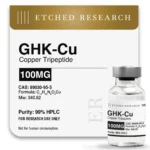
Research-grade material. A Janoshik report for this compound is available on request. For research use only.
For Research Use Only. Not for human consumption. Etched Research supplies compounds for laboratory and research use only. Nothing on this page is medical advice, a health claim, or a recommendation to use.