- What it is: A small-molecule inhibitor of the enzyme NNMT (not a peptide).
- Research areas: body weight and fat mass in diet-induced obese mice, alone and combined with a reduced-calorie diet, plus muscle repair and strength in aged mice.
- Evidence level: Real animal data, no human trials. A handful of published mouse studies, all from one research group.
- The short version: 5-Amino-1MQ has real, published mouse data showing reduced body weight and fat mass in obesity models. None of it is human data.
What it is
5-Amino-1MQ is a small molecule, not a peptide. Its full name is 5-amino-1-methylquinolinium. It is a quinolinium compound that carries a permanent positive charge, so it is usually listed with a counter-ion, most often as the iodide salt. It was developed by a research group at the University of Texas Medical Branch as an inhibitor of the enzyme nicotinamide N-methyltransferase (NNMT).
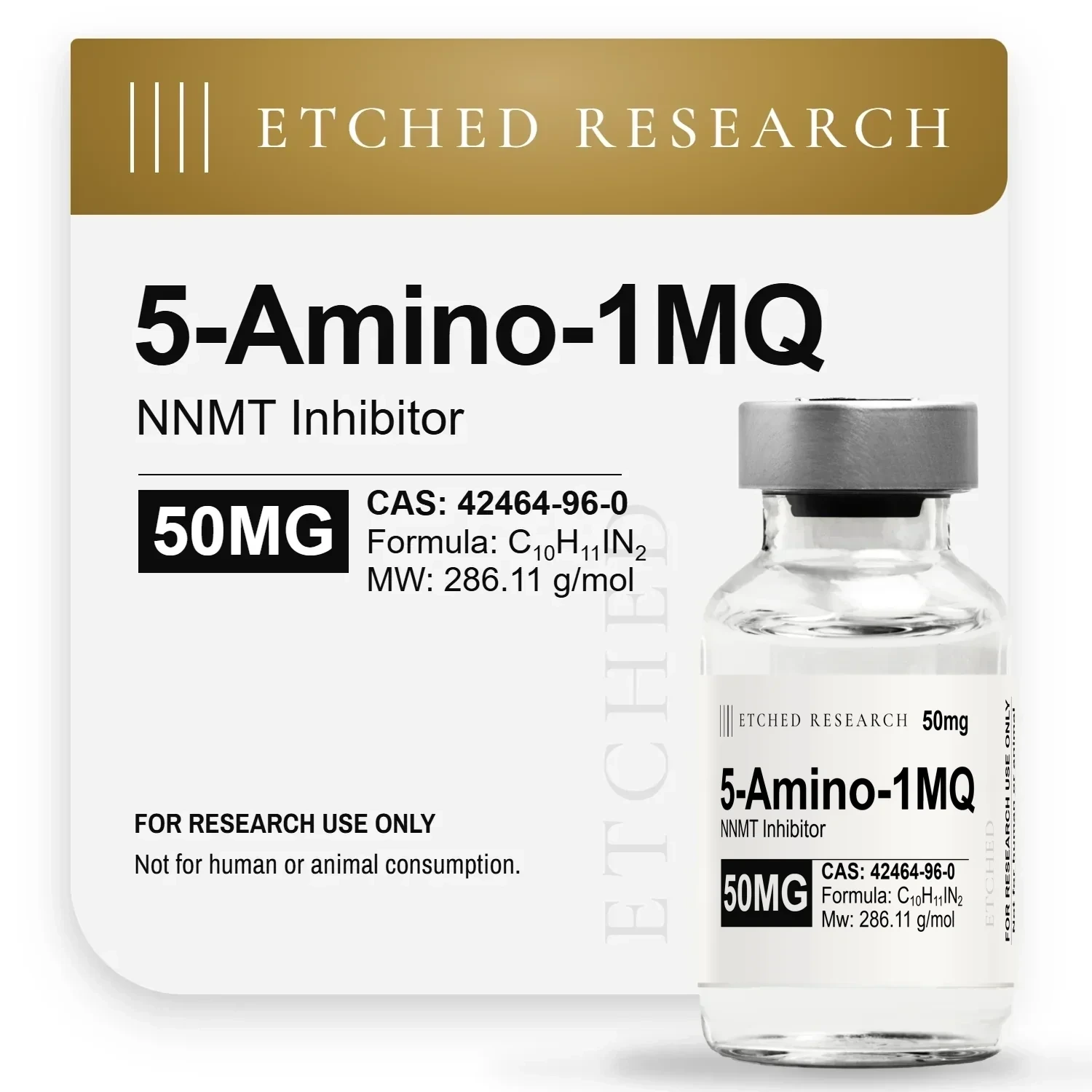
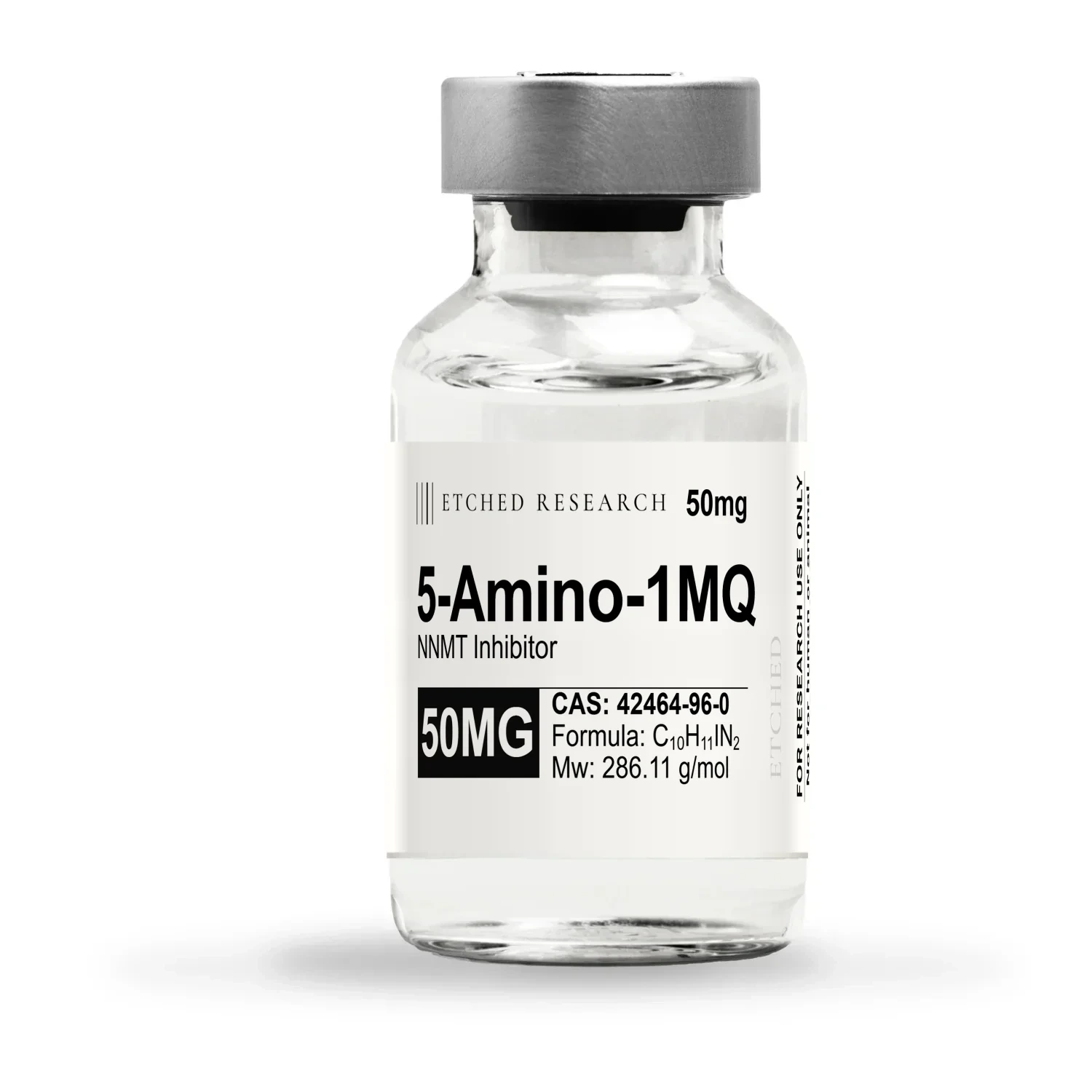
Specs at a glance. Reference values for the compound named on the label, from PubChem or KEGG. They describe the compound, not a measurement of the vial you receive. The salt in this vial has not been confirmed, so both the charged compound and its iodide salt are shown.
| Compound | 5-Amino-1MQ (5-amino-1-methylquinolinium), small molecule, not a peptide |
|---|---|
| Sequence | Not a peptide. Small molecule. |
| Molecular formula | C10H11N2+ (the charged compound). As the iodide salt: C10H11IN2. The salt in this vial has not been confirmed. |
| Molecular weight | 159.21 g/mol (the charged compound). As the iodide salt: 286.11 g/mol. |
| CAS number | Not confirmed for this vial. The iodide salt is CAS 42464-96-0. |
| Reference record | PubChem CID 66522933 (iodide salt). PubChem CID 950107 (the charged compound) |
| Form | Lyophilized (freeze-dried) powder in one sealed vial |
| Vial size | 50 mg per vial |
| Storage (dry powder) | -20°C or colder, long term. Keep the vial sealed and away from light. |
| Lab report | No lab report on file for this compound. All lab reports → |
What the evidence is
The published in-body research on 5-Amino-1MQ is in mice, from one research group, plus one pharmacokinetic study in rats (Awosemo et al., 2021). We found no human trial published on PubMed or registered on ClinicalTrials.gov.
| Study | Type | Who or what | What was given | What it measured | What it found |
|---|---|---|---|---|---|
| Neelakantan et al., Biochemical Pharmacology, 2018 | Animal, plus fat-cell work in the lab | 18 male mice made obese on a high-fat diet (9 treated, 9 untreated) | 20 mg/kg three times a day for 11 days | Body weight, white fat mass, fat cell size, blood cholesterol, food intake | Treated mice lost about 5.1% of body weight while untreated mice gained about 1.4%. In the treated mice, white fat mass was about 35% lower, fat cells were over 30% smaller and total cholesterol was about 30% lower. Food intake did not change |
| Sampson et al., Scientific Reports, 2021 | Animal | Obese male mice switched to a low-fat diet, with or without 5-Amino-1MQ (8 treated) | Daily for 45 days | Body weight, fat and lean mass, liver fat | Mice given the compound plus the diet switch lost 6.3 g against 2.9 g for mice on the diet switch alone, and about 29% of fat mass against about 3%. Their body composition and liver fat reached the levels of lean control mice. The compound was not tested without the diet switch |
| Babula et al., Diabetes, Obesity and Metabolism, 2024 | Animal | Obese male mice kept on a high-fat diet (8 per group) | 10 or 32 mg/kg once a day for 28 days | Weight and fat gain, glucose tolerance, insulin, liver | At 32 mg/kg, mice gained 0.9 g of body weight against 5.4 g for untreated mice, and 1.3 g of fat against 4.7 g. Mice on 10 mg/kg gained 5.2 g, close to untreated. The higher dose also lowered liver weight and liver fat and improved glucose tolerance. Lean mass and food intake did not change |
| Neelakantan et al., Biochemical Pharmacology, 2019 | Animal | 24-month-old male mice with an injured leg muscle | 5 or 10 mg/kg twice a day for 1 or 3 weeks | Muscle stem cell activity, muscle fiber size, muscle strength | In treated mice, repairing muscle fibers were nearly twice as large in cross-section, and peak strength of the injured muscle was about 70% higher than in untreated mice |
| Dimet-Wiley et al., Scientific Reports, 2024 | Animal | 35 female mice aged 22 months, with or without an exercise program | 10 mg/kg for 8 weeks | Grip strength, running, muscle mass, muscle fiber size | Treated sedentary mice had about 40% more grip strength than untreated sedentary mice, and treated exercised mice about 60% more. The compound alone did not increase muscle mass or fiber size |
Last reviewed 2026-09-24. The same scientist is an author on every study above, and staff of Ridgeline Therapeutics, a company he founded, are authors on the 2021 and both 2024 studies. How it works, and what none of this establishes, is on the full research summary →
Storage and shipping
This product is on pre-order. It ships as lyophilized powder in a sealed vial. Store the powder frozen at -20°C. US addresses only. Shipping costs and cutoff times →
Questions about 5-Amino-1MQ
Is 5-Amino-1MQ a peptide?
No. It is a small molecule with 10 carbon atoms, built on a quinoline ring. Peptides are chains of amino acids. 5-Amino-1MQ has none. It is often sold alongside peptides, which is where the mix-up comes from.
Why are there two molecular weights?
The active part is a charged ion (the cation), which weighs 159.21 g/mol. It is normally made and listed as a salt with iodide, which weighs 286.11 g/mol. The CAS number 42464-96-0 and PubChem CID 66522933 refer to the iodide salt. The 2018 and 2024 obesity papers name the compound but do not state which salt they used. The salt in this vial has not been confirmed either.
Is there human data?
No. All the studies above were in mice, and we found no human trial published or registered. The mouse results are real, but mouse obesity and aging studies do not reliably predict what happens in people.
Is there a lab report for 5-Amino-1MQ?
Not yet. No independent lab report is on file for this compound. When one is, it will be listed on the lab reference page.
Shipping, eligibility and what comes in the box: store FAQ →
For research use only. Not for human consumption.