- What it is: A peptide engineered from erythropoietin to act at the innate repair receptor without EPO’s effect on red blood cells.
- Research areas: sarcoidosis-associated small fiber neuropathy in three placebo-controlled human trials, smaller human trials in type 2 diabetes and diabetic eye disease, plus mechanism work in nerve-injury, inflammation and wound-healing research models.
- Evidence level: Real human trial data exists, all of it small and short, and most of it in one rare-disease population. ClinicalTrials.gov lists no trial beyond phase 2.
- The short version: ARA-290 has real, published human trial data behind it, which is genuinely uncommon in this category. That data is narrow, small groups followed for four to twelve weeks, mostly one disease population, and a development program that never reached a phase 3 trial.
What it is
ARA-290 is a synthetic peptide made of 11 amino acids. Its generic drug name is cibinetide. It copies the outer face of one region of erythropoietin (EPO), called helix B. It was first described in 2008 by a team led by Michael Brines and Anthony Cerami.
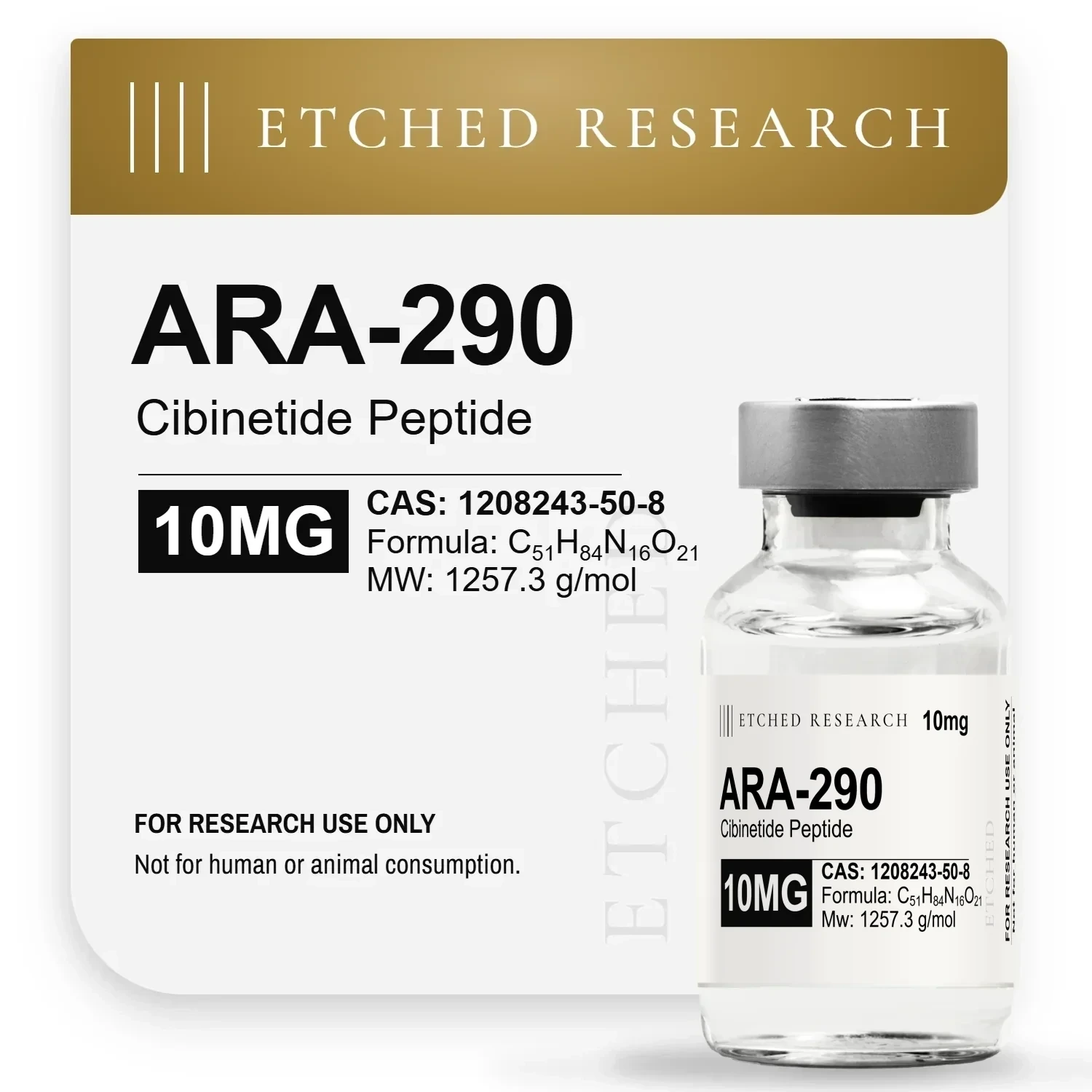
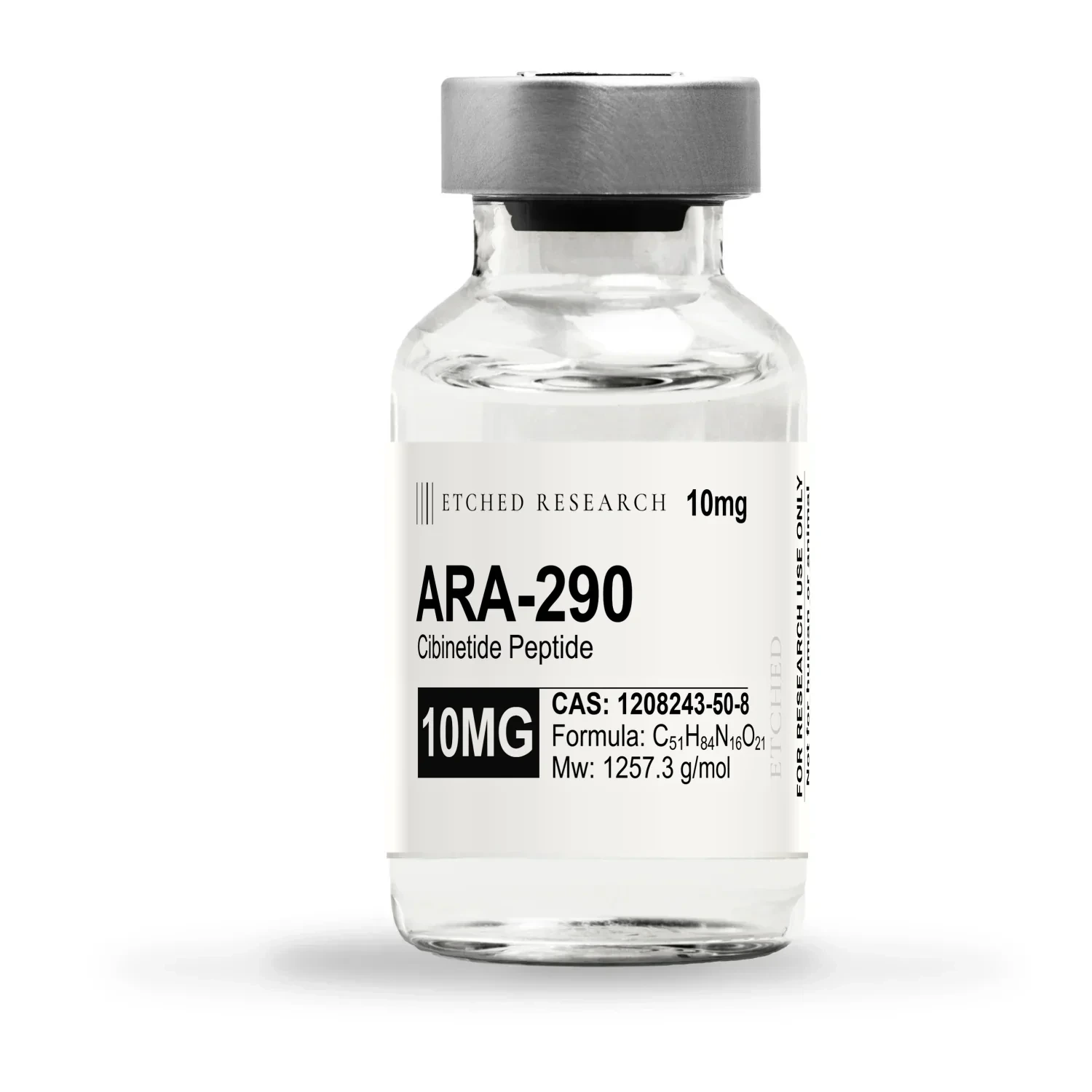
Specs at a glance. Reference values for the compound named on the label, from PubChem or KEGG. They describe the compound, not a measurement of the vial you receive. Molecular weight is the free base (the peptide alone, without a salt). Synthetic peptides are usually supplied as a salt such as acetate or TFA, and the salt in this vial has not been confirmed.
| Compound | ARA-290 (cibinetide) |
|---|---|
| Sequence | pGlu-Glu-Gln-Leu-Glu-Arg-Ala-Leu-Asn-Ser-Ser (11 aa) |
| Molecular formula | C51H84N16O21 |
| Molecular weight | 1257.3 g/mol (average, free base) |
| CAS number | 1208243-50-8 |
| Reference record | PubChem CID 91810664 |
| Form | Lyophilized (freeze-dried) powder in one sealed vial |
| Vial size | 10 mg per vial |
| Storage (dry powder) | -20°C or colder, long term. Keep the vial sealed and away from light. |
| Lab report | No lab report on file for this compound. All lab reports → |
What the evidence is
ARA-290 has been given to people in a handful of small trials, each four to twelve weeks long, most of them in adults with nerve damage linked to sarcoidosis. The early work behind it was in rodents. No phase 3 trial is registered.
| Study | Type | Who or what | What was given | What it measured | What it found |
|---|---|---|---|---|---|
| Swartjes et al., Anesthesiology, 2011 | Animal | Rats and mice with an injured leg nerve, including mice bred without the CD131 receptor | 30 µg/kg, five doses two days apart, then once a week | Sensitivity to touch and cold | Lower sensitivity in treated rats for up to 15 weeks. No effect in mice without CD131 |
| Heij et al., Molecular Medicine, 2012 | Human, randomized, double-blind, placebo-controlled pilot | 22 adults with sarcoidosis and small fiber neuropathy symptoms | 2 mg three times a week for 4 weeks | A neuropathy symptom score, pain, fatigue, mood and quality of life | The symptom score improved more than placebo. Pain and fatigue improved about equally in both groups. No change in mood |
| Dahan et al., Molecular Medicine, 2013 | Human, blinded, placebo-controlled | 38 adults with sarcoidosis and small nerve fiber loss (21 on ARA-290, 17 on placebo) | 4 mg daily for 28 days | Neuropathy symptoms, nerve fiber density in the cornea, a 6-minute walk test | Improvement reported on symptoms, corneal nerve fiber density and walk distance |
| Brines et al., Molecular Medicine, 2015 | Human, phase 2, placebo-controlled | Adults with type 2 diabetes and painful neuropathy | 4 mg daily for 28 days, then one month of follow-up | HbA1c, blood lipids, neuropathy symptoms, corneal nerve fiber density | HbA1c, lipids and symptoms improved. Nerve fiber density rose only in the subgroup with the lowest starting density |
| Culver et al., Investigative Ophthalmology & Visual Science, 2017 | Human, phase 2b, randomized, placebo-controlled | 64 adults with sarcoidosis-related small nerve fiber loss and nerve pain | 1, 4 or 8 mg a day for 28 days | Main measure: corneal nerve fiber area. Also skin nerve fibers, pain and a 6-minute walk test | Nerve fiber area rose more than placebo at 4 mg only. The 1 mg and 8 mg groups did not reach significance. Pain improved in every group, placebo included |
| Lois et al., Journal of Clinical Medicine, 2020 | Human, phase 2, single group, no placebo | 9 adults with diabetic macular edema (swelling at the back of the eye), 8 finished | 4 mg a day for 12 weeks | Visual acuity, retinal thickness, retinal sensitivity, tear production | No average improvement in vision, retinal thickness, retinal sensitivity or tears. A vision-questionnaire score improved |
Last reviewed 2026-09-24. Staff of Araim Pharmaceuticals, the company developing cibinetide, are authors on the 2013, 2015, 2017 and 2020 trials. More on the mechanism, and what none of it establishes, is on the full research summary →
Storage and shipping
This product is on pre-order. It ships as lyophilized powder in a sealed vial. Store the powder frozen at -20°C. US addresses only. Shipping costs and cutoff times →
Questions about ARA-290
Is ARA-290 the same thing as cibinetide?
Yes. Cibinetide is the generic drug name (INN and USAN) for ARA-290. Papers also call it ARA 290, ARA290 and pHBSP, short for pyroglutamate helix B surface peptide.
Is there human data?
Yes, but it is small. The five patient trials above enrolled between 9 and 64 people and ran four to twelve weeks. The largest found a difference from placebo at one of three doses, and the diabetic eye trial found no average change in vision.
Is ARA-290 an approved drug?
We found no approval anywhere. Its developer announced an FDA orphan drug designation in 2016, which marks a drug in development, not an approved one, and ClinicalTrials.gov lists no cibinetide trial past phase 2. Etched Research sells ARA-290 as a research compound for laboratory use only. It is not for human use.
Is there a lab report for ARA-290?
Not yet. No independent lab report is on file for this compound. When one is, it will be listed on the lab reference page.
Shipping, eligibility and what comes in the box: store FAQ →
For research use only. Not for human consumption.