Semax: What the Research Actually Shows
- What it is: A synthetic 7-amino-acid peptide built from a short fragment of the hormone ACTH.
- Research areas: memory and recovery in stroke models, brain protection after a loss of blood flow (ischemia), and changes in brain gene activity and BDNF (a nerve growth signal).
- Evidence level: Mostly small or Russian-origin studies, plus rat models. The English-language record is thin, and there are no large independent Western trials.
- The short version: Semax has been studied mainly in Russia, where researchers looked at how it affected memory, brain injury, and nerve-signal genes in stroke and animal models. Most of that work is small, early, or published in Russian. This is a summary of what researchers observed in their models, not a claim about what it does for a person.
The Janoshik lab result for this compound is on the COA page. For research use only.
On this page: Quick facts · Is Semax FDA approved? · What the research found · How it works · Limits · Common questions
Semax is a synthetic peptide developed by Russian researchers and examined mostly in rat models of brain injury and in BDNF signaling. Much of that research was published in Russian and the English-language evidence is thin, so this page stays honest about how much has actually made it into print.
Quick facts
- Names: Semax, ACTH(4-7)PGP, ACTH(4-7)-Pro-Gly-Pro, and its sequence written out, Met-Glu-His-Phe-Pro-Gly-Pro (PubChem).
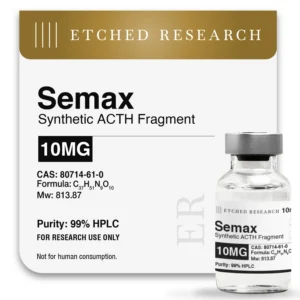
- What it is: a synthetic seven-amino-acid peptide. It is an ACTH(4-7) fragment with a Pro-Gly-Pro tail. Formula C37H51N9O10S, molecular weight 813.9 g/mol (PubChem).
- Evidence on this page: one small human study (110 stroke patients, published in Russian, no placebo group reported) and three rat studies. All four come from Russian research groups.
- Approval: a registered drug in Russia, sold there as nasal drops, and on Russia’s list of Vital and Essential Drugs (Radchenko et al., Acta Naturae, 2025). Not approved in the US. See below.
- How the body handles it: FDA’s 2026 review found no pharmacokinetic studies in humans, so no human half-life figure is given here.
Is Semax FDA approved?
No. In a July 2026 briefing document for its Pharmacy Compounding Advisory Committee, FDA states that Semax is not a component of any FDA-approved drug and that it found no pharmacokinetic studies in humans. FDA reviewed the evidence for the uses Semax was nominated for (cerebral ischemia, migraine and trigeminal neuralgia), found a lack of evidence of effectiveness and too little clinical information to describe its safety, and proposed not adding Semax (free base or acetate) to the list of bulk substances US pharmacies may compound with. FDA briefing document.
The same FDA document notes that Semax is a registered drug in Russia, sold as nasal drops. Etched Research does not sell that product. The Semax Etched Research sells is a research compound for laboratory use only, and it is not for human use.
What the research found, and what it did not
One small human study and three rat studies, all from Russian research groups. The results are listed as the authors reported them.
Semax across stages of ischemic stroke (Zh Nevrol Psikhiatr Im S S Korsakova, 2018). A study in 110 people recovering from ischemic stroke. Researchers gave Semax alongside rehabilitation and tracked motor recovery, a daily-function score, and blood levels of BDNF (a nerve growth signal). They reported that early rehab plus Semax raised BDNF and sped functional and motor recovery in that group. This is a small study in a Russian-language journal. PMID 29798983. https://pubmed.ncbi.nlm.nih.gov/29798983/
Gene activity after stroke in rats (BMC Genomics, 2014). An animal study, not people. Researchers blocked an artery in rat brains, then used genome-wide analysis to see which genes Semax turned up or down at 3 and 24 hours. They reported Semax shifted the activity of genes tied to the immune and blood-vessel systems in the injured brain. Live animal model. PMID 24661604. https://pubmed.ncbi.nlm.nih.gov/24661604/
Gene mapping after ischemia-reperfusion in rats (Genes, 2020). Another rat study. Researchers used RNA sequencing after a temporary artery block to map how gene activity changed. They reported Semax lowered the activity of inflammation-related genes and raised the activity of genes tied to nerve signaling. Live animal model. PMID 32580520. https://pubmed.ncbi.nlm.nih.gov/32580520/
Brain protection and memory in rats (Bulletin of Experimental Biology and Medicine, 2006). A rat study of focal stroke in the front of the brain. Researchers gave intranasal Semax for six days and measured injury size and memory behavior. They reported smaller injury areas and better memory scores in the treated animals. Live animal model. PMID 17603664. https://pubmed.ncbi.nlm.nih.gov/17603664/
Etched Research’s Semax 10mg is sold for laboratory research only, and its page lists the identity data.
How it works
Semax is a short 7-amino-acid peptide. It is based on a fragment of ACTH, a natural hormone, with a small tail (Pro-Gly-Pro) added so it holds up longer in the body. Russian researchers built it to keep ACTH’s nerve-related effects while dropping its hormone (stress-axis) activity.
The leading idea in the research points at neurotrophic signaling, meaning the signals that help nerve cells grow and survive. Several studies tie Semax to BDNF, a growth signal for neurons. The animal work also shows shifts in genes linked to inflammation and blood-vessel activity after brain injury. The honest read: the exact receptor and pathway are still open questions in the published work. No single clean mechanism has been locked down.
What the research does not establish
The honest limits are the whole point here.
- The evidence base is thin and heavily Russian-origin. The human studies are small, and there are no large independent Western randomized trials confirming them.
- There is no approved use in the US. Semax is not an FDA-approved drug, and it has not been shown to be effective or safe in the general public.
- Much of the strongest-sounding data comes from rat models of stroke. What happened in those animals may not happen in people.
- Nothing here is a safety conclusion, and this is not a claim that the compound is safe to use.
- This page is a research summary only.
Anyone telling you the human case is settled is well ahead of the published research.
Common questions
Is Semax a peptide?
Yes. It is a chain of seven amino acids, Met-Glu-His-Phe-Pro-Gly-Pro. The first four match a short stretch of the hormone ACTH, and the last three (Pro-Gly-Pro) were added to the end (PubChem).
What is the difference between Semax and Selank?
Both are seven-amino-acid peptides developed in Russia, but they are built from different starting molecules. Semax comes from a fragment of the hormone ACTH. Selank is based on tuftsin, a small immune-related peptide (Rahman et al., JAAOS Global Research & Reviews, 2026). No published study on this page compares the two directly.
What is Semax used for?
Outside Russia it has no approved use. In research, it has been studied mostly in rat models of stroke, plus one small Russian study in stroke patients, all listed above. When FDA reviewed the evidence in 2026 for the uses it was nominated for, it found a lack of evidence of effectiveness (FDA briefing document).
Last reviewed 2026-09-23.
New reports, new research.
We send a note when a new lab report is posted or a compound comes back in stock, plus a short list of new research pages in any month we publish some. Never more than one email a week, and nothing else.
For Research Use Only. Not for human consumption. Etched Research supplies compounds for laboratory and research use only. Nothing on this page is medical advice, a health claim, or a recommendation to use.
The Janoshik lab result for this compound is on the COA page. For research use only.