SS-31 (Elamipretide): What the Research Actually Shows
- What it is: A lab-made peptide built to reach inside mitochondria (also called elamipretide or MTP-131).
- Research areas: rare mitochondrial myopathy, Barth syndrome, and heart failure with reduced pumping strength.
- Evidence level: Real human trials, which is rare here, but a mixed record. The two larger trials (MMPOWER-3 and PROGRESS-HF) did not hit their main goals. The positive readouts came from a short 5-day trial and a very small long-term group.
- The short version: SS-31 has more human trial data than most in this category, but the record is mixed rather than a clean win. Nearly all of it ran in people with rare mitochondrial or heart disease, not healthy adults.
The Janoshik lab result for this compound is on the COA page. For research use only.
On this page: Quick facts · Is SS-31 FDA approved? · What the human trials found · How it works · Limits · Common questions
SS-31, also called elamipretide or MTP-131, is a lab-made peptide built to reach the inside of mitochondria, the structures that make most of a cell’s energy. It has real human clinical-trial data behind it, which is rare in this category, so this page walks through what researchers actually studied.
A quick note on framing. The trials use the name elamipretide, and most of them ran in people with rare mitochondrial or heart conditions, not in healthy adults. We cite that literature below as research.
Quick facts
- Names: SS-31, elamipretide, MTP-131, Bendavia. “SS” stands for Szeto-Schiller, the two researchers whose labs developed it.
- What it is: a synthetic four-amino-acid peptide (D-Arg-2′,6′-Dmt-Lys-Phe-NH2) that binds cardiolipin on the inner mitochondrial membrane.
- Human trials: yes. Published trials run from early dose studies to phase 3, nearly all in people with rare mitochondrial or heart conditions. Several missed their main goals, including the phase 3 trial (Karaa et al., 2023).
- Approved drug: Forzinity (elamipretide hydrochloride), FDA accelerated approval, September 2025. See below.
Is SS-31 FDA approved?
Yes, as a prescription drug. In September 2025 the FDA gave accelerated approval to Forzinity, whose active ingredient is elamipretide hydrochloride. Accelerated approval rests on an early measure, and keeping it depends on a confirmatory trial. FDA prescribing information.
That approval covers one prescription product for one condition. Etched Research does not sell Forzinity. The SS-31 Etched Research sells is a research compound for laboratory use only, and it is not for human use.
What the research found, and what it did not
All the trials below ran in people with a rare mitochondrial or heart condition. The results are listed as reported, including the ones that missed.
Early dose trial in mitochondrial myopathy (Neurology, 2018). A phase 1/2 randomized, placebo-controlled trial in 36 adults with a genetically confirmed mitochondrial myopathy. Researchers gave the compound by IV at rising doses and measured walking distance on a 6-minute walk test after 5 days. The highest-dose group walked about 64.5 meters farther, compared with about 20.4 meters in the placebo group. PMID 29500292. https://pubmed.ncbi.nlm.nih.gov/29500292/
MMPOWER-3, the large follow-up trial (Neurology, 2023). A phase 3 randomized, double-blind, placebo-controlled trial in 218 people with primary mitochondrial myopathy. They took 40 mg a day by injection or placebo for 24 weeks. This trial did not meet its two main goals (walking distance and a fatigue score). A later subgroup look found a walking-distance signal only in people with one specific genetic variant type. PMID 37268435. https://pubmed.ncbi.nlm.nih.gov/37268435/
TAZPOWER long-term extension in Barth syndrome (Genetics in Medicine, 2024). Barth syndrome is a rare genetic disorder that affects the heart and energy metabolism. In this open-label extension, a small group (10 entered, 8 reached the end) took 40 mg a day by injection for 168 weeks. Researchers recorded improvements in walking distance, fatigue scores, and some heart-function measures over that stretch. Injection-site reactions were the most common side effect logged. PMID 38602181. https://pubmed.ncbi.nlm.nih.gov/38602181/
PROGRESS-HF, a heart-failure trial (Journal of Cardiac Failure, 2020). A phase 2 randomized, placebo-controlled trial in 71 people with heart failure and reduced pumping strength. They took placebo, 4 mg, or 40 mg a day by injection for 28 days. Researchers measured heart volume on MRI and found no meaningful difference versus placebo at 4 weeks. The trial reported it was well tolerated in that group. PMID 32068002. https://pubmed.ncbi.nlm.nih.gov/32068002/
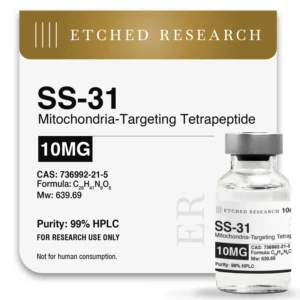
Etched Research’s SS-31 10mg is sold for laboratory research only, and its page lists the identity data.
How it works
Mitochondria make most of a cell’s energy. Inside each one sits a fatty molecule called cardiolipin, which helps hold the energy-making machinery in the right shape.
SS-31 is built to bind to cardiolipin on the inner mitochondrial membrane. In the models studied, that binding helped keep the energy machinery stable, which researchers tied to steadier energy output and less oxidative stress (the cell-level wear that comes from leftover reactive molecules). Because it works down inside the mitochondria, researchers class it as a mitochondria-targeting peptide, not a hormone or a stimulant.
Cardiolipin is found only on the inner membrane of mitochondria. It helps fold that membrane into ridges called cristae and holds the energy-making protein complexes together. It also sits next to cytochrome c, a small protein that passes electrons down the chain. A 2014 review by the peptide’s inventor described SS-31 binding cardiolipin through electric charge and oily-surface attraction. In lab and animal studies, that binding kept cardiolipin from turning cytochrome c into a peroxidase, a form that oxidizes lipids instead of carrying electrons (Szeto, British Journal of Pharmacology, 2014).
A 2020 biophysics study looked at how the peptide actually sits on a membrane. SS-31 settled at the membrane surface and changed its surface charge without breaking the membrane apart. In isolated mitochondria it also changed how calcium spread near that surface and eased the energy cost of calcium stress (Mitchell et al., Journal of Biological Chemistry, 2020). Both papers are lab work, and the inventor is an author on both.
What the research does not establish
The honest limits matter more than the headlines.
- Nearly all the human trials ran in people with rare mitochondrial or heart disease. Researchers have not established these results in healthy adults.
- The record is mixed, not a clean win. The two larger trials (MMPOWER-3 and PROGRESS-HF) did not hit their main goals. The positive readouts came from a short 5-day trial and a very small long-term group.
- The studies tracked specific markers over weeks to a few years, in people with specific diseases.
- Side effects like injection-site reactions were logged within these groups. That record is not a statement about safety for any one person, and nothing here is a claim that the compound is safe to use.
- This page is a research summary only.
Common questions
Is SS-31 the same as elamipretide?
Yes. SS-31 is the lab code and elamipretide is the generic name used in the trials. MTP-131 and Bendavia are earlier development names. The approved drug uses the hydrochloride salt form.
What is the difference between SS-31 and MOTS-c?
They are different kinds of molecule. SS-31 is a synthetic four-amino-acid peptide designed to bind cardiolipin inside mitochondria. MOTS-c is a 16-amino-acid peptide encoded in mitochondrial DNA itself, studied mainly as a metabolic signal (Lee et al., Cell Metabolism, 2015). SS-31 has human trial data. MOTS-c research is mostly in cells and animals. No published study compares the two directly.
What is the half-life of SS-31?
The approved drug’s prescribing information does not state one. Half-life figures quoted on vendor sites often cite no source.
What did the cardiolipin studies show?
In cell and animal studies, SS-31 binding to cardiolipin was linked to more stable mitochondrial structure and less oxidative stress (Szeto, 2014). In people, the record is mixed: the two largest trials missed their main goals.
Why was SS-31 studied in Barth syndrome?
Barth syndrome is a rare inherited disorder caused by changes in the TAFAZZIN gene. Tafazzin normally reshapes cardiolipin into its mature form, so in Barth syndrome the cardiolipin in the inner mitochondrial membrane is abnormal. SS-31 binds cardiolipin, which is why researchers tested it there. In a 2021 study using a human cell line with tafazzin removed, researchers found lower levels of complex I, a core part of the energy-making chain, and higher levels of a stress-response protease called PARL. Treating the cells with SS-31 reversed those changes (Anzmann et al., Journal of Biological Chemistry, 2021). That is a cell-dish result. The human Barth data is the small TAZPOWER extension above.
Last reviewed 2026-09-24.
New reports, new research.
We send a note when a new lab report is posted or a compound comes back in stock, plus a short list of new research pages in any month we publish some. Never more than one email a week, and nothing else.
For Research Use Only. Not for human consumption. Etched Research supplies compounds for laboratory and research use only. Independent lab results, where they exist, are published on the COA page. Nothing on this page is medical advice, a health claim, or a recommendation to use.
The Janoshik lab result for this compound is on the COA page. For research use only.