Ipamorelin: What the Research Actually Shows
- What it is: A small lab-made peptide studied as a selective growth hormone secretagogue, a compound that nudges the body to release its own growth hormone.
- Research areas: Growth hormone release without raising stress hormones, its short half-life in the blood, and postoperative ileus (slow gut recovery after bowel surgery).
- Evidence level: Thin and early. Mostly older animal work, one small human pharmacokinetic study, and one human trial that did not beat placebo.
- The short version: The ipamorelin record is thin, mostly older and mostly preclinical. Early animal work showed it triggered a GH pulse without stirring up cortisol, but the one larger human trial (in bowel-surgery patients) missed its main goal. Effects on muscle, strength, or body composition in healthy adults are not established, and none of this is a safety conclusion.
No independent lab report is on file for this compound. For research use only.
On this page: Quick facts · What the research found · How it works · Limits · Common questions
Ipamorelin is a small lab-made peptide studied as a selective growth hormone secretagogue, which is a compound that nudges the body to release its own growth hormone. The honest headline is that the research is thin, mostly older and mostly preclinical, and we lay it out straight below.
A quick note on framing. We found no approval for ipamorelin as a drug anywhere. We cite the studies below as research, not as a suggestion to use anything.
Quick facts
- Names: ipamorelin (generic name), NNC 26-0161 (development code) (PubChem).
- What it is: a five-amino-acid peptide (Aib-His-D-2-Nal-D-Phe-Lys-NH2), formula C38H49N9O5, 711.9 g/mol (PubChem CID 9831659). Novo Nordisk researchers first described it in 1998 as a growth hormone secretagogue acting through the same receptor as GHRP-6 (Raun et al., 1998), now known as the ghrelin receptor.
- Human studies: one pharmacokinetic study in healthy men and one published phase 2 trial in adults after bowel surgery, with 117 enrolled and 114 analyzed. A second phase 2 trial, with 320 people enrolled, is listed as completed in 2014 with no results posted. Both trials were sponsored by Helsinn Therapeutics (ClinicalTrials.gov, searched 24 September 2026).
- How the body handled it (the one human pharmacokinetic study): after a 15-minute IV infusion, the half-life was about 2 hours, and growth hormone came in a single pulse peaking at 0.67 hours (Gobburu et al., 1999).
- Approval: we found no drug approval for ipamorelin from the FDA or any other regulator. In September 2023 the FDA added ipamorelin acetate to its list of bulk drug substances that may present significant safety risks when used in compounding (category 2, outsourcing facilities) (FDA).
What the research found, and what it did not
The work below runs from cells and animals in 1998 to two small human studies, one in healthy men and one in bowel-surgery patients. The results are listed as reported, including the one that missed.
First characterization (Raun, European Journal of Endocrinology, 1998). The study that introduced ipamorelin. Working in rat pituitary cells, rats and pigs, researchers reported that this five-amino-acid peptide triggered growth hormone release, and that unlike GHRP-6 and GHRP-2 it did not raise ACTH or cortisol in pigs beyond the levels seen with GHRH, even at doses more than 200 times the GH-releasing dose. Animal and in vitro model, not people. PMID 9849822. https://pubmed.ncbi.nlm.nih.gov/9849822/
Human pharmacokinetics (Gobburu, Pharmaceutical Research, 1999). A small study in healthy adult male volunteers, eight at each of five dose levels. Researchers gave ipamorelin as a 15-minute infusion at rising doses and tracked both the peptide and growth hormone in the blood. They observed a single short pulse of growth hormone release and a short half-life of about 2 hours. Human model, but small and early. PMID 10496658. https://pubmed.ncbi.nlm.nih.gov/10496658/
Postoperative ileus trial (Beck, International Journal of Colorectal Disease, 2014). A randomized, placebo-controlled proof-of-concept trial in adults after bowel surgery, in research on postoperative ileus, the slow return of gut movement after an operation. Ipamorelin or placebo was given into a vein twice a day. The trial enrolled 117 patients and analyzed 114. Its main measure was the time from the first dose until a patient could tolerate a standard solid meal, and researchers found no statistically significant difference from placebo (a median of 25.3 hours versus 32.6 hours, p = 0.15). An honest negative result, and we include it because it is part of the record. PMID 25331030. https://pubmed.ncbi.nlm.nih.gov/25331030/
Trial registry records (ClinicalTrials.gov). The postoperative ileus study is registered as NCT00672074, with the protocol and outcome measures on file. https://clinicaltrials.gov/study/NCT00672074. A second, larger phase 2 trial in bowel-surgery patients, NCT01280344, enrolled 320 people and tested three dose levels against placebo. It is listed as completed in May 2014, no results are posted on the registry, and we found no published paper for it. https://clinicaltrials.gov/study/NCT01280344
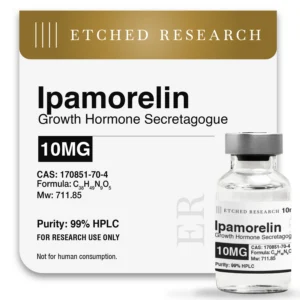
Etched Research’s Ipamorelin 10mg is sold for laboratory research only, and its product page lists the formula, molecular weight and CAS number.
How it works
The pituitary gland releases growth hormone in natural pulses. One of the switches that triggers those pulses is the ghrelin receptor.
Ipamorelin is built to bind that ghrelin receptor. In the studies above, that binding prompted the pituitary to put out a pulse of the body’s own growth hormone. Researchers call it “selective” because in the early animal work it nudged growth hormone without stirring up the stress hormones (ACTH and cortisol) that some related peptides also raise.
Like the GHRH-type compounds, it works upstream. It asks the gland to release growth hormone, rather than adding growth hormone from outside.
What the research does not establish
- The human data is thin. The main human study is a small, early pharmacokinetic look, and the one published larger human trial (in bowel-surgery patients) did not beat placebo on its main goal. A second, larger trial has no posted results.
- Most of the mechanism work is animal or in vitro, not people.
- There is no approved human use. We found no approval for ipamorelin from the FDA or any other regulator.
- Each finding describes a research model. It does not tell you what would happen in a person, and nothing here is a claim that this compound is safe to use.
Common questions
Is ipamorelin FDA approved?
No approval was found. The FDA status on record is the opposite of an approval: in September 2023 the agency added ipamorelin acetate to its category 2 list of bulk drug substances that may present significant safety risks in compounding. Its entry cites a risk of immune reactions from aggregation or peptide impurities for some routes, and a published study that identified serious adverse events, including death, when ipamorelin was given by IV for gastric motility (FDA).
Is ipamorelin a growth hormone?
No. It is a five-amino-acid peptide that prompts the pituitary to release the body’s own growth hormone (Raun et al., 1998). In healthy men given a single IV infusion, growth hormone rose in one pulse and then fell to negligible levels at every dose tested (Gobburu et al., 1999). Growth hormone itself is a much larger protein.
What is the half-life of ipamorelin?
About 2 hours, in the one human pharmacokinetic study. That study gave healthy men a 15-minute IV infusion and found the growth hormone response peaked at 0.67 hours (Gobburu et al., 1999). It did not test other routes, and half-life figures quoted on vendor sites often cite no source.
What is the difference between ipamorelin and tesamorelin?
They act at different receptors. Ipamorelin is a five-amino-acid peptide that works through the ghrelin receptor (Beck et al., 2014). Tesamorelin is a 44-amino-acid analog of GHRH, the brain’s own growth hormone releasing hormone, with far more human trial data behind it (tesamorelin research summary). Both lead to growth hormone release from the pituitary. No published study compares the two directly.
Last reviewed 2026-10-05.
New reports, new research.
We send a note when a new lab report is posted or a compound comes back in stock, plus a short list of new research pages in any month we publish some. Never more than one email a week, and nothing else.
For Research Use Only. Not for human consumption. Etched Research supplies compounds for laboratory and research use only. Nothing on this page is medical advice, a health claim, or a recommendation to use.
No independent lab report is on file for this compound. For research use only.