- What it is: A synthetic five-amino-acid peptide in the growth hormone secretagogue class.
- Research areas: Growth hormone release without raising stress hormones, its short half-life in the blood, and return of bowel function after surgery.
- Evidence level: Thin and early. Mostly older animal work, one small human pharmacokinetic study, and one human trial that did not beat placebo.
- The short version: The ipamorelin record is thin, mostly older and mostly preclinical. Early animal work showed it triggered a GH pulse without stirring up cortisol, but the one larger human trial (in bowel-surgery patients) missed its main goal. Effects on muscle, strength, or body composition in healthy adults are not established, and none of this is a safety conclusion.
What it is
Ipamorelin is a synthetic peptide made of five amino acids. Two of them are D-form amino acids and one, Aib (2-aminoisobutyric acid), is not found in natural proteins. It belongs to the growth hormone secretagogue class and was first described in 1998.
| Other names | NNC 26-0161, NNC-26-0161 |
|---|---|
| Sequence | Aib-His-D-2-Nal-D-Phe-Lys-NH2 (5 amino acids, C-terminal amide) |
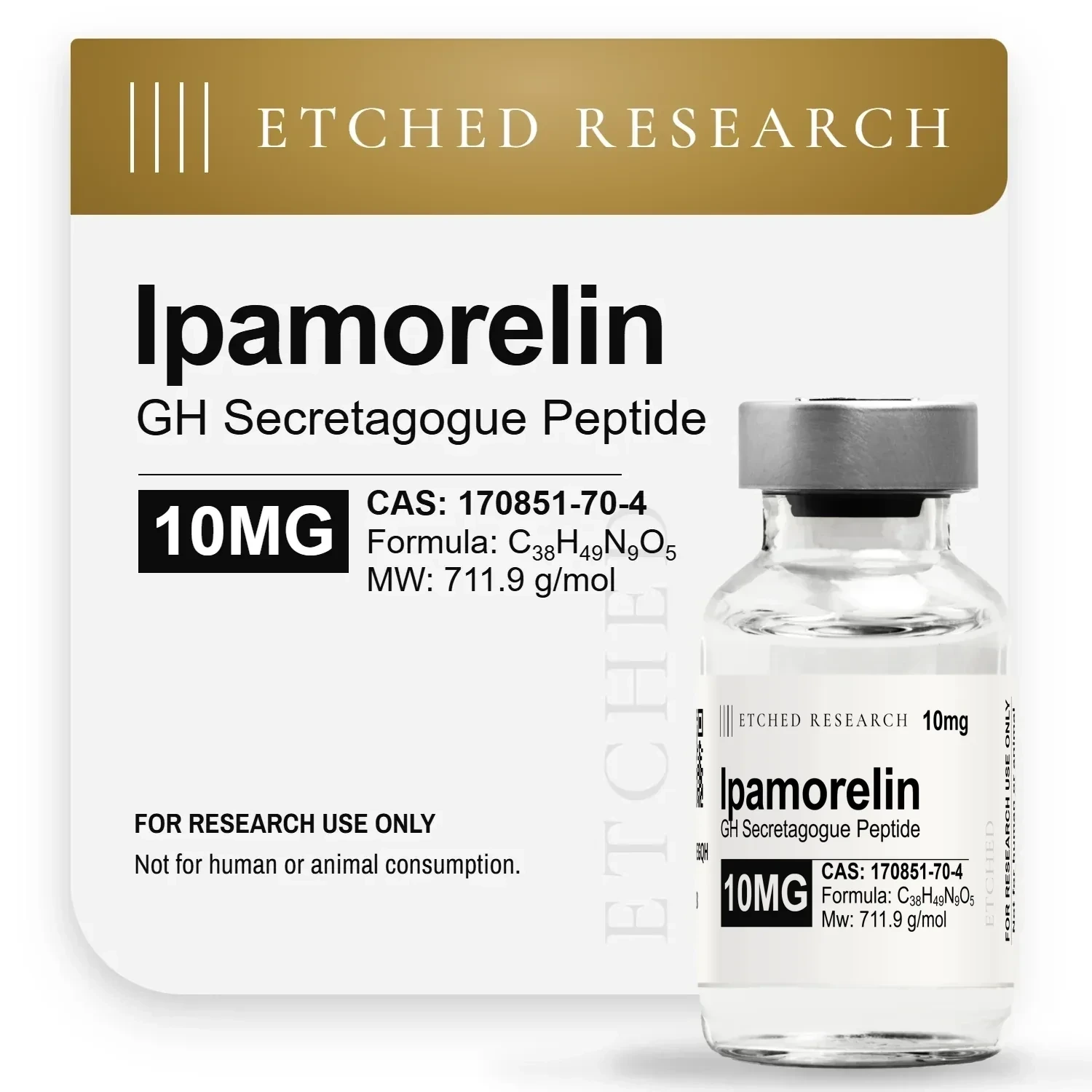
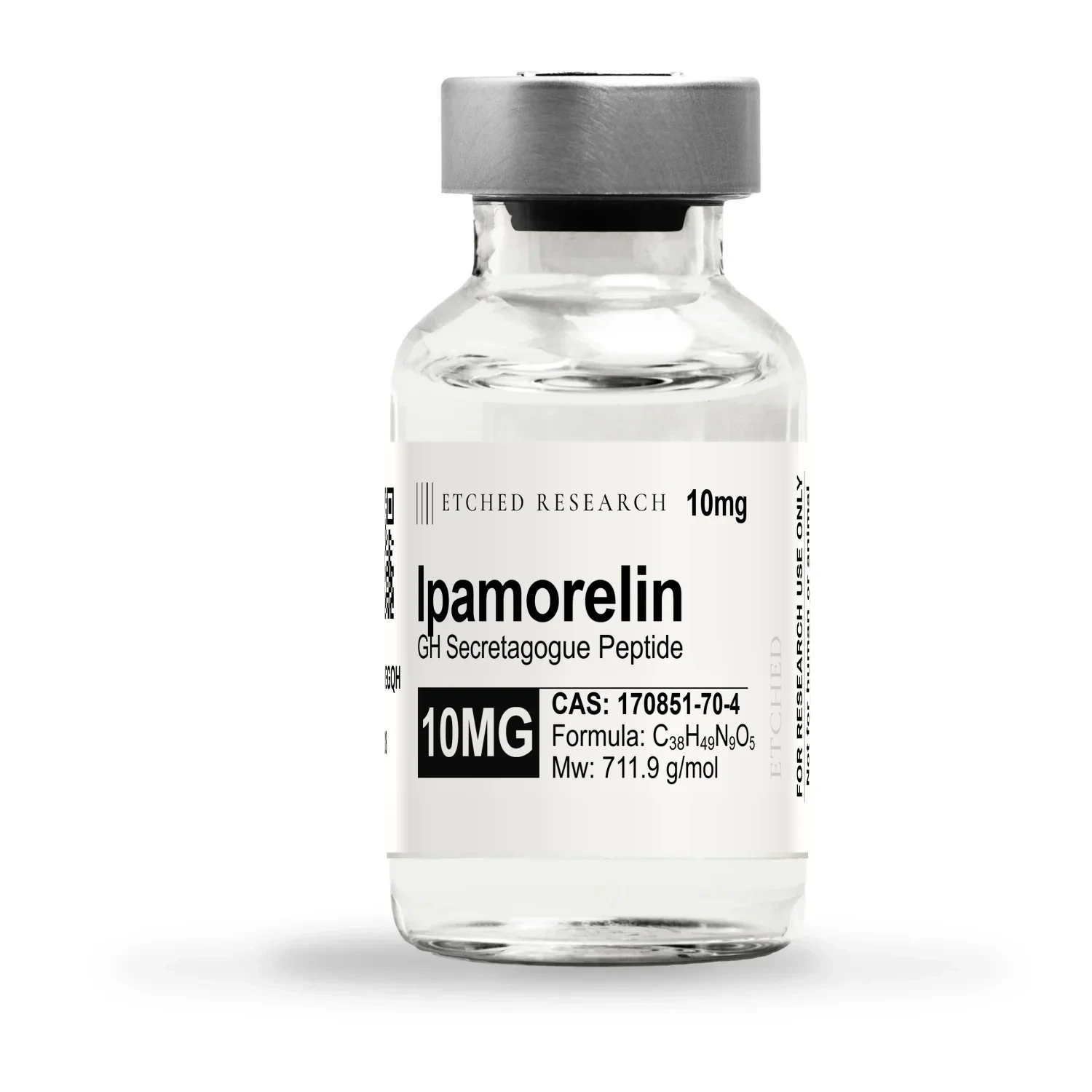
| Molecular formula | C38H49N9O5 |
| Molecular weight | 711.9 g/mol (peptide, free base) |
| CAS number | 170851-70-4 |
| PubChem CID | 9831659 |
| InChIKey | NEHWBYHLYZGBNO-BVEPWEIPSA-N |
| Form | Lyophilized (freeze-dried) powder, 10mg per vial |
What the evidence is
Most ipamorelin research is older cell and animal work from 1998 to 2009. The human record is one pharmacokinetic study in healthy men and one phase 2 trial after bowel surgery that did not beat placebo.
| Study | Type | Who or what | What was given | What it measured | What it found |
|---|---|---|---|---|---|
| Raun et al., European Journal of Endocrinology, 1998 | Cell and animal | Rat pituitary cells, anesthetized rats and conscious pigs | Ipamorelin at a range of doses, compared with GHRP-6, GHRP-2 and GHRH | Growth hormone release. In pigs, also ACTH, cortisol, FSH, LH, prolactin and TSH | Growth hormone release similar in strength to GHRP-6. In pigs, no change in FSH, LH, prolactin or TSH, and ACTH and cortisol no different from GHRH, even at doses over 200 times the GH-releasing dose. GHRP-6 and GHRP-2 raised ACTH and cortisol |
| Johansen et al., Growth Hormone & IGF Research, 1999 | Animal | Adult female rats | 18, 90 or 450 µg a day, split into three doses, for 15 days | Leg bone growth rate, body weight, IGF-1, bone turnover markers | Bone growth rate rose with dose, from 42 to 52 µm a day at the top dose. Body weight gain rose too. No change in total IGF-1 or bone turnover markers |
| Gobburu et al., Pharmaceutical Research, 1999 | Human, dose-escalation pharmacokinetic study | Healthy adult men, 8 at each of 5 dose levels | One dose over 15 minutes, at one of five levels, 4.21 to 140.45 nmol/kg | Blood levels of ipamorelin and growth hormone | Half-life of about 2 hours. One growth hormone pulse, peaking at 0.67 hours, then falling to negligible levels at every dose |
| Venkova et al., Journal of Pharmacology and Experimental Therapeutics, 2009 | Animal | Male rats after abdominal surgery with bowel handling | 0.01 to 1 mg/kg, once, or four times a day for 2 days | Time to first bowel movement, stool output, food intake and body weight over 48 hours | One 1 mg/kg dose shortened time to first bowel movement but did not change stool output, food intake or weight. Repeated dosing at 0.1 or 1 mg/kg raised all three |
| Beck et al., International Journal of Colorectal Disease, 2014 | Human, phase 2, randomized, double-blind, placebo-controlled | 117 adults after bowel resection surgery (114 analyzed) | 0.03 mg/kg twice a day, from the day after surgery for up to 7 days | Main measure: time to tolerating a solid meal. Also side effects and lab tests | No significant difference from placebo: median 25.3 hours versus 32.6 hours. No significant difference on the secondary measures either. Side effects were logged in 87.5% of the ipamorelin group and 94.8% of the placebo group |
Last reviewed 2026-09-24. The 1998 and 1999 animal studies came from Novo Nordisk, where ipamorelin was developed. The 2014 trial was sponsored by Helsinn Therapeutics (NCT00672074). How it works, and what none of this establishes, is on the full research summary →
Storage and shipping
Ships as lyophilized powder in a sealed vial. Store the powder frozen at -20°C. US addresses only. Shipping costs and cutoff times →
Questions about Ipamorelin
What is NNC 26-0161?
NNC 26-0161 is the development code for ipamorelin, which is the generic name. Papers write the sequence as Aib-His-D-2-Nal-D-Phe-Lys-NH2, sometimes shortened to Aib-His-2Nal-Phe-Lys-NH2.
Is there human data?
Very little. A 1999 study measured blood levels and growth hormone in healthy men after a single dose. A 2014 phase 2 trial in 117 adults after bowel surgery found no significant difference from placebo. A second, larger phase 2 trial is registered as completed in 2014, with no results posted.
Is ipamorelin an approved drug?
We found no drug approval for ipamorelin from the FDA or any other regulator. Etched Research sells ipamorelin as a research compound for laboratory use only. It is not for human use.
Where can I buy Ipamorelin for research?
Etched Research sells Ipamorelin on this page as a 10mg vial of lyophilized powder, for laboratory research use only, shipped to US addresses. Where an independent laboratory report exists for a compound, the measurements are published on the lab reference page, including the compounds we hold no report for.
Is there a lab report for Ipamorelin?
Not yet. No independent lab report is on file for this compound. When one is, it will be listed on the lab reference page.
Shipping, eligibility and what comes in the box: store FAQ →
For research use only. Not for human consumption.