KPV: What the Research Actually Shows
- What it is: A three-amino-acid peptide (Lys-Pro-Val) that makes up the tail end of the natural hormone alpha-MSH.
- Research areas: intestinal inflammation and colitis in animal models, how it quiets inflammatory signals in gut and immune cells, and how the body takes it in through a transporter called PepT1.
- Evidence level: Animal and in-vitro (lab-dish) models. No large independent human trials.
- The short version: KPV is the small tail piece of alpha-MSH, and researchers have studied it mostly in mice and cell cultures to see how it lowers inflammation in the gut. Across those colitis models it lowered inflammatory markers and eased tissue damage. This is a summary of what researchers observed in their models, not a claim about what it does for a person.
The Janoshik lab result for this compound is on the COA page. For research use only.
On this page: Quick facts · What the research found · How it works · Limits · Common questions
KPV is a synthetic copy of a three-amino-acid piece of the hormone alpha-MSH, examined mostly in mouse and cell models of gut inflammation. Below is what researchers looked at, in what kind of model, and what they observed, not what it does for you.
Quick facts
- Names: KPV, Lys-Pro-Val, alpha-MSH (11-13), L-lysyl-L-prolyl-L-valine (PubChem CID 125672).
- What it is: a three-amino-acid peptide (lysine, proline, valine) that matches the last three amino acids of alpha-MSH, a 13-amino-acid hormone. Formula C16H30N4O4, 342.4 g/mol (PubChem).
- Evidence: three studies below mix lab-dish cells and mice, and one is a review of that earlier work. A search of PubMed and ClinicalTrials.gov on 2026-09-23 found no published or registered human trial of KPV.
- Approval status: KPV is not an FDA-approved drug and is not the active ingredient in any approved drug. The FDA lists it among bulk substances for compounding that may present significant safety risks, and says it has found no human exposure data on drug products containing KPV (FDA, current as of April 2026).
What the research found, and what it did not
Every study below used lab-dish cells, mice, or both. Most looked at colitis that researchers induced in mice, not at people.
KPV uptake and gut inflammation (Gastroenterology, 2008). Researchers tested KPV in intestinal and immune cells and in two mouse colitis models. They reported that a transporter called PepT1 carried KPV into cells, where it lowered inflammatory signaling and cut pro-inflammatory cytokines, and that oral KPV reduced colitis in the mice. This mixes lab-dish cells and live animals, not people. PMID 18061177. https://pubmed.ncbi.nlm.nih.gov/18061177/
KPV in two colitis models (Inflammatory Bowel Diseases, 2008). A mouse study using DSS-induced colitis and a transfer colitis model. Researchers reported that KPV-treated mice recovered sooner, regained more body weight, and showed less inflammation in the gut tissue. They also noted the effect looked at least partly independent of the MC1R receptor. Live animal model. PMID 18092346. https://pubmed.ncbi.nlm.nih.gov/18092346/
Targeted oral delivery to the inflamed colon (Molecular Therapy, 2017). Researchers packed KPV into nanoparticles coated with hyaluronic acid to aim it at inflamed colon tissue, then tested it in cells and in a DSS mouse colitis model. They reported the targeted delivery eased colitis more than uncoated particles in that model. Lab-dish cells plus live animals. PMID 28143741. https://pubmed.ncbi.nlm.nih.gov/28143741/
Review of alpha-MSH and its tripeptides (Endocrine Reviews, 2008). A review, not a new experiment. The authors pulled together the in-vitro and animal work on alpha-MSH and its tripeptide KPV and described consistent anti-inflammatory and protective effects across models, without the pigment (skin-darkening) effects of the full hormone. They framed it as early-stage potential, not settled human use. PMID 18612139. https://pubmed.ncbi.nlm.nih.gov/18612139/
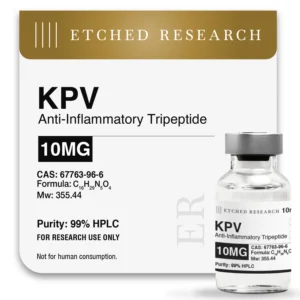
Etched Research’s KPV 10mg is sold for laboratory research only, and its page lists the identity data.
How it works
KPV is the last three amino acids (Lys-Pro-Val) of alpha-MSH, a natural hormone in the melanocortin family. Researchers made the short piece on its own because it seems to carry much of the anti-inflammatory action without the hormone’s other jobs.
The leading idea in the research is that KPV quiets two of the body’s main inflammation switches, called NF-kB and MAPK. When those calm down, cells make fewer inflammatory messengers (cytokines). Studies also point to a transporter named PepT1, found on gut and immune cells, that pulls KPV inside where it can act. The honest read: most of this comes from cell and animal work, and the exact steps are still being mapped.
What the research does not establish
The honest limits are the whole point here.
- Almost all of it is preclinical. Most studies use mice or isolated cells, not human trials.
- There is no approved human use. KPV is not an FDA-approved drug, and it has not been shown to be effective or safe in people.
- The gut findings come from colitis models in animals. What happened there does not tell you what would happen in a person.
- Nothing here is a safety conclusion, and this is not a claim that the compound is safe to use.
- This page is a research summary only.
Anyone telling you the human case is settled is ahead of the research.
Common questions
What is KPV peptide made of?
Three amino acids joined in a chain: lysine, proline and valine. The name is their one-letter codes. The same three sit at positions 11 to 13 of the hormone alpha-MSH, which is why KPV is also listed as alpha-MSH (11-13) (PubChem).
Is KPV a growth hormone peptide?
No. KPV comes from alpha-MSH, a hormone in the melanocortin family, not from the growth hormone system. Reviews of the research describe it as an anti-inflammatory fragment that lacks the part of alpha-MSH needed to bind the known melanocortin receptors (Brzoska et al., 2010).
Does KPV bind melanocortin receptors?
Not as far as published work shows. KPV is often called a melanocortin-derived peptide because it comes from alpha-MSH, but it lacks the whole sequence alpha-MSH uses to bind any of the known melanocortin receptors. In lab and animal models it still kept most of the hormone’s anti-inflammatory activity, without the pigment effect, and how it signals is still unknown (Brzoska et al., 2010). In one mouse colitis study, KPV still worked in mice whose MC1R receptor did not function (Kannengiesser et al., 2008).
Is KPV FDA approved?
No. It is not an approved drug, and the FDA lists it among bulk substances for compounding that may present significant safety risks, noting it has found no human exposure data on drug products containing it (FDA).
Last reviewed 2026-09-24.
New reports, new research.
We send a note when a new lab report is posted or a compound comes back in stock, plus a short list of new research pages in any month we publish some. Never more than one email a week, and nothing else.
For Research Use Only. Not for human consumption. Etched Research supplies compounds for laboratory and research use only. Independent lab results, where they exist, are published on the COA page. Nothing on this page is medical advice, a health claim, or a recommendation to use.
The Janoshik lab result for this compound is on the COA page. For research use only.