BPC-157: What the Research Actually Shows
- What it is: A synthetic 15-amino-acid peptide first drawn from a protein found in stomach fluid.
- Research areas: Tendon and ligament healing, muscle repair after injury, and new blood vessel growth at an injury site.
- Evidence level: Almost all animal and in-vitro models. No controlled human trials.
- The short version: Nearly every BPC-157 study so far used rats or isolated cells, not people. Researchers watched connective tissue like tendon and ligament repair faster in those models, and looked at collagen and blood vessel signals as the reason why. What that would mean in a person is still unstudied, and none of it is a safety conclusion.
The Janoshik lab result for this compound is on the COA page. For research use only.
On this page: Quick facts · What the research found · How it works · Limits · Common questions
BPC-157 is a synthetic 15-amino-acid peptide, first drawn from a protein found in stomach fluid. Researchers have studied it mostly in animal models of how tendon, ligament, and muscle repair after injury. No controlled human trials exist, and we found no regulatory approval.
A BPC-157 research vial is a sealed vial of freeze-dried powder sold for laboratory research only. It is not a medicine or a finished product. This page covers the science: what the studies looked at, in what kind of model, and what they observed.
Quick facts
- Names: BPC-157, short for Body Protection Compound 157. Older research papers also use the codes PL 14736 and PLD-116 (Krivic et al., 2006).
- What it is: a synthetic peptide of 15 amino acids (Gly-Glu-Pro-Pro-Pro-Gly-Lys-Pro-Ala-Asp-Asp-Ala-Gly-Leu-Val), formula C62H98N16O22, 1419.5 g/mol (PubChem CID 9941957). Its sequence comes from a protein in human gastric juice (Chang et al., 2014).
- Evidence: a 2025 systematic review of the musculoskeletal research found 36 studies. 35 were in animals or cells and 1 was in people, a look back at patient charts with no control group. The authors found no clinical safety data (Vasireddi et al., HSS Journal, 2025).
- How the body handles it (animals only): in rats and dogs, BPC-157 had a half-life under 30 minutes after an IV or intramuscular injection and was broken down into small peptide fragments and amino acids (He et al., Frontiers in Pharmacology, 2022).
- Approval: we found no approval for BPC-157 from the FDA or any other regulator.
- FDA compounding list: the FDA lists BPC-157 among substances that were in category 2 (“may present significant safety risks”) before their nominations were withdrawn. Its entry says the agency “lacks sufficient information to know whether the drug would cause harm when administered to humans” (FDA, page current as of 22 April 2026).
What the research found, and what it did not
Every study below used rats or isolated cells, not people, and the review at the end sums up that same animal work. The results are listed as reported, including the 2009 finding that BPC-157 had no direct effect on blood vessel growth in cell cultures.
Ligament healing in rats (Journal of Orthopaedic Research, 2010). Researchers cut the knee ligament in rats and gave BPC-157 by several routes over 90 days. They observed better functional recovery and better structural healing in the treated animals. Live animal model, not people. PMID 20225319. https://pubmed.ncbi.nlm.nih.gov/20225319/
Achilles tendon-to-bone healing in rats (Journal of Orthopaedic Research, 2006). This study looked at how a detached Achilles tendon reattached to bone in rats. Treated animals healed faster, and BPC-157 offset some of the harm corticosteroids caused in that model. PMID 16583442. https://pubmed.ncbi.nlm.nih.gov/16583442/
Blood vessel growth during repair (Journal of Physiology and Pharmacology, 2009). Researchers examined new blood vessel growth in muscle and tendon healing in animals. They reported BPC-157 raised VEGF, a signal tied to vessel formation, and linked that to more complete repair. PMID 20388964. https://pubmed.ncbi.nlm.nih.gov/20388964/
Tendon cells in a dish (Molecules, 2014). An in vitro study, meaning isolated tendon cells in a lab plate rather than a live animal. BPC-157 raised growth hormone receptor levels on those cells in a dose- and time-dependent way, which the authors tied to healing signaling. PMID 25415472. https://pubmed.ncbi.nlm.nih.gov/25415472/
Review of the soft-tissue research (Cell and Tissue Research, 2019). A review pulled together the musculoskeletal studies and reported consistent healing effects across the animal work. The authors were clear that the evidence is preclinical and that human efficacy is not confirmed. PMID 30915550. https://pubmed.ncbi.nlm.nih.gov/30915550/
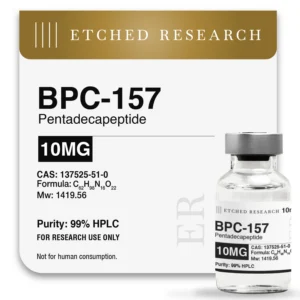
Etched Research supplies BPC-157 as a lyophilized powder for laboratory research. The BPC-157 10mg product page lists its identity data and storage.
How it works
Researchers propose two main ideas, and neither is fully proven at the molecular level.
First, BPC-157 seems to interact with the signals that control how the body lays down collagen, the scaffold that holds tissue together. Second, it appears to influence growth factor signals tied to new blood vessel growth at an injury site. Both ideas come out of animal and cell studies. The exact receptor it binds to is still an open question in the published research.
What the research does not establish
- Almost all of it is preclinical. Most studies use rats or isolated cells, not human trials.
- There is no approved human use. BPC-157 is not an FDA-approved drug, and it has not been shown to be effective or safe in people.
- Each finding describes what happened in a research model.
- Nothing here is a safety conclusion, and this is not a claim that the compound is safe to use.
The honest limits are the point. Anyone telling you the human case is settled is ahead of the research.
Common questions
Is BPC-157 FDA approved?
No. BPC-157 is not an FDA-approved drug for any use (Vasireddi et al., 2025). On the FDA’s compounding page, its entry says the agency lacks enough information to know whether it would cause harm in people (FDA).
What is BPC-157’s FDA status in 2026?
It is not approved. The FDA page on bulk drug substances for compounding, current as of 22 April 2026, lists BPC-157 under “bulk drug substances nominated but withdrawn.” The page says that list holds substances that were previously in category 2 and whose nominations were withdrawn by the people who nominated them. BPC-157 is not in the page’s current category 2 table. Its entry names a possible risk of immune reactions, questions about peptide impurities, and no or only limited safety information (FDA).
What is BPC-157 made of?
Fifteen amino acids joined in a chain: glycine, glutamic acid, three prolines, glycine, lysine, proline, alanine, two aspartic acids, alanine, glycine, leucine and valine (PubChem). The sequence was taken from a protein found in human gastric juice. The material used in research is made synthetically.
What side effects has BPC-157 research recorded?
Very little is known. A 2019 review noted few reports of adverse reactions in the animal studies (Gwyer et al., 2019). A 2025 systematic review found no clinical safety data in people (Vasireddi et al., 2025). The FDA has named a possible risk of immune reactions and questions about impurities (FDA). None of this is a safety conclusion.
Last reviewed 2026-09-24.
New reports, new research.
We send a note when a new lab report is posted or a compound comes back in stock, plus a short list of new research pages in any month we publish some. Never more than one email a week, and nothing else.
For Research Use Only. Not for human consumption. Etched Research supplies compounds for laboratory and research use only. Independent lab results, where they exist, are published on the COA page. Nothing on this page is medical advice, a health claim, or a recommendation to use.
The Janoshik lab result for this compound is on the COA page. For research use only.