IGF-1 LR3: What the Research Actually Shows
- What it is: A lab-made version of IGF-1, edited in two spots so it slips past the proteins that normally hold IGF-1 in check.
- Research areas: growing engineered cells in lab culture, body weight and muscle in food-restricted and catabolic rats, and organ growth in guinea pigs.
- Evidence level: There are no human trials. Its main documented use is as a lab cell-culture reagent, and the animal results are mixed.
- The short version: LR3 IGF-1 has mostly been used as a research reagent for growing cells, not tested in people. The animal work is split, holding body weight in one model without saving muscle. There is no human data.
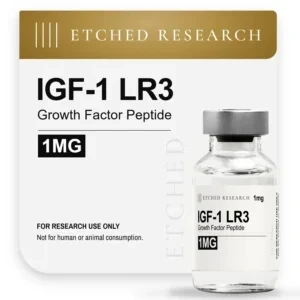
IGF-1 LR3 1mg. For research use only.
On this page: Quick facts · What the research found · How it works · Limits · Common questions
IGF-1 LR3 (Long R3 IGF-1) is a lab-made version of IGF-1, changed in two spots so it slips past the proteins that normally hold IGF-1 in check. Most of its real-world use has been as a research reagent in cell culture, and the honest headline is that we found no published human trial of it, which this page does not hide.
Below is what researchers looked at, in what kind of model, and what they observed.
Quick facts
- Names: IGF-1 LR3, Long R3 IGF-I, LR3 IGF-I, LongR3. Its creators called it Long [Arg3]-IGF-I (Francis et al., 1992).
- What it is: an 83-amino-acid analog of human IGF-1. It is the 70-amino-acid IGF-1 sequence with arginine in place of glutamic acid at position 3, plus a 13-amino-acid extension on the front end (Francis et al., 1992). Sequence MFPAMPLSSLFVNGPRTLCGAELVDALQFVCGDRGFYFNKPTGYGSSSRRAPQTGIVDECCFRSCDLRRLEMYCAPLKPAKSA, monoisotopic mass 9105.4 Da, about 9.1 kDa (Thomas et al., 2022).
- Evidence: cell-culture studies and a few short studies in rats and guinea pigs. We found no published human trial, and ClinicalTrials.gov returns no study for “Long R3” or “IGF-1 LR3” (ClinicalTrials.gov, searched 24 September 2026).
- Approval: we found no approval for IGF-1 LR3 from the FDA or any other regulator. The FDA-approved drug mecasermin (Increlex) is regular 70-amino-acid human IGF-1, not LR3 (FDA prescribing information).
What the research found, and what it did not
The studies below were done in cultured cells, rats and guinea pigs. None enrolled people.
Its main real-world job, growing cells in a lab (Biotechnology Progress, 2000). Long R3 IGF-1 is best known as an additive put into cell-culture media to help engineered cells grow and make proteins. In one study, researchers compared it with insulin in two Chinese hamster ovary (CHO) cell lines, a standard lab cell line, making recombinant proteins in serum-free culture. Both supported cell growth, and LR3 kept both lines alive better than insulin under production conditions. This is lab-reagent data, not a study in animals or people. PMID 11027158. https://pubmed.ncbi.nlm.nih.gov/11027158/
The first cell studies (Journal of Molecular Endocrinology, 1992). The team that built the analog compared it with IGF-1 in several cell types. It was more potent than IGF-1 in cells that release IGF binding proteins, and less potent than IGF-1 in chick embryo fibroblasts, which release none. That split points to the binding proteins, not the receptor, as the reason for its extra strength. PMID 1378742. https://pubmed.ncbi.nlm.nih.gov/1378742/
Food-restricted rats (Tomas, Growth Hormone and IGF Research, 2001). Rats on limited food received LR3 IGF-1 by infusion for 7 days. It kept their overall body weight about 3 to 8% higher, but it did not protect their skeletal muscle from wasting, and in adult rats it raised the rate of muscle protein breakdown. An honest split result: better body weight, no muscle rescue. Rat model, not people. PMID 11472075. https://pubmed.ncbi.nlm.nih.gov/11472075/
Catabolic rats (Tomas, Biochemical Journal, 1992). In rats pushed into tissue loss with a steroid (dexamethasone), LR3 IGF-1 was about 2.5 times more potent than regular IGF-1 at pushing back against the loss. Researchers linked that strength to the fact that the analog dodges the binding proteins. Carcass weight as a share of body weight stayed low in every treated group. Rat model, catabolic state. PMID 1371669. https://pubmed.ncbi.nlm.nih.gov/1371669/
Organ growth in guinea pigs (Conlon, Journal of Endocrinology, 1995). A steady 7-day infusion of Long R3 IGF-1 increased the relative weight of certain organs (gut, kidney, spleen, and adrenal glands) but did not increase overall growth, and it lowered the animals’ own circulating IGF-1, IGF-2 and binding proteins. Guinea pig model. PMID 7561636. https://pubmed.ncbi.nlm.nih.gov/7561636/
Etched Research’s IGF-1 LR3 1mg is sold for laboratory research only, and its page lists the identity data.
How it works
Start with the natural molecule. IGF-1 is 70 amino acids long, and in the blood it mostly rides on carrier proteins (IGF binding proteins) that grab it and release it slowly.
LR3 is that molecule with two edits. First, one building block at position 3 is swapped (glutamic acid becomes arginine, which is the “R3” in the name). Second, a 13-amino-acid tail is added to the front (the “Long” part). That makes it 83 amino acids instead of 70.
Those two changes make it bind the carrier proteins very weakly. So instead of being held and doled out slowly, more of it stays free to act. It still binds the type 1 IGF receptor, though in one rat study about 3 times less well than IGF-1 (Tomas et al., 1992). That combination, weaker binding-protein grip with the receptor still reachable, is the whole reason the analog exists as a research tool.
That grip matters most in a lab dish. Many cultured cells release their own IGF binding proteins into the liquid around them, and those proteins tie up regular IGF-1. In the first cell studies, LR3 tied for the most potent version tested in cell lines that release binding proteins, and was less potent than IGF-1 in a cell line that releases none (Francis et al., 1992). That property is behind its main use as a cell-culture media additive.
What the research does not establish
- There is no published human trial data. LR3 IGF-1 has been used mainly as a lab reagent, not tested as a treatment in people, and there are no human trials showing it is effective.
- Cell-culture results show what the molecule does to isolated cells in a dish. They cannot show what happens in a whole body, where absorption, the body’s own binding proteins and organ-level feedback all come into play.
- Natural IGF-1 has a large research record of its own in animals and people. That record belongs to IGF-1. It is not evidence for LR3, which has a much smaller record of its own.
- The animal results are mixed. In one model it held body weight but did not save muscle. We found no study that gave IGF-1 LR3 to people.
- Nothing here is a safety conclusion. This is not a claim that the compound is safe to use.
- It is not FDA-approved for any human use.
The missing human record is the point. Anyone telling you the human case is settled is well ahead of the research.
Common questions
Is IGF-1 LR3 FDA approved?
No. We found no approval for LR3 from the FDA or any other regulator. The only FDA-approved IGF-1 drug we found is mecasermin, sold as Increlex, which is regular 70-amino-acid human IGF-1, not LR3. Its label says it is indicated for growth failure in children 2 years and older with severe primary IGF-1 deficiency, or with a growth hormone gene deletion who have developed antibodies to growth hormone (FDA prescribing information). Etched Research does not sell Increlex.
What is Long R3 IGF-1 used for in cell culture?
It is added to serum-free culture media to help engineered cells grow and stay alive while they make proteins. In one study of two Chinese hamster ovary (CHO) cell lines making recombinant proteins, both insulin and LR3 supported growth, and LR3 kept both lines alive better than insulin under production conditions (Morris and Schmid, 2000). That is lab-reagent data about cells, not about animals or people.
Is IGF-1 LR3 a steroid or a peptide?
Neither a steroid nor a short peptide. It is a small protein, a single chain of 83 amino acids with a mass of about 9.1 kDa (Thomas et al., 2022). It has no steroid structure.
What is the difference between IGF-1 LR3 and IGF-1?
Size and grip. LR3 is 13 amino acids longer and has arginine at position 3. In cell studies it was more potent than IGF-1 where cells release IGF binding proteins, and less potent where they don’t (Francis et al., 1992). In catabolic rats it was about 2.5 times as potent as IGF-1 while binding the IGF receptor 3 times less well (Tomas et al., 1992). None of this was tested in people.
What is the difference between IGF-1 LR3 and IGF-1 DES?
IGF-1 DES, or des(1-3) IGF-1, is IGF-1 with its first three amino acids removed. LR3 goes the other way, adding 13. Both bind poorly to IGF binding proteins. In the same catabolic-rat study, both were about 2.5 times as potent as IGF-1 (Tomas et al., 1992). That is a rat result only.
Last reviewed 2026-09-24.
New reports, new research.
We send a note when a new lab report is posted or a compound comes back in stock, plus a short list of new research pages in any month we publish some. Never more than one email a week, and nothing else.
For Research Use Only. Not for human consumption. Etched Research supplies compounds for laboratory and research use only. Where an independent laboratory report exists for a compound, the measurements are published on the COA page, including the compounds we hold no report for. Nothing on this page is medical advice, a health claim, or a recommendation to use.