PT-141 (Bremelanotide): What the Research Actually Shows
- What it is: A synthetic peptide that switches on melanocortin receptors, a signaling system tied to sexual arousal. In the research literature it is called bremelanotide.
- Research areas: sexual desire and arousal (the main human trial literature) and melanocortin-pathway biology.
- Evidence level: Real human evidence, but for one narrow use only. Two large phase 3 trials in premenopausal women, plus an FDA approval of a finished prescription drug for that single diagnosis. Outside that, the record is thin.
- The short version: In two large trials researchers watched it raise measured sexual-desire scores and lower related distress in premenopausal women, and regulators later approved a finished drug version for that one use. This page reports what researchers studied. It is not a recommendation to use the compound, and this material is supplied for research only.
The Janoshik lab result for this compound is on the COA page. For research use only.
On this page: Quick facts · Is PT-141 FDA approved? · What the human trials found · How it works · Limits · Common questions
PT-141, known in the research literature as bremelanotide, is a synthetic peptide that activates melanocortin receptors. It has a large body of human trial evidence behind it, so this page reports what those trials actually measured, and where the record stops.
A quick note on framing. Below is what researchers looked at, in what kind of study, and what they measured. A finished, prescription version of bremelanotide is FDA-approved for one narrow medical use. That approved drug is a regulated medicine, and it is a different thing from a research compound. We cite the trial literature below as research.
Quick facts
- Names: bremelanotide (generic name, INN and USAN), PT-141 (development code), also written PT 141 or PT141 (PubChem). The prescription drug is sold as Vyleesi.
- What it is: a cyclic peptide of seven amino acids, Ac-Nle-cyclo[Asp-His-D-Phe-Arg-Trp-Lys]-OH, formula C50H68N14O10, 1025.2 g/mol as the free base (PubChem CID 9941379, FDA prescribing information). It is a synthetic analog of alpha-MSH (Diamond et al., 2006).
- Human trials: two identical phase 3 trials in 1,267 premenopausal women with HSDD, a 52-week open-label extension, a phase 2b dose-finding trial, a blood-pressure trial and earlier small nasal-spray studies. A 2022 review counted 3,500 people across 43 completed studies in the development program (Clayton et al., 2022).
- How the body handles it (from the approved drug’s prescribing information): after an injection under the skin, blood levels peak at about 1 hour, nearly all of the dose reaches the blood (about 100% bioavailability), and the mean terminal half-life is about 2.7 hours (range 1.9 to 4.0 hours).
- Approved drug: Vyleesi (bremelanotide, as an acetate salt), approved by the FDA in June 2019. See below.
Is PT-141 FDA approved?
Yes, as a prescription drug. The FDA approved Vyleesi, whose active ingredient is bremelanotide as an acetate salt, on June 21, 2019 (NDA 210557). Its label says it is indicated for premenopausal women with acquired, generalized hypoactive sexual desire disorder (HSDD), meaning low sexual desire that causes marked distress or interpersonal difficulty and is not due to a co-existing medical or psychiatric condition, problems with the relationship, or the effects of a medication or drug substance. The same label says it is not indicated for HSDD in postmenopausal women or in men, and not indicated to enhance sexual performance. Drugs@FDA record and prescribing information.
That approval covers one prescription product for one diagnosis. Etched Research does not sell Vyleesi. The PT-141 Etched Research sells is a research compound for laboratory use only, and it is not for human use.
What the research found, and what it did not
The large trials below ran in premenopausal women with a diagnosed desire or sexual dysfunction disorder. The early nasal-spray studies were small. Results are listed as reported, including the ones that missed.
Two phase 3 trials, the RECONNECT studies (Kingsberg, Obstetrics and Gynecology, 2019). A pair of identical phase 3, randomized, double-blind, placebo-controlled trials in 1,267 premenopausal women diagnosed with hypoactive sexual desire disorder (HSDD). Women got bremelanotide 1.75 mg under the skin as-needed, or placebo, for 24 weeks. Researchers reported statistically significant increases in a sexual-desire score and reductions in desire-related distress compared with placebo. Common side effects reported at 10% or higher included nausea, flushing, and headache. Human trial. PMID 31599840. https://pubmed.ncbi.nlm.nih.gov/31599840/
The long-term open-label extension (Simon, Obstetrics and Gynecology, 2019). A 52-week open-label follow-on to the trial above, meaning everyone knew they were getting the drug. Of 684 women who enrolled, 272 completed it. Researchers reported no new safety signals over the longer window and sustained symptom scores, with drug-related nausea (about 40%) and flushing (about 21%) the most common events. Human study, open-label. PMID 31599847. https://pubmed.ncbi.nlm.nih.gov/31599847/
The RECONNECT exit study (Koochaki, Journal of Women’s Health, 2021). A patient-experience study built on surveys and interviews with women from the phase 3 trials. Researchers reported that women who received bremelanotide described more sexual desire and arousal and better-quality sexual activity with a partner. This is self-reported, qualitative data drawn from the same trial population. PMID 33538638. https://pubmed.ncbi.nlm.nih.gov/33538638/
The trial registration (ClinicalTrials.gov). The registered protocol for the first RECONNECT phase 3 trial (study 301), NCT02333071, lists 723 participants and is listed as completed. This is a trial record, not a separate result. https://clinicaltrials.gov/study/NCT02333071
Phase 2b dose-finding trial (Clayton, Women’s Health, 2016). A randomized, placebo-controlled trial in premenopausal women with female sexual dysfunction, 327 of them in the efficacy analysis. Participants received placebo or 0.75, 1.25 or 1.75 mg under the skin as desired over 12 weeks. For the two higher doses combined, the main measure rose by 0.7 satisfying sexual events a month against 0.2 on placebo, and function and distress scores improved more than on placebo. The lowest dose was not part of that result. PMID 27181790. https://pubmed.ncbi.nlm.nih.gov/27181790/
Blood pressure trial (White, Journal of Hypertension, 2017). A randomized, placebo-controlled trial in 397 premenopausal women with female sexual dysfunction and normal or controlled blood pressure, using 24-hour monitoring. At the two higher doses, systolic blood pressure rose 2.4 to 3.2 mmHg more than placebo in the 4 hours after dosing, with peaks usually lasting under 15 minutes, and heart rate fell. PMID 27977473. https://pubmed.ncbi.nlm.nih.gov/27977473/
Early nasal-spray studies (Diamond, 2004 and 2006). Before the injected form, bremelanotide was tested as a nasal spray. A 2004 study gave it to healthy men and men with mild-to-moderate erectile dysfunction, and measured blood levels (half-life about 1.9 to 2.1 hours) and erectile response, which differed from placebo at doses above 7 mg (PMID 14963471, https://pubmed.ncbi.nlm.nih.gov/14963471/). A 2006 crossover study gave one 20 mg nasal dose to 18 premenopausal women with sexual arousal disorder. More reported moderate or high desire than after placebo, but the in-clinic genital blood-flow measure did not change significantly (PMID 16839319, https://pubmed.ncbi.nlm.nih.gov/16839319/).
An independent re-analysis (Spielmans, Journal of Sex Research, 2021). Using data from the FDA application, this re-analysis found efficacy results similar to the original phase 3 report. It also reported that dropout for side effects was much higher on bremelanotide, that fewer bremelanotide participants both finished the trial and chose to enter the extension, and that most outcomes listed in the trial protocols were not reported in the published paper. PMID 33678061. https://pubmed.ncbi.nlm.nih.gov/33678061/
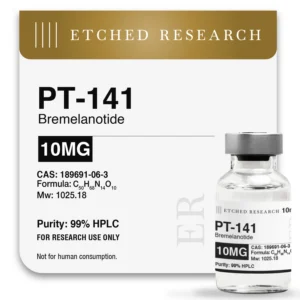
Etched Research supplies PT-141 as a lyophilized powder for laboratory research. The PT-141 10mg product page lists its identity data and storage.
How it works
Bremelanotide is a synthetic analog of alpha-MSH, a natural hormone, and it switches on melanocortin receptors. The approved drug’s prescribing information says it activates several receptor subtypes, and that at the doses used in the trials, binding to MC1R and MC4R matters most. MC4R is found in many areas of the brain and spinal cord. MC1R sits on pigment cells, which is why the label lists darkened patches of skin as a known effect.
The honest part: the same label says the mechanism by which the drug improves HSDD in women is unknown. The chain from receptor to measured desire scores is not mapped, and the human evidence sits inside one narrow group of people.
What the research does not establish
- The phase 3 evidence covers one narrow group only: premenopausal women with a specific low-desire diagnosis. The approved drug’s label says it is not indicated for postmenopausal women or men, or to enhance sexual performance. The earlier nasal-spray studies in men and women were small and short.
- The approved product is a regulated prescription medicine. A research compound is not that medicine, and approval of the drug is not permission to self-use research material.
- Trials reported side effects including nausea, flushing, headache and short rises in blood pressure. An independent re-analysis found dropout for side effects much higher on bremelanotide than on placebo. Listing side effects is not a safety conclusion.
- The findings measure desire scores, distress scores, and self-report. They do not tell you what the compound would do for any one person.
- Nothing here is a safety conclusion, and this is not a claim that the compound is safe to use.
- This page is a research summary only.
The one approved use is real, and it is narrow. Everything past that edge is unsettled, whatever a seller tells you.
Common questions
Is bremelanotide the same as PT-141?
Yes. PT-141 is the development code and bremelanotide is the generic drug name for the same molecule, with the same PubChem entry (PubChem CID 9941379). Vyleesi is the brand name of the approved prescription drug, which contains bremelanotide as an acetate salt (Drugs@FDA).
Is PT-141 a peptide?
Yes. The FDA prescribing information describes it as a synthetic, cyclic heptapeptide, meaning a ring-shaped chain of seven amino acids (Drugs@FDA). The same label says the body breaks it down by cutting the bonds between those amino acids.
What is the difference between PT-141 and Melanotan 2?
They share the same seven-amino-acid ring. PubChem lists the same core structure for both, and the difference is at one end of the chain: bremelanotide ends in a carboxylic acid, Melanotan II ends in an amide (bremelanotide, CID 9941379, Melanotan II, CID 92432). Bremelanotide went through phase 3 trials and FDA review. The trials on this page do not test Melanotan II or compare the two.
Was a nasal form of PT-141 tested?
The nasal form was tested only in early, small studies. In 18 premenopausal women with sexual arousal disorder, one 20 mg nasal dose led more women to report moderate or high desire than placebo, but the in-clinic blood-flow measure did not change (Diamond et al., 2006). The phase 3 trials and the approved drug use an injection under the skin, not a nasal spray (Kingsberg et al., 2019). No phase 3 trial of a nasal form is cited here.
Last reviewed 2026-09-24.
New reports, new research.
We send a note when a new lab report is posted or a compound comes back in stock, plus a short list of new research pages in any month we publish some. Never more than one email a week, and nothing else.
For Research Use Only. Not for human consumption. Etched Research supplies compounds for laboratory and research use only. Nothing on this page is medical advice, a health claim, or a recommendation to use.
The Janoshik lab result for this compound is on the COA page. For research use only.