Thymosin Alpha-1: What the Research Actually Shows
- What it is: A lab-made copy of a natural thymus peptide that researchers use to study how the immune system is signaled and tuned.
- Research areas: Severe sepsis in the ICU, chronic hepatitis B trials, and broader immune-modulation research.
- Evidence level: Randomized human trials exist, in sepsis and hepatitis B. The catch is the results are mixed, and the largest recent trial came back close to a tie.
- The short version: Thymosin Alpha-1 has been tested in randomized human trials in sepsis and hepatitis B. The record is real, but it is mixed, and none of it is a green light to use anything.
The Janoshik lab result for this compound is on the COA page. For research use only.
On this page: Quick facts · Is Thymosin Alpha-1 FDA approved? · What the human trials found · How it works · Limits · Common questions
Thymosin Alpha-1 is an immune-signaling peptide with a longer human research trail than most compounds in this space. This page lays out what researchers actually tested, in what kind of study, and what they found, in plain words.
We are telling you what researchers observed in their models. We are not telling you what it does for you.
Quick facts
- Names: Thymosin Alpha-1, thymalfasin (the generic drug name), Tα1, TA1. Sold as a prescription drug under the name Zadaxin in some countries outside the US.
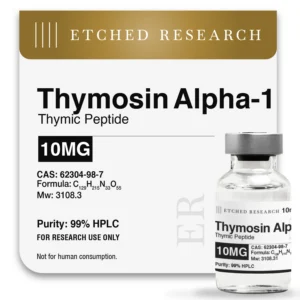
- What it is: a 28-amino-acid, highly acidic peptide first isolated from calf thymus and sequenced in 1977 in Allan Goldstein’s lab (Goldstein et al., PNAS, 1977). Molecular formula C129H215N33O55, 3108.3 g/mol (PubChem).
- Human trials: three randomized trials and one pooled analysis are summarized below, three of the four in sepsis. The largest trial found no clear difference from placebo. A fifth entry is a US pilot trial that stopped early with no results posted.
- How the body handles it: in 9 healthy volunteers given an injection under the skin, blood levels peaked within 1 to 2 hours and the elimination half-life was under 3 hours (Rost et al., 1999).
- Approval status: not approved in the United States. See below.
Is Thymosin Alpha-1 FDA approved?
No. In a December 2024 briefing document, the FDA stated that it has approved no drug products containing thymosin alpha-1, and that it is not approved in the United States, Japan or Europe, with Italy the one European exception. The same document notes that its maker, SciClone Pharmaceuticals, reports approvals for its product Zadaxin in countries across the Asia-Pacific region, Latin America, Eastern Europe and the Middle East, and that the FDA could not independently verify those claims in every country. FDA Pharmacy Compounding Advisory Committee briefing, 4 December 2024.
Etched Research does not sell Zadaxin. The Thymosin Alpha-1 Etched Research sells is a research compound for laboratory use only, and it is not for human use.
What the research found, and what it did not
The trials below ran in hospital patients with sepsis and in adults with chronic hepatitis B. The results are listed as reported, including the ones that missed.
Severe sepsis trial, 361 patients (ETASS, Critical Care, 2013). A multicenter randomized controlled trial in six Chinese teaching hospitals. Researchers split 361 ICU patients with severe sepsis into a treatment group (181) and a control group (180). They recorded a lower 28-day death rate in the Thymosin Alpha-1 group (26% versus 35%), with a relative risk of 0.74. That result sat right at the edge of statistical significance (95% CI 0.54 to 1.02), so it pointed in a direction rather than closing the case. PMID 23327199. https://pubmed.ncbi.nlm.nih.gov/23327199/
Larger sepsis trial, 1,106 patients (TESTS, BMJ, 2025). A bigger, tougher follow-up. This was a multicentre, double-blind, placebo-controlled phase 3 trial across 22 centres in China. Researchers randomized 1,106 adults with sepsis to Thymosin Alpha-1 (552) or placebo (554). At 28 days, the death rate was nearly the same in both arms (23.4% versus 24.1%). In plain terms, the largest and best-controlled trial did not show a clear survival difference. PMID 39814420. https://pubmed.ncbi.nlm.nih.gov/39814420/
Pooled analysis of sepsis trials (Front Cell Infect Microbiol, 2025). A systematic review and meta-analysis that combined the randomized sepsis trials, including the mixed ones above. Across the pooled data, researchers reported a lower 28-day mortality overall (odds ratio 0.73, 95% CI 0.59 to 0.90). The same authors were careful to note the effect changed a lot between subgroups, so the pooled number hides real variation. PMID 40969554. https://pubmed.ncbi.nlm.nih.gov/40969554/
Chronic hepatitis B phase III trial (J Viral Hepat, 1999). A randomized, double-blind, placebo-controlled study in 97 patients who were hepatitis B e-antigen positive with detectable virus. Patients got Thymosin Alpha-1 or placebo twice a week for six months. Researchers saw a modest edge in the treatment group (14% complete response versus 4%), but it did not reach statistical significance (P = 0.084), and the authors said their data did not confirm the stronger results reported elsewhere. PMID 10607256. https://pubmed.ncbi.nlm.nih.gov/10607256/
US pilot trial in COVID-19, stopped early (Rhode Island Hospital, 2020 to 2023). A phase 2 pilot trial of thymalfasin in hospital patients with COVID-19 and low lymphocyte counts (a type of white blood cell). It enrolled 56 people and was terminated because enrollment was slow and the lead investigator moved to another institution. No results are posted, so it gives no answer either way. NCT04487444. https://clinicaltrials.gov/study/NCT04487444
Etched Research’s Thymosin Alpha-1 10mg is sold for laboratory research only, and its page lists the identity data.
How it works
The thymus is a small gland behind the breastbone where T-cells, a type of immune cell, mature. It makes a natural peptide called thymosin alpha 1, and this compound is a lab-made copy of it.
Researchers examine it as an immune modulator, mostly in T-cell activity and in the messengers immune cells use to signal each other. The research asks how it shifts that signaling, not whether it pushes the immune system up or down.
The sepsis and hepatitis B trials above tested that idea in hospital patients, and the results are mixed.
The honest read on mechanism: researchers describe it as an immune-modulator, and the exact chain of steps is still being worked out in the literature.
What the research does not establish
The limits matter more than the headlines.
- The results are mixed, not settled. A smaller trial leaned positive, the largest and most rigorous trial (TESTS) came back close to a tie, and a pooled analysis landed in between. Anyone selling this as proven is ahead of the evidence.
- The human trials ran in sick, hospitalized people (severe sepsis, chronic hepatitis B). Researchers have not established these results in healthy adults or the general public.
- The studies tracked specific endpoints (28-day death, viral response) over weeks to months. They do not establish long-term outcomes, and they were not built to show anything about performance, recovery, or day-to-day immune health.
- One trial carried the word “safety” in its name. That refers to what researchers monitored inside a controlled hospital study. It is not a statement that this compound is safe for any one person to use, and nothing here is a claim that it is safe.
- This page is a research summary only.
Common questions
Is Thymosin Alpha-1 the same as TB-500?
No. They are different molecules that share the word “thymosin” because both come from the thymosin family first described in thymus extract (Goldstein et al., PNAS, 1977). Thymosin Alpha-1 is a 28-amino-acid peptide examined in immune signaling research. TB-500 is a research-market name tied to thymosin beta-4 (Tewari et al., Am J Sports Med, 2026), a separate protein that is the main actin-binding molecule in cells and is studied mostly in wound and tissue repair (Goldstein et al., Trends Mol Med, 2005).
Is Thymosin Alpha-1 a growth hormone or a steroid?
Neither. It is a short peptide from the thymus, and researchers describe it as an immune modulator. The FDA’s 2024 review notes its immune effects are carried at least in part through Toll-like receptor 9 on dendritic and lymphoid cells (FDA briefing, 2024). It is not a growth hormone, a growth-hormone releaser or a steroid hormone.
Where has Thymosin Alpha-1 been tested in people?
In published human research, it has been tested mainly in two settings: adults in intensive care with sepsis, and adults with chronic hepatitis B. The results are covered above and are mixed. The largest sepsis trial found no clear difference in 28-day deaths (Wu et al., BMJ, 2025), and the hepatitis B trial did not reach statistical significance (Mutchnick et al., 1999). Its maker reports approvals outside the US for uses including hepatitis B and C, which the FDA says it could not verify in every country. This page covers the research only.
Last reviewed 2026-09-24.
New reports, new research.
We send a note when a new lab report is posted or a compound comes back in stock, plus a short list of new research pages in any month we publish some. Never more than one email a week, and nothing else.
For Research Use Only. Not for human consumption. Etched Research supplies compounds for laboratory and research use only. Nothing on this page is medical advice, a health claim, or a recommendation to use.
The Janoshik lab result for this compound is on the COA page. For research use only.