Selank: What the Research Actually Shows
- What it is: A synthetic 7-amino-acid peptide developed by Russian researchers, based on a natural fragment called tuftsin.
- Research areas: anxiety and neurasthenia, nootropic (thinking and focus) effects, and how it acts on the GABA calming system.
- Evidence level: Thin and mostly Russian-language. The human studies are small, and there are no large, independent Western trials confirming them.
- The short version: Most Selank research is small and published in Russian, and the exact pathway is still an open question. The leading idea points at the brain’s GABA calming system. The human case is not settled, and this is a research summary, not a reason to use anything.
The Janoshik lab result for this compound is on the COA page. For research use only.
On this page: Quick facts · Is Selank FDA approved? · What the research found · How it works · Limits · Common questions
Selank is a synthetic peptide developed by Russian researchers. Most of its human research is two small anxiety studies, and most of the rest is rat and cell work on the GABA system. Most of that research was published in Russian, and the English-language evidence is thin, so this page is honest about how much (and how little) has actually made it into print.
Here is the honest version. Below is what researchers looked at, in what kind of model, and what they observed.
Quick facts
- Names: Selank, TP-7, Selanc, and its sequence written out, Thr-Lys-Pro-Arg-Pro-Gly-Pro (PubChem).
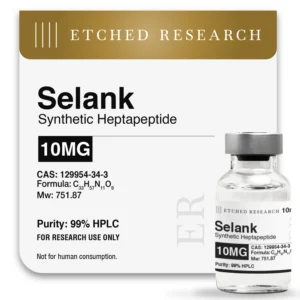
- What it is: a synthetic seven-amino-acid peptide. It is tuftsin (Thr-Lys-Pro-Arg) with three more amino acids, Pro-Gly-Pro, added to the end (Czabak-Garbacz et al., Pharmacological Reports, 2006). Formula C33H57N11O9, molecular weight 751.9 g/mol (PubChem CID 11765600).
- Who developed it: the Institute of Molecular Genetics of the Russian Academy of Sciences, with the Zakusov Institute of Pharmacology, both in Moscow (Filatova et al., 2017).
- Evidence on this page: two small human studies (62 and 60 adults with anxiety disorders, each compared with a benzodiazepine, no placebo group reported, published in Russian), plus rat, cell and blood-sample studies. All of it comes from Russian research groups.
- Approval: listed among the peptide drugs registered in the Russian Federation, classed there as an anxiolytic (Deigin et al., Pharmaceutics, 2022). Not approved in the US. See below.
Is Selank FDA approved?
No. We found no Selank approval in FDA’s drug approval database (Drugs@FDA, searched 24 September 2026). FDA does name it on its list of bulk substances that may present significant safety risks in compounding. For selank acetate, FDA says compounded drugs may carry a risk of immune reactions for some routes, from clumping and peptide-related impurities, and that it lacks important information on the safety of selank acetate given to humans. It sits in the section for substances once in category 2 whose nominations were withdrawn (FDA, content current as of 22 April 2026).
Outside the US, a 2022 review of Russian peptide drugs lists Selank among the 14 peptide products registered in the Russian Federation (Deigin et al., 2022). Etched Research does not sell that product. The Selank Etched Research sells is a research compound for laboratory use only, and it is not for human use.
What the research found, and what it did not
Two small human studies in adults with anxiety disorders, one rat study and one cell study, all from Russian research groups. The results are listed as the authors reported them.
Anxiety and neurasthenia trial (Zh Nevrol Psikhiatr Im S S Korsakova, 2008). A study in 62 people with generalized anxiety disorder and neurasthenia (a long-standing “worn out” state). Selank in 30 patients was compared with medazepam, an anti-anxiety drug, in 32 patients. Researchers reported the anti-anxiety effect was similar between the two, with Selank also showing anti-fatigue and mild stimulant effects in that group. They also measured enkephalin, one of the body’s own opioid-like signals, in the blood. Its half-life rose during Selank treatment, mostly in the generalized anxiety patients. The abstract reports no placebo group. This is a small study in a Russian-language journal. PMID 18454096. https://pubmed.ncbi.nlm.nih.gov/18454096/
Comparison with phenazepam (Zh Nevrol Psikhiatr Im S S Korsakova, 2014). A later Russian study compared Selank with phenazepam, a benzodiazepine, in 60 patients with phobic anxiety and somatoform disorders. Researchers reported anti-anxiety and mild nootropic effects, with the anti-anxiety effect lasting a week after the last dose, and a better quality of life. The abstract gives no numbers and does not say how Selank compared with phenazepam. Again, a small Russian-language study. PMID 25176261. https://pubmed.ncbi.nlm.nih.gov/25176261/
Selank plus diazepam in rats (Behavioural Neurology, 2017). An animal study, not people. Researchers gave 48 rats Selank, diazepam, both, or salt water for 14 days, with half the rats put through chronic mild stress, and tested anxiety in a maze. Without stress, every group scored more anxious after the 14 days of dosing, and the Selank group changed least (none of those changes was statistically significant). Under stress, rats given Selank plus diazepam scored the same as before the stress. Groups were small, six rats each. Live animal model. PMID 28280289. https://pubmed.ncbi.nlm.nih.gov/28280289/
Gene expression in nerve cells (Frontiers in Pharmacology, 2017). An in vitro study, meaning isolated neuroblastoma cells in a lab dish rather than a live animal. Researchers looked at 84 genes tied to the GABA system (the brain’s main calming signal). Selank alone did not directly change those gene levels, but it shifted how GABA acted on them. The authors said this partly supports the idea that Selank affects how GABA meets its receptor. PMID 28293190. https://pubmed.ncbi.nlm.nih.gov/28293190/
Etched Research supplies Selank as a lyophilized powder for laboratory research. The Selank 10mg product page lists its identity data and storage.
How it works
Selank is a heptapeptide, a chain of seven amino acids. Its first four are tuftsin, a natural fragment cut from the immune protein immunoglobulin G. Tuftsin acts on immune cells that swallow germs and debris, such as macrophages (Fridkin and Najjar, 1989). Selank adds a three-amino-acid tail, Pro-Gly-Pro. Russian researchers report that short peptides carrying this tail are far more stable than most signaling peptides, and they name Selank as one of them (Ashmarin et al., 2005).
The leading idea in the research points at the GABA system, the signal that calms brain activity down. In the cell study above, Selank did not switch GABA genes on or off by itself, but it changed how GABA behaved. Other work has pointed at the enzymes that break down enkephalins, the body’s own opioid-like signals, in human blood samples (Zozulya et al., 2001), and at immune messengers such as IL-6 in blood from patients (Uchakina et al., 2008). Animal work has also measured brain chemicals. In a mouse study, a Selank injection raised norepinephrine in the hypothalamus of two mouse strains, but moved dopamine breakdown products in opposite directions in the two strains and lowered serotonin in the hippocampus of only one (Narkevich et al., 2008, in Russian). In the 2019 alcohol study in rats, Selank blocked a rise in BDNF, a protein that supports nerve cells, in two brain areas (Kolik et al., 2019). The honest read: the exact receptor and pathway are still open questions in the published research. No single clean mechanism has been locked down.
What the research does not establish
The honest limits are the whole point here.
- The evidence base is thin and mostly Russian-language. The human studies are small, and there are no large, independent Western randomized trials confirming them.
- There is no approved use in the US. Selank is not an FDA-approved drug, and it has not been shown to be effective or safe in the general public.
- The strongest-sounding findings come from small clinical studies or from animal and cell models. What happened in those settings does not tell you what would happen in a person.
- Nothing here is a safety conclusion, and this is not a claim that the compound is safe to use.
- This page is a research summary only.
Anyone telling you the human case is settled is well ahead of the published research.
Common questions
Are Selank and Semax the same?
No. Both are seven-amino-acid peptides from the same Moscow institute, and both end in the same Pro-Gly-Pro tail. Selank is built on tuftsin (Czabak-Garbacz et al., 2006), and Semax on a fragment of the hormone ACTH (PubChem). One Russian study gave either one, or a placebo, to 52 healthy people and compared brain scans. It reported both shared and separate effects on the connection between the amygdala and part of the temporal lobe, measured over 20 minutes (Panikratova et al., 2020). It measured brain connections only, not symptoms or behavior.
What did the human Selank studies measure?
The two human studies we found compared Selank with a benzodiazepine in small groups of adults with anxiety diagnoses, and neither abstract reports a placebo group (Zozulia et al., 2008). In 62 adults with generalized anxiety disorder and neurasthenia, the anti-anxiety effect was similar to medazepam, a benzodiazepine (Zozulia et al., 2008). A 60-patient study against phenazepam reported an anti-anxiety effect but gives no numbers in its abstract (Medvedev et al., 2014). Neither abstract reports a placebo group, both are in Russian, and neither has been repeated outside Russia.
Is Selank approved anywhere?
Not in the US. A 2022 review lists it among the peptide drugs registered in Russia, classed as an anxiolytic (Deigin et al., 2022). In research, it has been examined in the small anxiety trials above and in rat and cell work on the GABA system, stress and memory. In a 2019 rat study, Selank given for 7 days raised memory-test scores in rats not given alcohol, and in rats given alcohol for 30 weeks it prevented the memory drop seen during withdrawal (Kolik et al., 2019).
Last reviewed 2026-09-24.
New reports, new research.
We send a note when a new lab report is posted or a compound comes back in stock, plus a short list of new research pages in any month we publish some. Never more than one email a week, and nothing else.
For Research Use Only. Not for human consumption. Etched Research supplies compounds for laboratory and research use only. Nothing on this page is medical advice, a health claim, or a recommendation to use.
The Janoshik lab result for this compound is on the COA page. For research use only.