Epithalon: What the Research Actually Shows
- What it is: A synthetic four-amino-acid peptide bioregulator, modeled on a pineal-gland extract and studied in telomerase research.
- Research areas: Telomerase activity and telomere length in cells, a lifetime study in one mouse strain, and pineal and circadian signaling.
- Evidence level: Thin. Mostly older Russian lab and animal work, plus a couple of recent cell studies. No controlled human trial.
- The short version: Epithalon is a four-amino-acid peptide with a big story and a small evidence base. Most of what researchers have published comes from Russian animal and cell studies, with very little independent confirmation.
No independent lab report is on file for this compound. For research use only.
On this page: Quick facts · What the research found · How it works · Bioregulators · Limits · Common questions
Epithalon (also spelled Epitalon) is a synthetic pineal-gland peptide that Russian researchers have studied for decades in aging and telomere work. The honest version is that the science is mostly animal and cell-based, the human evidence is thin, and this page keeps that front and center.
We are telling you what researchers observed in their models.
Quick facts
- Names: Epithalon, Epitalon, Epithalone and AEDG, all the same peptide (PubChem CID 219042). It is not the same thing as Epithalamin, the pineal extract it was designed from.
- What it is: a synthetic peptide of 4 amino acids, called a tetrapeptide (Ala-Glu-Asp-Gly), formula C14H22N4O9, 390.35 g/mol (PubChem). Its sequence was designed from the amino-acid makeup of Epithalamin, an extract of cattle pineal glands (Araj et al., Int J Mol Sci, 2025).
- Evidence: mostly cell and animal studies, and most of them list Vladimir Khavinson of the St. Petersburg Institute of Bioregulation and Gerontology as an author. A few small human reports exist, mostly in Russian-language journals, with no comparison group described in their abstracts. The main independent study we found is a 2025 cell study from a UK university (Al-Dulaimi et al., 2025).
- Approval: Epithalon is not an FDA-approved drug. The FDA lists epitalon among substances that were in category 2 (“may present significant safety risks”) before their nominations were withdrawn, and its entry says the agency “lacks sufficient information to know whether the drug would cause harm if administered to humans” (FDA, page current as of 22 April 2026). We found no approval of it as a drug by any regulator.
What the research found, and what it did not
Most studies below used cells in a dish or mice, and most come from one research group in St. Petersburg, Russia. The two small human reports are included with their limits, and so are the results that did not move.
Telomerase in human cells (Bull Exp Biol Med, 2003). The best-known early paper, from Vladimir Khavinson’s group at the St. Petersburg Institute of Bioregulation and Gerontology. Working with human fetal fibroblasts in a dish (in vitro, not in a person), a cell type that starts with no telomerase activity, researchers reported that Epithalon switched on telomerase activity and lengthened telomeres, the protective caps on the ends of chromosomes. This is a cell-culture finding, not a human outcome. PMID 12937682. https://pubmed.ncbi.nlm.nih.gov/12937682/
Lifespan and aging markers in mice (Biogerontology, 2003). An animal study in female SHR mice, 54 per group, injected on 5 days in a row every month from three months of age until natural death. Researchers reported the peptide did not change average lifespan or body weight, but it raised maximum lifespan by about 12%, slowed the age-related loss of reproductive cycling, and lowered chromosome damage in bone marrow cells. Real animal data, one strain, one lab group. PMID 14501183. https://pubmed.ncbi.nlm.nih.gov/14501183/
Telomere length in human cell lines (Biogerontology, 2025). A more recent lab study that revisited the telomere claim, from a group at Brunel University London, outside the St. Petersburg program. Working with two breast cancer cell lines and normal human epithelial cells and fibroblasts, researchers reported that Epitalon increased telomere length, through telomerase in the normal cells and through an alternative lengthening pathway (ALT) in the cancer cells. Again, this is cell culture in a lab, not a study in living people. PMID 40908429. https://pubmed.ncbi.nlm.nih.gov/40908429/
Melatonin in old monkeys and older people (Advances in Gerontology, 2007). A Russian-language report, with Khavinson among the authors. It gave Epitalon, and separately Epithalamin, to old monkeys and to older people, and the authors report that night-time melatonin in the blood rose. The English abstract gives no group sizes, doses or comparison group, so this is a small uncontrolled report, not a trial. PMID 17969590. https://pubmed.ncbi.nlm.nih.gov/17969590/
Retinal degeneration in rats and patients (Neuro Endocrinology Letters, 2002). From Khavinson’s group. In Campbell rats, a strain with inherited retinal degeneration, researchers reported better electrical and functional activity of the retina. In patients with degenerative retinal disease, the abstract reports a positive clinical effect in 90% of cases, but it gives no patient number, dose or comparison group. PMID 12195242. https://pubmed.ncbi.nlm.nih.gov/12195242/
2025 overview of the whole record (Int J Mol Sci, 2025). A recent review from the Medical University of Warsaw that pulled together roughly 25 years of Epitalon research across cell, animal, and computer-model studies. The authors describe geroprotective and neuroendocrine effects reported in that work. They also say it remains uncertain whether the mechanisms found so far are the only ones, and that physical and structural studies of the peptide are still limited. The review’s tone is favorable, so read it as a map of the literature, not an independent test of it. PMID 40141333. https://pubmed.ncbi.nlm.nih.gov/40141333/
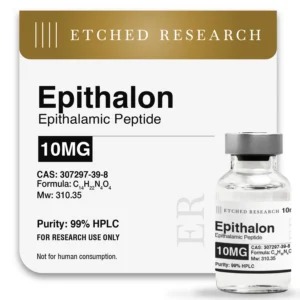
Etched Research supplies Epithalon as a lyophilized powder for laboratory research. The Epithalon 10mg product page lists its identity data and storage.
How it works
Epithalon is a short peptide, just four amino acids (Ala-Glu-Asp-Gly, or AEDG). Its sequence was designed from the amino-acid makeup of epithalamin, a natural extract from the pineal gland (a tiny gland in the brain tied to sleep and daily rhythm).
The headline idea in the research is telomerase. Each time a cell divides, its telomeres get a little shorter, and that shortening is one marker of aging. Telomerase is the enzyme that can add length back. In the cell studies above, researchers reported Epithalon nudging telomerase activity and telomere length upward. A second thread in the work points at the pineal and neuroendocrine side, meaning effects on hormone and circadian signaling.
The honest read on mechanism: it is a working theory built mostly on cell and animal data. The 2025 review says it remains uncertain whether the mechanisms found so far are the only ones. Apart from that, the human piece is largely missing.
What are bioregulators, and where does Epithalon sit?
Epithalon is usually described as a bioregulator, and that word means something specific. Bioregulators are very short peptides, 2 to 7 amino acids long in this literature, that came out of one Russian research program at the St. Petersburg Institute of Bioregulation and Gerontology (Khavinson et al., Molecules, 2021). Each one in the group is matched to a particular tissue.
The proposed mechanism is what separates them from most other research peptides. The theory in this literature is that short peptides can enter the cell nucleus and interact with histone proteins and with DNA, including sequences in gene promoters, turning particular genes up or down (Khavinson et al., 2021). In one lab study, labeled Epithalon was seen inside the nucleus of cultured human cells (Fedoreyeva et al., 2011). That is why the research describes them as epigenetic regulators rather than hormones. It is a proposed mechanism, not a settled one, and most of the work behind it comes from the same research program.
The first generation were crude extracts taken from animal organ tissue. Epithalamin, the pineal extract that Epithalon was modeled on, is one of those. The second generation are the synthetic short peptides, and Epithalon (Ala-Glu-Asp-Gly) is the most studied compound in the group.
Other compounds named in the same body of work, with the tissue each is designated for in that literature, include Thymogen and Thymalin (thymus), Vilon (immune), Pinealon (brain and pineal), Cortagen (cerebral cortex), Cartalax (cartilage), Livagen (liver), Testagen (testes), Ovagen, Bronchogen (bronchial), Chonluten and Vesugen (vascular). Etched Research does not stock any of these. They are named here because the family context is part of reading the Epithalon record honestly.
The evidence caveat applies to the whole family, and harder
Everything on this page about thin evidence applies to bioregulators generally, and arguably more so. Almost the entire literature traces back to that one research program, much of it published in Russian-language journals, with small sample sizes and limited independent replication outside it. Epithalon is the best-documented compound in the group and it still has no controlled human trial. The rest have considerably less behind them.
What the research does not establish
The honest limits are the whole point here.
- The evidence base is thin and heavily tied to one research program. The strongest lifespan and telomere claims come from Russian animal and cell studies, and they have not been broadly replicated by independent labs. The 2025 UK cell study is the main exception we found, and it was also in cells, not people.
- We found no controlled human trial of Epithalon. Cell-dish and mouse results do not tell you what would happen in a person. A search of the US trial registry, ClinicalTrials.gov, for epitalon, epithalon and epithalamin returned no registered studies (ClinicalTrials.gov, checked 24 September 2026).
- The animal lifespan finding was specific and modest. In the mouse study, average lifespan did not change, and only the longest-lived mice lived longer, in one strain, under one lab’s conditions.
- Nothing here is a safety conclusion, and this is not a claim that the compound is safe to use.
- This page is a research summary only.
Common questions
Is Epitalon the same as Epithalon?
Yes. Epitalon, Epithalon and Epithalone are spellings of the same peptide, Ala-Glu-Asp-Gly, and PubChem lists all three under one record (PubChem CID 219042). Epithalamin is different: it is the extract of cattle pineal glands that Epitalon’s sequence was designed from (Araj et al., 2025).
Is Epitalon FDA approved?
No. Epitalon is not an FDA-approved drug for any use. On the FDA’s compounding page, it is listed among substances that were in category 2 before their nominations were withdrawn, and its entry says the agency lacks enough information to know whether it would cause harm in people (FDA).
Is Epitalon a growth hormone?
No. It is a four-amino-acid peptide (PubChem), while growth hormone is a much larger protein. The research on Epitalon centers on telomerase and on pineal and melatonin signaling (Araj et al., 2025), not on growth hormone release.
What did the melatonin report measure?
Night-time melatonin in the blood. A 2007 Russian-language report said it rose in old monkeys and older people given Epitalon or the pineal extract, but its abstract gives no group sizes or comparison group (Korkushko et al., 2007). None of the studies on this page measured sleep.
Last reviewed 2026-09-24.
New reports, new research.
We send a note when a new lab report is posted or a compound comes back in stock, plus a short list of new research pages in any month we publish some. Never more than one email a week, and nothing else.
For Research Use Only. Not for human consumption. Etched Research supplies compounds for laboratory and research use only. Nothing on this page is medical advice, a health claim, or a recommendation to use.
No independent lab report is on file for this compound. For research use only.