Tesamorelin: What the Research Actually Shows
- What it is: A lab-made analog of GHRH, the growth hormone releasing hormone the brain makes.
- Research areas: Deep belly (visceral) fat, liver fat, and related blood markers in people with HIV-associated fat changes.
- Evidence level: Human clinical trials exist, mostly in people with HIV-associated fat changes.
- The short version: Tesamorelin is one of the more heavily studied growth hormone signaling compounds, with real human trial data behind it. Researchers measured drops in visceral and liver fat over a matter of months, almost all in people with HIV-related fat changes. Those trials also logged side effects, and none of this is a safety conclusion.
The Janoshik lab result for this compound is on the certificate of analysis page. For research use only.
On this page: Quick facts · Is Tesamorelin FDA approved? · What the human trials found · How it works · Limits · Common questions
Tesamorelin is one of the most heavily studied compounds in the Growth Hormone Signaling Research category, with real human clinical-trial data behind it. This page walks through what researchers have looked at, in plain language, so you can read the science for yourself.
A quick note on framing. Tesamorelin is a lab-made analog of GHRH (growth hormone releasing hormone), not a copy of it. The approved drug version has one narrow FDA-approved use, quoted from the FDA label in the section below. We cite the trial literature as research.
Quick facts
- Names: tesamorelin (generic name), TH9507 (development code). The prescription drug is sold as Egrifta.
- What it is: a synthetic analog of human GHRH. It carries the full 44-amino-acid GHRH sequence, with a hexenoyl group (a six-carbon chain) attached to the first amino acid, tyrosine. It is a GHRH analog, not a GLP-1 compound.
- Human trials: two phase 3 trials and further randomized trials, all in adults with HIV who had extra abdominal fat. A 2026 meta-analysis pooled five of them.
- How the body handles it (from the approved drug’s prescribing information): after an injection under the skin, blood levels peak at about 0.15 hour (roughly 9 minutes), less than 4% of the dose reaches the blood, and the mean elimination half-life in healthy subjects was 11 minutes.
- Approved drug: Egrifta (tesamorelin, as an acetate salt), first approved by the FDA in 2010. See below.
Is Tesamorelin FDA approved?
Yes, as a prescription drug. The FDA first approved Egrifta, whose active ingredient is tesamorelin as an acetate salt, in 2010. Its current label (Egrifta WR, revised March 2025) says it is indicated to reduce excess abdominal fat in adults with HIV who have lipodystrophy. The same label says it is not indicated for weight loss management, because it has a weight-neutral effect, and that its long-term cardiovascular safety has not been established. FDA prescribing information.
That approval covers one prescription product for one condition. Etched Research does not sell Egrifta. The tesamorelin Etched Research sells is a research compound for laboratory use only, and it is not for human use.
What the research found, and what it did not
Every trial below except the last ran in adults with HIV who had extra abdominal fat. The last one enrolled older adults, some healthy and some with mild memory problems.
Phase 3 trial, 412 participants (Falutz, NEJM, 2007). A large randomized, placebo-controlled trial in people with HIV and abdominal fat. Over 26 weeks, researchers measured a drop in visceral fat (the deep fat around the organs) in the tesamorelin group compared to placebo. PMID 18057338. https://pubmed.ncbi.nlm.nih.gov/18057338/
Visceral fat and liver fat (Stanley, JAMA, 2014). A randomized, placebo-controlled trial of 50 participants over 6 months. Researchers recorded reductions in both visceral fat and liver fat in the study group versus placebo. PMID 25038357. https://pubmed.ncbi.nlm.nih.gov/25038357/
Metabolic markers (Stanley, Clinical Infectious Diseases, 2012). An analysis that tied the visceral-fat reduction seen in the trials to improvements in certain blood markers, like triglycerides, within the studied group. PMID 22495074. https://pubmed.ncbi.nlm.nih.gov/22495074/
Pooled meta-analysis of 5 trials (Badran, Obesity Research and Clinical Practice, 2026). Combined five randomized controlled trials. Across them, researchers reported reduced visceral fat, trunk fat, and liver fat, plus a modest rise in lean mass. The same review noted side effects logged in the trials, including joint pain, muscle pain, and injection-site reactions. PMID 41545261. https://pubmed.ncbi.nlm.nih.gov/41545261/
Trial registry record (ClinicalTrials.gov). One of the GHRH/tesamorelin studies in HIV-associated fat redistribution, registered as NCT01263717, with the full protocol and outcome measures on file. https://clinicaltrials.gov/study/NCT01263717
Thinking and memory in older adults (Baker, Archives of Neurology, 2012). A randomized, placebo-controlled trial of 152 adults aged 55 to 87. 66 had mild cognitive impairment (early memory and thinking problems), and the rest were healthy. Over 20 weeks, the tesamorelin group scored better than placebo on a combined thinking score, mostly on executive function (planning and switching between tasks). Verbal memory showed only a trend. IGF-1 rose 117% and body fat fell 7.4%. Side effects, all mild, were reported by 68% of the tesamorelin group and 36% of the placebo group. This is one trial, and the authors called for longer ones. PMID 22869065. https://pubmed.ncbi.nlm.nih.gov/22869065/
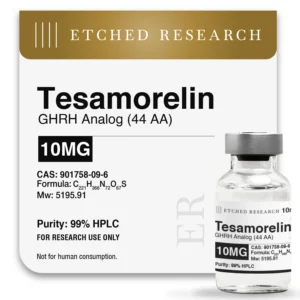
Etched Research supplies Tesamorelin as a lyophilized powder for laboratory research. The Tesamorelin 10mg product page lists its identity data and storage.
How it works
Your hypothalamus (a small region of the brain) sends a signal called GHRH to the pituitary gland. That signal tells the pituitary to release growth hormone.
Tesamorelin is a lab-made analog of that GHRH signal. It keeps the full natural GHRH sequence and adds a small fatty-acid group at one end, and trial researchers describe it as a stabilized analog of human GHRH (Baker et al., 2012). In the studies above, it pushed the pituitary to put out more of the body’s own growth hormone in natural pulses, which in turn raised IGF-1 (a downstream marker). Researchers studied this along the growth hormone signaling chain, the loop that runs brain to pituitary to liver.
The key point on mechanism: it works upstream. It asks the gland to release growth hormone, rather than adding growth hormone from outside. That is why researchers group it with GHRH analogs and not with direct GH.
What the research does not establish
The honest limits matter more than the headlines.
- Nearly every human tesamorelin trial enrolled participants with HIV-associated fat changes. Researchers have not established these same results in healthy adults. The thinking-score result in older adults comes from a single 20-week trial.
- The trials tracked specific markers (visceral fat, liver fat, IGF-1) over a matter of months. They do not establish outcomes over many years.
- The studies logged side effects such as joint pain and injection-site reactions within their groups. That record is not a statement about safety for any one person, and nothing here is a claim that this compound is safe to use.
- This page is a research summary only.
Common questions
Is tesamorelin a growth hormone?
No. It is a GHRH analog. The prescribing information describes it as stimulating the body’s own growth hormone production, which raises IGF-1. In the 412-person phase 3 trial, IGF-1 rose 81% on tesamorelin and fell 5% on placebo (Falutz et al., NEJM, 2007). Growth hormone itself is a different, much larger protein.
Is tesamorelin a peptide or a steroid?
A peptide. It is a chain of 44 amino acids with a small fatty-acid group attached at one end (FDA prescribing information). It has no steroid structure.
What is the difference between tesamorelin and sermorelin?
Both are GHRH analogs. Sermorelin is the first 29 amino acids of human GHRH (PubChem). Tesamorelin keeps all 44 and adds a hexenoyl group to the first amino acid. The trials cited on this page do not compare the two.
Is tesamorelin good for muscle growth?
That has not been tested directly. A 2026 meta-analysis of five randomized trials, all in adults with HIV-associated fat changes, found about 1.4 kg more lean body mass on tesamorelin than on placebo (Badran et al., 2026). Lean mass is not muscle size or strength. None of those five trials were built to measure strength or performance, and none ran in healthy adults.
How is tesamorelin different from CJC-1295 and ipamorelin?
CJC-1295 is also a GHRH analog, but a long-acting one. In healthy adults its half-life was 5.8 to 8.1 days, and one injection kept IGF-1 raised for 9 to 11 days (Teichman et al., JCEM, 2006). Tesamorelin’s mean half-life in healthy subjects was 11 minutes (FDA prescribing information). Ipamorelin works through a different receptor. It is a five-amino-acid peptide that acts on the GHRP receptor, the one ghrelin uses, not the GHRH receptor, based on rat and pig studies (Raun et al., 1998). No trial cited here compares the three directly.
Last reviewed 2026-09-24.
New reports, new research.
We send a note when a new lab report is posted or a compound comes back in stock, plus a short list of new research pages in any month we publish some. Never more than one email a week, and nothing else.
For Research Use Only. Not for human consumption. Etched Research supplies compounds for laboratory and research use only. Nothing on this page is medical advice, a health claim, or a recommendation to use.
The Janoshik lab result for this compound is on the certificate of analysis page. For research use only.