MOTS-c: What the Research Actually Shows
- What it is: A 16-amino-acid peptide that the body’s own mitochondria encode.
- Research areas: metabolism and insulin signaling, AMPK signaling in muscle, and bone loss in animal models.
- Evidence level: Almost all animal and cell work. The little human data measured the body’s own MOTS-c, not a peptide given to people.
- The short version: MOTS-c research centers on an energy sensor called AMPK, mostly in mice and cells. The human data is thin, and it measured the body’s own MOTS-c, not a peptide given to people.
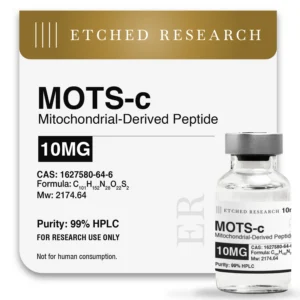
The Janoshik result for MOTS-c 10mg is on the COA page. No report is on file for the 40mg size. For research use only.
On this page: Quick facts · What the research found · How it works · Limits · Common questions
MOTS-c is a 16-amino-acid peptide encoded in mitochondrial DNA. Researchers have examined it mostly in metabolism, insulin signaling and AMPK research, almost all in animal and cell models.
Here is the honest version. Below is what the studies looked at, in what kind of model, and what they observed.
Quick facts
- Names: MOTS-c, short for mitochondrial open reading frame of the 12S rRNA-c.
- What it is: a 16-amino-acid peptide (MRWQEMGYIFYPRKLR) coded inside the mitochondrial gene for 12S ribosomal RNA, first described in 2015 by a University of Southern California group (Lee et al., Cell Metabolism, 2015). Molecular formula C101H152N28O22S2, 2174.6 g/mol (PubChem).
- Evidence: the studies below are in cells and mice, plus human exercise studies that measured the body’s own MOTS-c. No controlled human trial giving MOTS-c to people has been published.
- Approval status: MOTS-c is not an approved drug in the United States. The FDA’s Drugs@FDA database lists no product containing it.
What the research found, and what it did not
All the studies below ran in cells or mice, except the human exercise studies and one human genetics study, which measured natural MOTS-c or its gene and gave no peptide. The results are listed as reported, including the one that missed.
The founding metabolism study (Lee, Cell Metabolism, 2015). The paper that first described MOTS-c. Researchers ran cell experiments and mouse experiments and reported that skeletal muscle appeared to be its main target, and that treated mice were protected from diet-induced obesity and from insulin resistance tied to age and high-fat diet. Cells and mice, not people. PMID 25738459. https://pubmed.ncbi.nlm.nih.gov/25738459/
MOTS-c moves into the nucleus (Kim, Cell Metabolism, 2018). A cell study from the same group. Under metabolic stress such as glucose restriction, researchers found MOTS-c moved from the mitochondria into the nucleus, where it changed the activity of a broad range of genes, including antioxidant-response genes, and interacted with a stress-response factor called NRF2. The move depended on AMPK. Cells, not people. PMID 29983246. https://pubmed.ncbi.nlm.nih.gov/29983246/
Plasma metabolites and insulin markers (Kim, Physiological Reports, 2019). An animal study in diet-induced obese mice. Using metabolomics, researchers recorded a drop in three metabolic pathways that usually run high in obesity and diabetes models, and reported better insulin sensitivity. Mouse model. PMID 31293078. https://pubmed.ncbi.nlm.nih.gov/31293078/
Exercise and muscle aging (Reynolds, Nature Communications, 2021). A mixed study across young, middle-aged, and old mice, plus cell work and some human samples. Researchers observed that giving MOTS-c improved physical performance in mice at all three ages, including old mice treated late in life, and that in the human samples exercise raised the body’s own MOTS-c in muscle and blood. The human piece measured natural MOTS-c after exercise, not injected peptide. PMID 33473109. https://pubmed.ncbi.nlm.nih.gov/33473109/
A human exercise study that found only a trend (von Walden, Journal of Applied Physiology, 2021). Thirty people were randomized to one session of endurance exercise, resistance exercise or no exercise, and researchers measured natural MOTS-c and a related peptide, humanin, in blood and muscle. Humanin rose clearly after endurance exercise. MOTS-c showed only a trend to rise, and blood levels of both were not linked to fitness. No MOTS-c was given. PMID 34351816. https://pubmed.ncbi.nlm.nih.gov/34351816/
Bone loss and AMPK (Ming, Biochemical and Biophysical Research Communications, 2016). An animal study in mice that had surgery to model post-menopausal bone loss. Researchers observed less bone loss in treated mice and tied it to AMPK activation, since blocking AMPK partly cancelled the effect on bone-resorbing cells. Mouse model. PMID 27237975. https://pubmed.ncbi.nlm.nih.gov/27237975/
A MOTS-c gene variant and type 2 diabetes (Zempo, Aging, 2021). A human genetics study plus mouse and cell work. A mitochondrial DNA variant found in Asian populations (m.1382A>C) swaps one amino acid in MOTS-c (K14Q). Across three groups totaling 27,527 people, men who carried it had a higher rate of type 2 diabetes, and in one group the link showed up only in the least physically active men. Women showed no link. In male mice on a high-fat diet, normal MOTS-c was tied to lower weight and better glucose tolerance, and the variant form was not. The human part is an association in people who carry the variant naturally. No MOTS-c was given to people. PMID 33468709. https://pubmed.ncbi.nlm.nih.gov/33468709/
Muscle and fat metabolism review (Lee, Free Radical Biology and Medicine, 2016). A review of the mitochondrial-derived peptide field. The authors described MOTS-c as a signal that targets skeletal muscle and shifts glucose metabolism, and framed it as a new kind of mitochondrial messenger. A review, not new data. PMID 27216708. https://pubmed.ncbi.nlm.nih.gov/27216708/
Etched Research’s MOTS-c is sold in 10mg and 40mg vials for laboratory research only, and its product page lists the identity data.
How it works
MOTS-c is unusual because it comes from the mitochondria, the cell’s energy-making structures, rather than from the main DNA in the nucleus. That puts it in a small group called mitochondrial-derived peptides, short peptides read from mitochondrial DNA. Humanin, measured in the von Walden study above, is the other well-known one (Lee, 2016).
The mechanism researchers describe centers on an energy sensor called AMPK. In the founding study, MOTS-c held back the folate cycle and a linked purine-building pathway, and that led to AMPK switching on (Lee, 2015). In obese mice, a later study linked it to better insulin sensitivity and more fat burning for fuel (Kim, 2019).
MOTS-c may also carry signals the other way, from the mitochondria to the cell’s main DNA. In cells under metabolic stress it moved into the nucleus and changed which genes were switched on, a step that depended on AMPK (Kim, 2018).
The honest part: this is an energy-sensing and metabolism story built mostly from mice and cells. Human data so far is thin, and mostly about the body’s own MOTS-c rather than injected peptide.
What the research does not establish
- Almost all of it is animal and cell work. The metabolic and exercise findings come from mice and dishes, not from controlled human trials.
- The human data that exists mostly measured natural MOTS-c rising after exercise. That is not the same as showing an injected peptide does anything in people.
- There is no approved human use, and we found no controlled trial that gave MOTS-c to people.
- Each finding describes what happened in a research model.
- Nothing here is a safety conclusion, and this is not a claim that the compound is safe to use.
Common questions
What is the difference between MOTS-c and SS-31?
They are different kinds of molecule that both come up in mitochondrial research. MOTS-c is a 16-amino-acid peptide encoded in mitochondrial DNA itself, and the founding study described it as a metabolic signal acting mainly on skeletal muscle through AMPK (Lee et al., Cell Metabolism, 2015). SS-31 is a synthetic four-amino-acid peptide designed to bind cardiolipin, a lipid on the inner mitochondrial membrane. SS-31 has human trial data, with a mixed record. MOTS-c research is mostly in cells and animals. No published study compares the two directly. The SS-31 trials are covered on the SS-31 research summary.
Is MOTS-c FDA approved?
No. MOTS-c is not an approved drug in the United States, and the FDA’s Drugs@FDA database lists no product containing it. No controlled human trial giving MOTS-c to people has been published. This page covers the research only.
Is MOTS-c a GLP-1?
No. MOTS-c is a peptide encoded in mitochondrial DNA. The founding study traced its effects to the folate cycle and the AMPK energy sensor, mainly in skeletal muscle (Lee et al., 2015). That is a different pathway from the GLP-1 hormone receptor.
What did the obese-mouse studies measure?
They measured insulin sensitivity, body weight and liver fat in mice on a high-fat diet. In the founding study, treated mice were protected from diet-induced obesity (Lee et al., 2015). In a 2019 study of obese mice, the authors reported better insulin sensitivity and lower body weight and fatty liver (Kim et al., 2019). Neither abstract gives the size of the change. We found no published trial that gave MOTS-c to people.
Last reviewed 2026-09-24.
New reports, new research.
We send a note when a new lab report is posted or a compound comes back in stock, plus a short list of new research pages in any month we publish some. Never more than one email a week, and nothing else.
For Research Use Only. Not for human consumption. Etched Research supplies compounds for laboratory and research use only. Nothing on this page is medical advice, a health claim, or a recommendation to use.
The Janoshik result for MOTS-c 10mg is on the COA page. No report is on file for the 40mg size. For research use only.