Cagrilintide: What the Research Actually Shows
- What it is: Cagrilintide is a lab-made, long-acting amylin analog. Amylin is a natural hormone the body releases with insulin after a meal.
- Research areas: body weight in adults with overweight or obesity (clinical trials), and how amylin receptors in the brain respond to it (mouse work). Some trials tested it together with another compound, and those results are kept separate below.
- Evidence level: Real human trial data from phase 1, phase 2 and one phase 3 trial with a cagrilintide-only group, plus animal mechanism work. Still investigational.
- The short version: Cagrilintide is a long-acting amylin analog whose clinical trials measured body weight. Researchers looked at how body weight changed over a set number of weeks, both on its own and next to other compounds. Everything below is what happened in study models, not what it does for any person. Research use only.
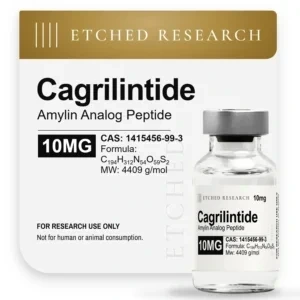
Cagrilintide 10mg. For research use only.
On this page: Quick facts · What the human trials found · How it works · Limits · Common questions
Cagrilintide is one of the newer names in metabolic research, and it already has human trial data behind it. This page lays out what researchers have studied, in plain language, and keeps the standalone research separate from the combination work.
Quick facts
- Names: cagrilintide (the generic drug name, INN), development code NN0174-0833 (PubChem).
- What it is: a 37-amino-acid amylin analog with a C20 fatty diacid attached to its first amino acid, formula C194H312N54O59S2, 4409 g/mol, CAS 1415456-99-3 (PubChem CID 171397054). Its developers built it as a stable, long-acting analog. The earlier amylin analog pramlintide, sold for diabetes, needs three injections a day because it clears quickly (Kruse et al., 2021).
- How long it lasts: in a 96-person trial where it was given alongside semaglutide, cagrilintide’s half-life was 159 to 195 hours, about 6.5 to 8 days, and it did not change how semaglutide was absorbed or cleared (Enebo et al., 2021).
- Human trials: phase 1 and phase 2 trials are published, and one phase 3 trial of the combination included a cagrilintide-only group. Phase 3 trials of cagrilintide on its own are listed as active on ClinicalTrials.gov (NCT07220642 and NCT07220759, searched 24 September 2026).
- Approval: we found no approval for cagrilintide from the FDA or any other regulator. In September 2025 its developer, Novo Nordisk, described it as being investigated in a new phase 3 program (Novo Nordisk release, 16 September 2025). When it filed the cagrilintide and semaglutide combination with the FDA in December 2025, it stated the combination “is not approved in the US or EU” (Novo Nordisk release, 18 December 2025).
What the research found, and what it did not
Every trial below ran in adults with overweight or obesity, most of them without diabetes. The standalone trials come first. The combination trial is kept separate, because its numbers belong to the pair.
Phase 2 dose-finding trial, standalone (Lau, Lancet, 2021). A randomized, double-blind trial with both a placebo group and an active comparator (liraglutide 3.0 mg). Of 906 adults with overweight or obesity and no diabetes, 706 received once-weekly cagrilintide on its own at doses from 0.3 to 4.5 mg for 26 weeks. Researchers recorded body-weight reductions ranging from about 6.0% to 10.8% across the cagrilintide doses, versus about 3.0% on placebo. The 4.5 mg group came in near 10.8%, compared with about 9.0% for liraglutide. Stomach and gut side effects were more common than on placebo (41% to 63% of the cagrilintide groups against 32%), mainly nausea. This is the standalone cagrilintide study, no semaglutide involved. The trial was funded by Novo Nordisk. PMID 34798060. https://pubmed.ncbi.nlm.nih.gov/34798060/
Phase 2 trial registry record (ClinicalTrials.gov). The standalone phase 2 dose-finding study above is registered as NCT03856047, with the protocol, dosing schedule, and outcome measures on file. https://clinicaltrials.gov/study/NCT03856047
REDEFINE 1, the cagrilintide-only group of a phase 3 trial (Garvey, New England Journal of Medicine, 2025). A 68-week, double-blind trial in 3,417 adults with overweight or obesity and no diabetes, with lifestyle advice in every group. Most took cagrilintide 2.4 mg plus semaglutide 2.4 mg. Smaller groups took either drug alone (302 on cagrilintide alone) or placebo. The published paper reports the combination: an average change in body weight of -20.4%, against -3.0% on placebo. The cagrilintide-only group was reported separately by the sponsor in September 2025: 11.8% average weight reduction against 2.3% on placebo at 68 weeks, estimated as if everyone had kept taking the treatment (Novo Nordisk release). That figure is a conference sub-analysis, not the paper’s main result. PMID 40544433. https://pubmed.ncbi.nlm.nih.gov/40544433/
Heart-rhythm study in healthy adults (Gabe, Diabetes, Obesity and Metabolism, 2024). A double-blind, placebo-controlled study in 105 healthy adults, 53 on cagrilintide raised step by step to 4.5 mg once a week. Researchers measured the QT interval on the ECG after the last dose and found no clinically relevant lengthening against placebo. PMID 39279639. https://pubmed.ncbi.nlm.nih.gov/39279639/
Phase 1b combination trial, 96 adults (Enebo, Lancet, 2021). A randomized, controlled early-stage trial. Here cagrilintide was tested together with semaglutide 2.4 mg, not on its own. At week 20, mean body-weight reductions were about 15.7% (cagrilintide 1.2 mg) and 17.1% (cagrilintide 2.4 mg) alongside semaglutide, versus about 9.8% for the pooled placebo groups. Those placebo groups took semaglutide 2.4 mg too, with a placebo in place of cagrilintide. We include it because it is part of the published record, and we note plainly that these numbers belong to the pair, not to cagrilintide by itself. PMID 33894838. https://pubmed.ncbi.nlm.nih.gov/33894838/
Mechanism study in mice (Carvas, eBioMedicine, 2025). A preclinical study in normal mice and mice bred without two amylin-receptor components (RAMP1 and RAMP3), all on a high-fat diet. In normal mice, cagrilintide lowered body weight and cut food intake in the first days of treatment, and it activated neurons in the hindbrain. Without the two receptor components, its effect on body weight was weaker, and its activation of the area postrema, a hindbrain region, dropped by 57%. The authors concluded that cagrilintide depends on the AMY1 and AMY3 amylin receptors to lower body weight. Mouse model, not people. PMID 40609154. https://pubmed.ncbi.nlm.nih.gov/40609154/
Etched Research supplies Cagrilintide as a lyophilized powder for laboratory research. The Cagrilintide 10mg product page lists its identity data and storage.
How it works
The pancreas releases a hormone called amylin along with insulin after a meal. Amylin is one of the signals that tells the brain you have had enough food, and it also slows how fast food leaves the stomach.
Cagrilintide is built to act like amylin but last much longer in the body, which is why the trials dosed it just once a week. In the mouse work above, it activated neurons in the hindbrain through amylin receptors and lowered food intake. That is the signal researchers are studying for its effect on body weight.
Amylin acts on a different pathway from GLP-1. Some trials tested cagrilintide together with semaglutide, a GLP-1 receptor agonist, and this page keeps those results apart from the standalone ones.
What the research does not establish
The honest limits matter more than the headlines.
- Cagrilintide is investigational. It is not approved for any use, and it has not been shown to be effective or safe in general use.
- The published standalone trials are phase 1 and phase 2, the longest 26 weeks. The only phase 3 data on cagrilintide alone so far is one group inside a combination trial, reported by the sponsor at a conference. Its own phase 3 trials are still running. None of this establishes long-term outcomes or results in the general public.
- Some of the strongest weight numbers come from trials that paired cagrilintide with semaglutide. Those results belong to the pair. The standalone numbers are lower.
- The phase 1b, phase 2 and phase 3 trials above were all funded by the developer, Novo Nordisk.
- The mechanism work is in mice, not people. It does not tell you how the receptors behave in a person.
- Every number above describes a research model.
Common questions
Is cagrilintide FDA approved?
No. We found no approval for cagrilintide from the FDA or any other regulator. Its developer described it in September 2025 as being investigated in a dedicated phase 3 program (Novo Nordisk release), and those trials are listed as active on ClinicalTrials.gov. A combination of cagrilintide and semaglutide was filed with the FDA in December 2025, and the filing stated it was not approved in the US or EU (Novo Nordisk release).
Is cagrilintide a GLP-1?
No. It is an amylin analog. Its developers built it from amylin, not from GLP-1 (Kruse et al., 2021), and in mice its effect on body weight depended on amylin receptors (Carvas et al., 2025). It shows up next to GLP-1 drugs because some trials combined it with semaglutide, which is a GLP-1 drug (Enebo et al., 2021).
Is cagrilintide the same as semaglutide?
No. They are different molecules that act on different receptors, amylin receptors for cagrilintide and GLP-1 receptors for semaglutide. REDEFINE 1 gave each one alone, the two together, or placebo for 68 weeks. The paper reports the combination at -20.4% average body-weight change against -3.0% on placebo (Garvey et al., 2025). The sponsor reported the cagrilintide-only group separately at 11.8% against 2.3% on placebo, as a conference sub-analysis (Novo Nordisk release).
Why do cagrilintide trial results differ so much?
Because they come from different trials. The highest early figures, about 15.7% and 17.1% at week 20, come from a phase 1b trial where every participant also took semaglutide 2.4 mg. Even its placebo groups, also on semaglutide, lost about 9.8% (Enebo et al., 2021). The phase 2 trial of cagrilintide alone recorded about 6.0% to 10.8% over 26 weeks, against 3.0% on placebo (Lau et al., 2021). The trials differ in length, dose and what else participants took, so a number from one cannot stand in for another.
What side effects have cagrilintide trials recorded?
Mostly stomach and gut effects. In the 26-week standalone trial, 41% to 63% of the cagrilintide groups had gastrointestinal side effects against 32% on placebo, mainly nausea (20% to 47% against 18%), and injection-site reactions were also common. About 4% of all participants stopped treatment because of side effects (Lau et al., 2021). A heart-rhythm study in 105 healthy adults found no clinically relevant QT lengthening at 4.5 mg (Gabe et al., 2024). These were time-limited trials in selected groups. None of this is a safety conclusion.
Last reviewed 2026-09-24.
New reports, new research.
We send a note when a new lab report is posted or a compound comes back in stock, plus a short list of new research pages in any month we publish some. Never more than one email a week, and nothing else.
For Research Use Only. Not for human consumption. Etched Research supplies compounds for laboratory and research use only. Where an independent laboratory report exists for a compound, the measurements are published on the COA page, including the compounds we hold no report for. Nothing on this page is medical advice, a health claim, or a recommendation to use.