Retatrutide: What the Research Actually Shows
- What it is: A lab-made molecule (also called LY3437943) that switches on three hormone receptors at once: GLP-1, GIP, and glucagon.
- Research areas: Body weight in obesity, blood sugar (HbA1c) in type 2 diabetes, and liver fat.
- Evidence level: Published human trials from phase 1 through phase 3, plus cell and mouse work. Still investigational, with no approval anywhere.
- The short version: Retatrutide is one of the newest metabolic compounds, and it already has real human trial data. Researchers recorded drops in body weight, blood sugar and liver fat within specific patient groups over less than a year. It is still investigational with no approval, the trials logged mostly gut-related side effects, and none of this is a safety conclusion.
The Janoshik lab result for this compound is on the COA page. For research use only.
On this page: Quick facts · What the human trials found · How it works · Limits · Common questions
Retatrutide (development code LY3437943) is an investigational lab-made peptide that switches on three hormone receptors at once: GLP-1, GIP and glucagon. It has published human trial data from phase 1 through phase 3, all in adults with obesity, type 2 diabetes or fatty liver disease, and no regulator has approved it.
This page covers the science for laboratory research, not a product or a medicine. It lays out what the trials measured, how the molecule acts in cell tests, and where the evidence stops, in plain words, with links so you can check each source yourself. Nothing here is a suggestion to use anything.
Quick facts
- Names: retatrutide (the generic drug name, INN), development code LY3437943, CAS 2381089-83-2 (PubChem).
- What it is: a 39-amino-acid peptide with a C20 fatty diacid attached to the lysine at position 17, formula C221H342N46O68, 4731 g/mol (PubChem). In cell tests it acts at the glucagon, GIP and GLP-1 receptors, with its GIP activity the strongest of the three (Coskun et al., 2022).
- How long it lasts: in the first single-dose study in people, its blood-level profile supported once-weekly dosing (Coskun et al., 2022). That abstract gives no half-life figure, so we do not quote one.
- Human trials: one phase 1 study, three phase 2 papers and one phase 3 paper are published (below). The developer has reported further phase 3 results in its own releases that are not yet published in full (Eli Lilly Q2 2026 results, 5 August 2026).
- Approval: we found no approval for retatrutide from the FDA or any other regulator. In August 2026 its developer, Eli Lilly and Company, said it planned to submit it to the US FDA in the first quarter of 2027 (Eli Lilly Q2 2026 results). A “pre-approval expanded access” program is listed on ClinicalTrials.gov (NCT07629401).
What the research found, and what it did not
Every trial below ran in adults with obesity or overweight, type 2 diabetes, or fatty liver disease, and every one was funded by the developer.
Phase 2 obesity trial, 338 adults (Jastreboff, NEJM, 2023). A randomized, placebo-controlled trial. Adults with obesity or overweight received weekly retatrutide at doses up to 12 mg for 48 weeks. Researchers recorded an average body-weight change of about -24% in the 12 mg group at 48 weeks, compared with about -2% on placebo. The most common events logged were gastrointestinal, mostly mild to moderate, and tied to dose. Heart rate rose with dose, peaked at 24 weeks and declined after that. Funded by Eli Lilly. PMID 37366315. https://pubmed.ncbi.nlm.nih.gov/37366315/
Phase 2 type 2 diabetes trial, 281 adults (Rosenstock, Lancet, 2023). A randomized trial with both a placebo group and an active comparator (dulaglutide 1.5 mg). At 24 weeks, the trial’s main measure, HbA1c (a long-term blood-sugar marker) fell by about 2 percentage points in the 8 mg and 12 mg groups, against almost no change on placebo and about 1.4 points on dulaglutide. Results held at 36 weeks, when body weight in the higher-dose groups had dropped by close to 17%, within the studied group. Funded by Eli Lilly. PMID 37385280. https://pubmed.ncbi.nlm.nih.gov/37385280/
Phase 2a liver-fat substudy, 98 participants (Sanyal, Nature Medicine, 2024). A randomized, placebo-controlled substudy of the obesity trial above, in adults with metabolic dysfunction-associated steatotic liver disease and at least 10% liver fat. In the 12 mg group, liver fat fell about 82% at 24 weeks versus almost no change on placebo, and 86% of that group reached a normal liver-fat level inside the study. PMID 38858523. https://pubmed.ncbi.nlm.nih.gov/38858523/
Phase 3 type 2 diabetes trial, 537 adults (Bajaj, TRANSCEND-T2D-1, Lancet, 2026). A 40-week, randomized, double-blind, placebo-controlled trial in adults whose type 2 diabetes was managed by diet and exercise alone. They received 4, 9 or 12 mg once a week or placebo. HbA1c changed by about -1.7 to -1.9 points across the doses against -0.8 on placebo, and body weight by -11.5% to -15.3% against -2.6%. Gut side effects were the most common, mostly mild to moderate, and eased over time. 2% to 5% of the retatrutide groups stopped because of side effects, against none on placebo. Funded by Eli Lilly. PMID 42250575. https://pubmed.ncbi.nlm.nih.gov/42250575/
Trial registry record (ClinicalTrials.gov). The phase 2 obesity study and its liver-fat substudy are registered as NCT04881760, with the full protocol, dosing schedule, and outcome measures on file. https://clinicaltrials.gov/study/NCT04881760
Discovery and first-in-human study (Coskun, Cell Metabolism, 2022). The developers’ own paper. In cells, it acted at all three receptors. In mice with obesity, it lowered body weight and improved blood-sugar control. In a phase 1 single-dose study in people, body weight was still lower 43 days after one dose. PMID 35985340. https://pubmed.ncbi.nlm.nih.gov/35985340/
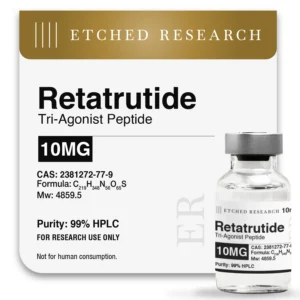
Etched Research supplies Retatrutide for laboratory research in two sizes, 10mg and 30mg, on one product page: Retatrutide 10mg, 30mg. It lists the identity data, the lab result for each size, and storage.
How it works
Most compounds studied in this area act at one or two gut-hormone receptors. Retatrutide is built to act on three at once: GLP-1, GIP, and glucagon.
In plain terms, GLP-1 and GIP are signals tied to appetite and blood sugar. Glucagon is a signal tied to how the body uses stored energy. In mice with obesity, the developers reported that the glucagon arm added higher energy use on top of the lower food intake driven by the GIP and GLP-1 arms (Coskun et al., 2022). That is mouse work, not a measurement in people.
That third target is what sets it apart from the older single and double agonists. Researchers are still mapping exactly how the three signals balance out.
What the research does not establish
The honest limits matter more than the headlines.
- Retatrutide is investigational. It is not approved for any use, and it has not been shown to be effective or safe in general use.
- The published human trials ran 48 weeks or less, in specific groups (obesity, type 2 diabetes, fatty liver). They do not establish long-term outcomes or results in the general public. Other phase 3 results so far come from the developer’s own releases, not full papers.
- Every trial on this page was funded by the developer, Eli Lilly and Company.
- The trials logged side effects, mostly gastrointestinal, within their groups. That record is not a statement about safety for any one person, and nothing here is a claim that this compound is safe to use.
- Every number above describes what happened in a research model. It does not tell you what would happen in a person, and it does not say the compound does anything “for you.”
Common questions
Is retatrutide FDA approved?
No. We found no approval for retatrutide from the FDA or any other regulator. In August 2026 its developer said it planned to submit it to the FDA in the first quarter of 2027 (Eli Lilly Q2 2026 results), and a pre-approval expanded access program is listed on ClinicalTrials.gov. This page covers research only.
Is retatrutide a GLP-1?
Partly. It acts at the GLP-1 receptor, but also at the GIP and glucagon receptors, which is why papers call it a triple agonist. In cell tests its activity at the glucagon and GLP-1 receptors was balanced, and its GIP activity was higher (Coskun et al., 2022).
Is retatrutide a peptide?
Yes. It is a chain of 39 amino acids, including two non-standard ones (2-aminoisobutyric acid and alpha-methyl-leucine), with a fatty-acid chain attached to one lysine. Its formula is C221H342N46O68 and its molecular weight is 4731 g/mol (PubChem).
What side effects have retatrutide trials recorded?
Mostly stomach and gut effects. In the phase 2 obesity trial they were the most common events, mostly mild to moderate and tied to dose, and heart rate rose with dose before easing after week 24 (Jastreboff et al., 2023). In the phase 2 diabetes trial, 35% of the retatrutide groups had mild-to-moderate gut events against 13% on placebo, with no severe low blood sugar (Rosenstock et al., 2023). In the phase 3 diabetes trial, 2% to 5% stopped because of side effects against none on placebo (Bajaj et al., 2026). These were time-limited trials in selected groups. None of this is a safety conclusion.
Last reviewed 2026-09-24.
New reports, new research.
We send a note when a new lab report is posted or a compound comes back in stock, plus a short list of new research pages in any month we publish some. Never more than one email a week, and nothing else.
For Research Use Only. Not for human consumption. Etched Research supplies compounds for laboratory and research use only. Independent lab results, where they exist, are published on the COA page. Nothing on this page is medical advice, a health claim, or a recommendation to use.
The Janoshik lab result for this compound is on the COA page. For research use only.