GHK-Cu: What the Research Actually Shows
- What it is: A small copper-binding tripeptide, three amino acids locked to a copper ion.
- Research areas: how copper-peptide biology drives matrix remodeling, growth-factor output, and gene expression in cell and animal models.
- Evidence level: Mostly preclinical (isolated cells and short animal work). Two published ulcer trials in people, from 1992 and 1994, split: one positive, one no different from placebo. A newer wound-repair trial is registered but still recruiting.
- The short version: Most of what researchers know about GHK-Cu comes from cells in a dish and short animal studies of copper-peptide biology. They frame it as a modulator of tissue remodeling, but the human case is not settled. This is a summary of research, not a reason to use anything.
The Janoshik lab results for both sizes are on the COA page. For research use only.
On this page: Quick facts · What the research found · How it works · Limits · Common questions
GHK-Cu is a small copper-binding tripeptide, three amino acids (glycine, histidine, lysine) locked to a copper ion. Studies often just call it copper tripeptide. Researchers have studied it mostly for one thing: how copper-peptide biology drives tissue remodeling and gene expression in cell and animal models.
Here is the honest version. Below is what the studies looked at, in what kind of model, and what they observed. This is a summary of research, not a description of what the compound does for you.
One more note up front. Etched Research supplies compounds for laboratory research only. Nothing here is a cosmetic or a topical product, and none of the research below is a reason to put anything on or in a body.
Quick facts
- Names: GHK-Cu for the copper complex, which PubChem also lists as prezatide copper (PubChem CID 71587328). GHK, or glycyl-L-histidyl-L-lysine, for the peptide without copper (PubChem CID 73587).
- What it is: a tripeptide, Gly-His-Lys, bound to a copper(II) ion. The peptide alone is C14H24N6O4, 340.4 g/mol. PubChem records the copper complex as C14H23CuN6O4+, 402.9 g/mol. GHK was first isolated from human plasma (Maquart et al., 1988).
- Evidence cited on this page: three cell studies, one rat study, two human ulcer trials (1992 and 1994, one positive and one negative), two reviews, and one registered Phase 2 wound trial that is still recruiting (NCT07437586).
- Approval: we found no drug approval for GHK-Cu anywhere. The FDA lists GHK-Cu for injectable routes among bulk substances that may present significant safety risks in compounding, citing a possible immune reaction risk from aggregation and impurities, and limited human data (FDA, content current as of 22 April 2026).
What the research found, and what it did not
The studies below used cultured cells, rats, and, in two older trials, people with chronic ulcers. Results are listed as reported, including the trial that missed.
Collagen output in fibroblasts (Maquart, FEBS Letters, 1988). An in vitro study using cultured fibroblasts, the cells that build connective tissue. Researchers reported that GHK-Cu raised the amount of collagen the cells made, starting at very low concentrations, and that the rise did not come from a change in cell number. They also pointed out that the same GHK sequence sits inside the chain of type I collagen, and proposed it could be freed when a wound breaks that collagen down. PMID 3169264. https://pubmed.ncbi.nlm.nih.gov/3169264/
Connective tissue in rat wound chambers (Maquart, Journal of Clinical Investigation, 1993). A live animal study. Researchers implanted small wire-mesh chambers in the backs of rats and injected either salt water or GHK-Cu into them. Chambers given GHK-Cu collected more collagen, total protein, DNA and other matrix material, with larger amounts at higher concentrations, and messages for type I and type III collagen went up. A control tripeptide had no significant effect. Rats, not people. PMID 8227353. https://pubmed.ncbi.nlm.nih.gov/8227353/
Venous leg ulcers, a trial that missed (Bishop, Journal of Vascular Surgery, 1992). A randomized, evaluator-blinded human trial. 86 evaluable patients with venous leg ulcers got one of three creams: a 0.4% tripeptide-copper complex, silver sulfadiazine, or an inert placebo. The copper-peptide cream did no better than placebo on ulcer size. Silver sulfadiazine did better than both. The abstract names the compound only as a tripeptide-copper complex, and PubMed indexes it as glycyl-histidyl-lysine. PMID 1495150. https://pubmed.ncbi.nlm.nih.gov/1495150/
Diabetic foot ulcers (Mulder, Wound Repair and Regeneration, 1994). A multicenter, randomized, evaluator-blinded, placebo-controlled human trial in people with diabetes and nerve-related foot ulcers. Everyone got the same standardized wound care, plus either a GHK-Cu gel or the same gel without it, applied daily. Median closure of ulcers on the sole of the foot was 98.5% with the GHK-Cu gel against 60.8% with the plain gel, and infections in ulcers treated right after the wound was cleaned were 7% against 34%. The abstract does not give the number of patients. Human trial, one of only two published. PMID 17147644. https://pubmed.ncbi.nlm.nih.gov/17147644/
Copper and matrix remodeling in fibroblasts (Siméon, Life Sciences, 2000). An in vitro study using cultured fibroblasts, meaning isolated cells in a lab dish. Researchers observed that GHK-Cu raised levels of MMP-2, an enzyme that reshapes the extracellular matrix, along with its mRNA and two matrix inhibitors (TIMP-1 and TIMP-2). Copper ions alone reproduced the MMP-2 effect, and the GHK peptide alone did not. PMID 11045606. https://pubmed.ncbi.nlm.nih.gov/11045606/
Growth-factor expression in stressed fibroblasts (Pollard, Archives of Facial Plastic Surgery, 2005). An in vitro study of human fibroblasts, some taken from patients who had been through radiation therapy. Treated cells, normal and irradiated, doubled faster than untreated ones, and the treated irradiated cells made more of two repair signals, bFGF and VEGF, early after treatment. PMID 15655171. https://pubmed.ncbi.nlm.nih.gov/15655171/
Tissue-remodeling review (Pickart, Journal of Biomaterials Science, 2008). A review that pulled together the GHK and GHK-Cu literature on tissue remodeling. It described the peptide acting on repair-cell recruitment, anti-inflammatory signaling, and the building of collagen, elastin, and other matrix proteins across research models. A review, not new data. PMID 18644225. https://pubmed.ncbi.nlm.nih.gov/18644225/
Gene-expression review (Pickart and Margolina, International Journal of Molecular Sciences, 2018). A review built on gene-profiling data. The authors mapped the many pathways that newer gene data suggest GHK regulates, and tied them to the repair and protective actions reported in earlier work. This is an interpretation of prior data, not an experiment. PMID 29986520. https://pubmed.ncbi.nlm.nih.gov/29986520/
Registered wound-repair trial (ClinicalTrials.gov). A Phase 2 study of a copper-peptide gel, registered as NCT07437586, testing time to closure of small standardized wounds made for the study. Listed as recruiting, with the full protocol and outcome measures on file. This is a trial record, not a result. https://clinicaltrials.gov/study/NCT07437586
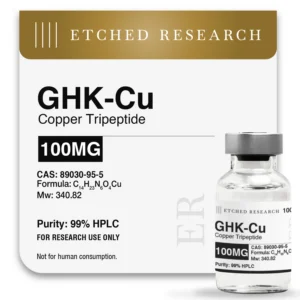
Etched Research supplies GHK-Cu for laboratory research in 50mg and 100mg vials, both on one product page: GHK-Cu 50mg, 100mg. That page lists the identity data, storage, and a dated lab result for each size.
How it works
The mechanism researchers describe starts with copper. GHK binds a copper(II) ion with high affinity, holding it through its free amine end, the neighboring amide nitrogen, and the histidine ring. In solution it forms mainly a one-to-one complex, and some of a two-GHK-per-copper form is also present (Hureau et al., 2011). Its pull on copper is similar to the copper-transport site on albumin (Pickart, 2008). GHK itself occurs naturally and was first isolated from human plasma (Maquart, 1988).
From there the studies point to two connected ideas. First, GHK-Cu seems to shift gene expression, turning the dial up or down on genes that control collagen, elastin, and the enzymes (like MMP-2) that break down and rebuild the extracellular matrix. Second, it appears to raise repair-linked growth signals such as VEGF and bFGF in cell models. Together, researchers frame it as a modulator of tissue remodeling, the process of tearing down old matrix and laying new matrix in its place.
The honest part: most of this mechanism comes from cells in a dish and short animal work. In one cell study, copper alone reproduced the MMP-2 effect and GHK alone did not (Siméon, 2000), so how much belongs to the peptide and how much to the copper it carries is not settled. The full receptor story is not settled either.
What the research does not establish
- Most of it is preclinical. Most findings come from isolated cells or short animal studies, not human trials.
- The human record is two ulcer trials from the early 1990s, and they split: one positive in diabetic foot ulcers, one no better than placebo in venous leg ulcers. Both used a gel or cream on chronic wounds.
- The registered Phase 2 trial listed above is a topical wound-closure study that is still recruiting. A registered trial is a plan, not a proven result.
- There is no approved general human use. GHK-Cu has not been shown to be effective in healthy people for repair, longevity, or anything else.
- Each finding describes what happened in a research model.
- Nothing here is a safety conclusion, and this is not a claim that the compound is safe to use.
Anyone who tells you the human case is settled is out ahead of the research.
Common questions
Is GHK-Cu FDA approved?
No. We found no drug approval for GHK-Cu anywhere. The FDA lists GHK-Cu for injectable routes among bulk substances that may present significant safety risks in compounding, and says there are limited data in humans to inform safety (FDA). The newest human study is a Phase 2 wound trial that is still recruiting (NCT07437586).
Is GHK-Cu a peptide?
Yes. GHK is a tripeptide, a chain of three amino acids: glycine, histidine and lysine. GHK-Cu is that peptide bound to a copper ion. PubChem keeps the peptide and the copper complex as separate records (GHK, CID 73587, prezatide copper, CID 71587328).
What is the difference between GHK-Cu and GLOW?
GHK-Cu is one compound. GLOW is a vendor name for a blend that contains GHK-Cu along with BPC-157 and TB-500 in one vial, and KLOW is the same three plus KPV. No published study has tested either blend. The research on this page is on GHK-Cu alone. GLOW 70mg has its own page.
What side effects has GHK-Cu research recorded?
Very little. The cell and rat studies above give no side-effect record in people. The abstracts of the two ulcer trials report no side-effect figures (Bishop et al., 1992, Mulder et al., 1994). For injected GHK-Cu, the FDA points to a possible immune reaction risk from aggregation and impurities (FDA). None of this is a safety conclusion.
Last reviewed 2026-09-24.
New reports, new research.
We send a note when a new lab report is posted or a compound comes back in stock, plus a short list of new research pages in any month we publish some. Never more than one email a week, and nothing else.
For Research Use Only. Not for human consumption. Etched Research supplies compounds for laboratory and research use only. Independent lab results, where they exist, are published on the COA page. Nothing on this page is medical advice, a health claim, or a recommendation to use.
The Janoshik lab results for both sizes are on the COA page. For research use only.